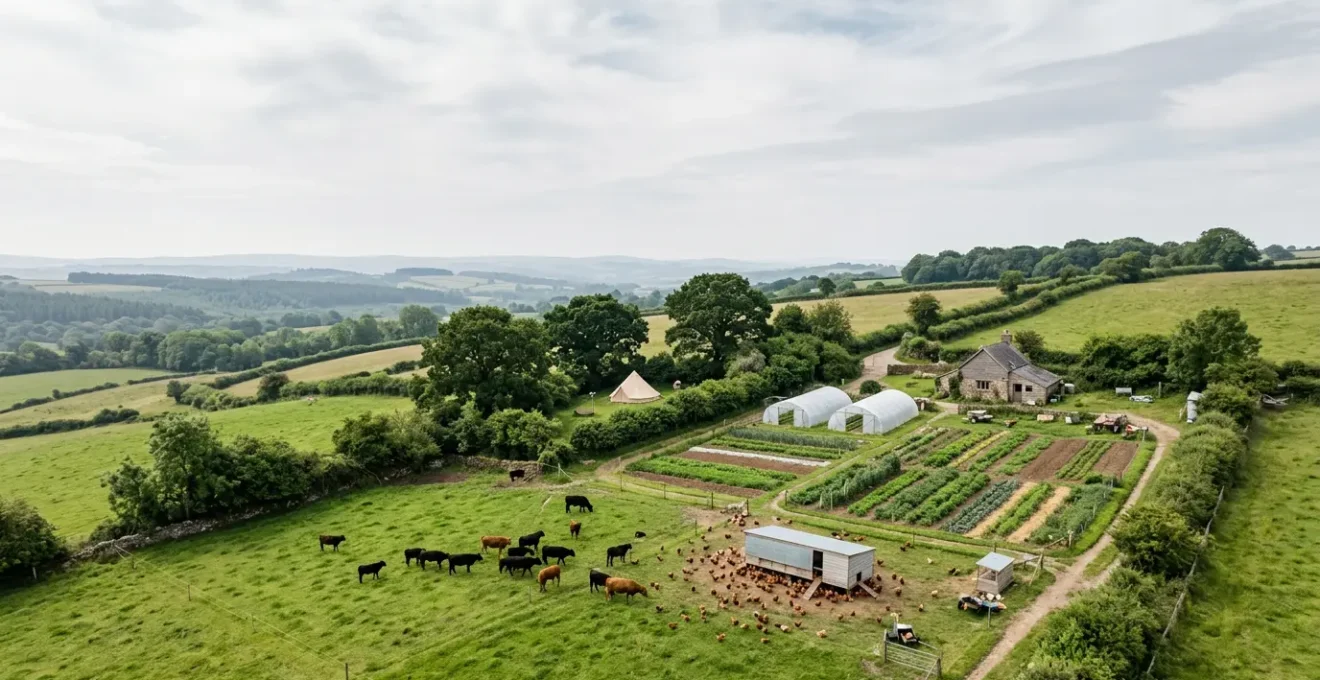
The highest ROI on a small farm doesn’t come from a single “best” enterprise, but from a strategic system where each business financially and biologically supports the others.
- Stacking enterprises, like running chickens behind cattle, creates symbiotic ROI by cutting input costs and creating new revenue from the same land base.
- Choosing a model requires a cold, hard look at startup costs, labor intensity (profit-per-hour), and customer retention models to avoid burnout.
Recommendation: Stop thinking about adding more work. Start designing your farm as an integrated system to maximize profitability per acre and per hour.
If you’re running a smallholding under 50 acres, you’re likely familiar with the precarious financial reality of relying on a single commodity. The conventional advice is to “diversify,” a vague suggestion that often leads to adding more work without adding significant profit. Farmers are told to start a glamping site, a vegetable box scheme, or to add another livestock breed, treating each as a separate, isolated venture. This approach frequently leads to operational chaos, decision fatigue, and, ultimately, burnout, with little to show for the extra hours worked.
The problem isn’t diversification itself, but the lack of a strategic framework. The common wisdom overlooks the hidden costs of complexity and the massive, untapped potential for synergy. But what if the key to profitability wasn’t just adding more enterprises, but intelligently stacking them? The most resilient and profitable small farms don’t just do more things; they design an integrated system where the waste of one enterprise becomes a valuable input for another. This is the principle of enterprise stacking.
This article moves beyond generic advice to provide a pragmatic, ROI-focused analysis of different diversified models. We will dissect the operational mechanics and financial realities of stacking enterprises, from the biological symbiosis of multi-species grazing to the cash flow implications of different sales models. We’ll explore how to add new ventures without compromising existing ones, compare startup costs, and provide a structure for managing your time effectively. The goal is to equip you with the mindset of a rural business advisor, enabling you to design a farm that is not just productive, but truly profitable.
To help you navigate these crucial business decisions, this guide breaks down the core components of building a resilient, multi-enterprise farm. We’ll examine specific, proven models and the strategic thinking required to implement them successfully.
Summary: Building a Profitable, Stacked Enterprise Farm System
- Why Stacking Chickens Behind Cows Increases Grass Growth by 30%?
- How to Add a Glamping Site Without Disrupting Your Lambing Season?
- Vegetable Box Scheme or Cut Flowers: Which Has the Lowest Startup Cost?
- The Burnout Risk of Running 3 Enterprises with Only Family Labour
- How to Structure Your Day When Managing Animals, Crops, and Customers?
- Monthly Subscription or Pay-As-You-Go: Which Retains Members Longer?
- Why Stacking Chickens Behind Cows Increases Grass Growth by 30%?
- Reducing Churn in Veg Box Schemes: How to Keep Customers in Winter?
Why Stacking Chickens Behind Cows Increases Grass Growth by 30%?
The concept of “enterprise stacking” is most clearly illustrated in multi-species rotational grazing. Moving a flock of chickens onto a pasture 3-4 days after a herd of cattle is a classic example of symbiotic ROI. It’s not just about having two products—beef and eggs—from the same piece of land; it’s about how one enterprise directly enhances the performance of the other, cutting costs and improving the farm’s foundational asset: its soil.
The biological mechanism is elegant and efficient. As chickens scratch through cow manure to find protein-rich fly larvae and insects, they perform several critical functions for free. First, they spread the nutrient-dense manure across the pasture. This prevents “hot spots” of concentrated nitrogen that would otherwise burn the grass and which cattle naturally avoid grazing for months. Second, by consuming fly larvae, the chickens act as a biological pest control, drastically reducing fly populations and improving the comfort and health of the cattle. The result is a more evenly fertilized pasture, faster grass regrowth, and a healthier, more palatable sward for the next cattle rotation. This synergy is confirmed by research on multi-species grazing that demonstrates how the practice breaks parasite cycles and reduces feed bills for both species.
This system design turns a waste product (manure) and a pest (flies) into a free resource (chicken feed), directly boosting the health of your pasture. Farms implementing this see dramatic pasture improvements, allowing the land to support significantly more livestock over time. For the smallholder focused on ROI, this isn’t just an ecological benefit; it’s a direct path to higher carrying capacity and lower input costs, the cornerstones of financial resilience.
How to Add a Glamping Site Without Disrupting Your Lambing Season?
Agritourism is often touted as a high-margin diversification option, but integrating a customer-facing business like glamping into a working farm requires rigorous planning to prevent operational and biological conflicts. The allure is clear; a propensity score matching study found that agritourism has a significant positive impact on the profitability of small farms. However, that profit can be quickly eroded if the new enterprise compromises your core agricultural operations, such as a sensitive lambing season.
The primary conflict is biosecurity. Lambing ewes are highly susceptible to stress, which can lead to mismothering, and newborn lambs are vulnerable to diseases. Uncontrolled public access introduces unacceptable risks. The solution lies in strategic zoning and seasonal management. Your farm layout must create clear, physical separations between “public” tourism zones and “private” agricultural zones. This might involve designated parking areas, fenced walkways, and clear signage that keeps guests away from livestock sheds and sensitive pastures. The glamping site should be positioned on a part of the holding that has independent access and is geographically separate from your lambing fields.
Furthermore, the business model must align with your agricultural calendar. Instead of being open year-round, your glamping season could run from late spring to early autumn, shutting down completely during the high-stress lambing and breeding periods. A 2024 study of Maryland agritourism operations confirmed that while visitor numbers boost profitability, success hinges on strategic planning around seasonality. By defining clear operational boundaries in both space and time, you can capture the high margins of agritourism without jeopardizing the health and productivity of your flock. This is risk-managed enterprise stacking.
Vegetable Box Scheme or Cut Flowers: Which Has the Lowest Startup Cost?
When considering a land-based enterprise, vegetable box schemes (CSAs) and cut flowers are two of the most popular models for small-scale producers. From a purely financial perspective, the choice isn’t about which is “better,” but which aligns with your available capital, labor capacity, and tolerance for waste. Analyzing them through an ROI lens reveals critical differences in their cost structure and operational demands.
At first glance, a vegetable box scheme can appear to have a lower barrier to entry. The basic infrastructure needs—a simple wash station, packing area, and a cooler—are less demanding than what is often required for cut flowers. However, the labor intensity for harvesting, washing, and packing dozens of varied weekly boxes is consistently high. In contrast, cut flowers can have higher initial infrastructure costs, especially if a cooler (critical for vase life) and hoop houses for season extension are required. The labor for flowers is also extremely high, often on a one-seed-one-stem basis, making it the largest single expense.
The following comparison breaks down the key financial and operational factors, based on data and best practices highlighted in resources like guides for professional flower farmers.
| Factor | Vegetable Box Scheme | Cut Flower Farm |
|---|---|---|
| Labor Intensity | High (harvesting, washing, packing weekly boxes) | Very High (one-seed-one-stem crops, labor is largest expense) |
| Infrastructure Needs | Basic cooler, wash station, packing area | Cooler critical for vase life, propagation greenhouse, possibly hoop houses |
| Profit per Market | $20 bouquet markup at farmers market possible | $20 bouquet with good retail markup, but wholesale difficult due to labor costs |
| Revenue Seasonality | Spring through fall, winter challenges with fresh produce | Seasonal peaks, sunflowers can represent 40-50% of annual business |
| Waste Management | Unsold vegetables can feed pigs (enterprise stacking) | Unsold flowers are near-total loss with limited repurposing options |
A crucial distinction is the potential for enterprise stacking in waste management. Unsold or cosmetically imperfect vegetables can be fed to pigs or chickens, turning a potential loss into a valuable input for another enterprise. Unsold flowers, however, are a near-total financial loss. This makes the vegetable model potentially more resilient within a stacked system, even if the profit per square foot for flowers can be higher in a perfect season.
The Burnout Risk of Running 3 Enterprises with Only Family Labour
The single greatest threat to a diversified small farm is not market failure or crop disease; it’s owner burnout. The romantic image of a bustling farm with multiple income streams often masks the reality of relentless work, decision fatigue, and the immense “operational drag” created by managing several disconnected businesses with a limited labor pool, often just the family.
Operational drag is the hidden friction caused by context-switching. Your brain pays a tax every time it shifts from “animal-husbandry-mode” to “customer-service-mode” to “crop-planning-mode.” When enterprises are merely “added” rather than “stacked,” this tax becomes prohibitively high. A day can be consumed by reacting to the most urgent-seeming task—chasing escaped sheep, then answering a wedding flower inquiry, then realizing the greenhouse wasn’t watered. This is not a sustainable business model; it’s a recipe for exhaustion and costly mistakes. The key metric for survival is not gross revenue, but profit per hour of labor. If adding a new enterprise doubles your work hours but only increases your net profit by 20%, it is a financial failure, regardless of the revenue figure.
Mitigating this risk requires a radical shift in mindset: from being a “doer” to a “designer.” You must ruthlessly design your farm as a system that minimizes complexity and decision-making during the peak season. This involves:
- Standardizing processes: Create checklists and standard operating procedures (SOPs) for everything from daily chores to packing an order.
- Batching tasks: Dedicate specific blocks of time to specific enterprises. Monday morning is for finances and communication, Tuesday for harvesting, etc.
- Designing for simplicity: Choose enterprises that share similar infrastructure, sales channels, or seasonal rhythms.
Without this intentional system design, family labor becomes the failing point that brings the entire structure down.
How to Structure Your Day When Managing Animals, Crops, and Customers?
For a diversified farmer, time is the most valuable and scarcest resource. An unstructured day is a recipe for inefficiency and burnout, where you are constantly reacting instead of executing a plan. The key to managing multiple enterprises is to create a daily and weekly structure that minimizes context-switching and aligns your work with the farm’s core financial drivers. Your schedule should be a business tool designed to maximize your profit per hour.
The first principle is to prioritize tasks based on their financial impact. For most livestock operations, feed is the single largest operating cost. As Pennsylvania State University extension research shows, effective pasture management can reduce dairy feed costs by $0.50 to $1.00 per cow per day. This means that a daily pasture walk to assess forage and plan the next grazing move is not a leisurely stroll; it is one of the highest-value economic activities you can perform. Therefore, it should be a non-negotiable part of your morning routine.
The second principle is task batching. Group similar activities into dedicated blocks of time. Instead of answering customer emails sporadically throughout the day, dedicate a one-hour block in the afternoon. Process all your financial receipts and update records on Friday mornings. This reduces “operational drag” and allows for deep, focused work. Your week should have a rhythm, with certain days dedicated to harvesting and packing, others to infrastructure projects, and others to marketing and administration. This proactive structure allows you to control your day, rather than letting it control you.
Your Action Plan: Structuring Your Time for Profitability
- Prioritize by cost: Know your feed conversion rates and largest operating costs. Schedule tasks that reduce these costs (like pasture management) as high-priority, daily activities.
- Batch similar tasks: Group all animal chores into one block, all harvesting into another, and all customer communication/admin into a third to reduce mental friction.
- Align with seasonal rhythms: Define your “High Season” (execution-focused) vs. “Low Season” (planning-focused) cadence. Use the low season for strategic planning, financial analysis, and infrastructure projects.
- Maximize existing resources: Before adding anything new, conduct an audit to ensure you are using your current land, tools, and time to full capacity. Streamline processes to cut expenses first.
- Establish a “First/Last Chore” routine: Start your day with a strategic, contemplative task (like a pasture walk) and end it by closing all “open loops” (tools put away, animals secure) to ensure a restful night.
Monthly Subscription or Pay-As-You-Go: Which Retains Members Longer?
The choice between a monthly subscription model (like a traditional CSA) and a pay-as-you-go (PAYG) or à la carte model is a critical strategic decision that profoundly impacts cash flow, customer loyalty, and operational planning. While PAYG offers flexibility that can attract new customers, the subscription model is often superior for long-term retention and financial stability, creating a partnership rather than a series of transactions.
The primary advantage of the subscription model is its ability to secure upfront capital. By having customers pay for a season or a month in advance, the farm receives crucial cash flow at the beginning of the growing season to cover the costs of seeds, compost, and labor. This pre-commitment de-risks the season for the farmer. As one case study on flower farm business models highlights, this model establishes customers before the season even begins, reducing marketing stress during peak production periods. Members who have pre-paid are financially and psychologically invested in the farm’s success. They are more forgiving of seasonal variability—like a week with fewer tomatoes due to blight—because they have bought into the entire season, not just one week’s box.
In contrast, a PAYG model places the marketing burden on the farm every single week. The customer makes a new purchase decision each time, comparing your offer against the supermarket. This can lead to unpredictable demand and higher “churn,” or customer turnover. While it might seem more customer-friendly, it can create a feast-or-famine revenue cycle. For the farmer, the subscription model fosters a stickier, more resilient customer base that understands the realities of farming. This economic preference for diversified, integrated systems is supported at a high level; a comprehensive 2022 meta-analysis concluded that diversified farming systems, often supported by such direct-to-consumer models, are economically preferable to simplified, commodity-based systems.
Why Stacking Chickens Behind Cows Increases Grass Growth by 30%?
We’ve established the biological synergy of stacking chickens and cattle. Now, let’s analyze this classic pairing from a purely ROI-focused perspective. The real power of this stacked enterprise isn’t just in the ecological benefits; it’s in how it directly translates to dollars and cents through reduced costs and new revenue streams, maximizing the financial output of every single acre.
First, consider the savings on input costs. The chickens, by foraging for larvae in manure and eating spilled grain, can source a significant portion of their protein needs directly from the pasture system. This directly reduces your feed bill, which is often the highest variable cost in a poultry enterprise. Simultaneously, the “sanitizing” service they provide reduces the need for chemical fly control for your cattle. The improved pasture fertility from the spread manure means you spend less on synthetic fertilizers. Each of these is a small, incremental saving that accumulates into a significant boost in your net margin over a season.
Second, this system generates a second, high-value revenue stream from the same land base. Pasture-raised eggs and chicken meat command a premium price in the market. A customer who already buys beef from you is a highly qualified lead for your poultry products. By moving a “chicken tractor” or mobile coop behind your cattle, you are effectively harvesting a second crop—protein—from the same solar energy that grew the grass. This is the essence of calculating a symbiotic ROI: the total return is greater than the sum of its parts because the enterprises are mutually beneficial. You are not just running a cattle business and a chicken business; you are running one integrated, more profitable grass-farming system.
Key Takeaways
- True farm profitability comes from system design, not just adding more work. Focus on how enterprises can support each other.
- Evaluate every new enterprise based on its “profit per hour of labor” and its potential for “operational drag” to avoid burnout.
- Use subscription models like CSAs to secure upfront capital, de-risk your season, and build a loyal customer base that supports the farm through seasonal ups and downs.
Reducing Churn in Veg Box Schemes: How to Keep Customers in Winter?
For many vegetable box schemes, the winter months represent the “great churn”—the period when customer subscriptions drop off significantly. The lack of variety compared to the bountiful summer months, often leading to a steady diet of root vegetables and brassicas, can cause “vegetable fatigue” and lead customers to pause or cancel their membership. For a small farm’s financial stability, retaining these customers year-round is critical.
The most successful schemes combat this by evolving their offering beyond fresh-only produce. They embrace the concept of enterprise stacking by creating value-added products from their own harvest. This transforms the winter box from a repetitive selection of raw vegetables into a curated “pantry stock-up.” As a case study of UK schemes revealed, shifting the model to include items like preserves (jams, chutneys), ferments (sauerkraut, kimchi), dried goods (herbs, dried mushrooms), and stored crops (onions, garlic, winter squash) dramatically improves winter retention. This approach better matches how people cook in the winter—relying more on pantry staples and preserved flavors.
This strategy not only solves the customer’s problem of variety but also solves the farmer’s problem of surplus and waste. The glut of tomatoes in August becomes tomato sauce for a January box. Excess cabbage in October becomes sauerkraut for February. As an expert from ATTRA Sustainable Agriculture notes:
Small-scale producers benefit most from finding ways to keep costs down and maximize productivity, often by using resources they already have on hand.
– ATTRA Sustainable Agriculture, Poultry on Diversified Farms: A Guide to Profitability and Sustainability
By offering flexible options, such as bi-weekly or monthly “Winter Stock-Up” boxes, farms can adapt to customers’ changing consumption habits while maintaining a consistent revenue stream through the leanest months. It’s a strategic pivot from selling what you can grow to selling what your customers want to eat, using your farm’s full productive capacity.
Now that you understand the principles of enterprise stacking, the next logical step is to begin designing your own integrated farm system. Start by auditing your existing resources and identifying opportunities for symbiotic connections, focusing on maximizing your profit per hour, not just your total revenue.