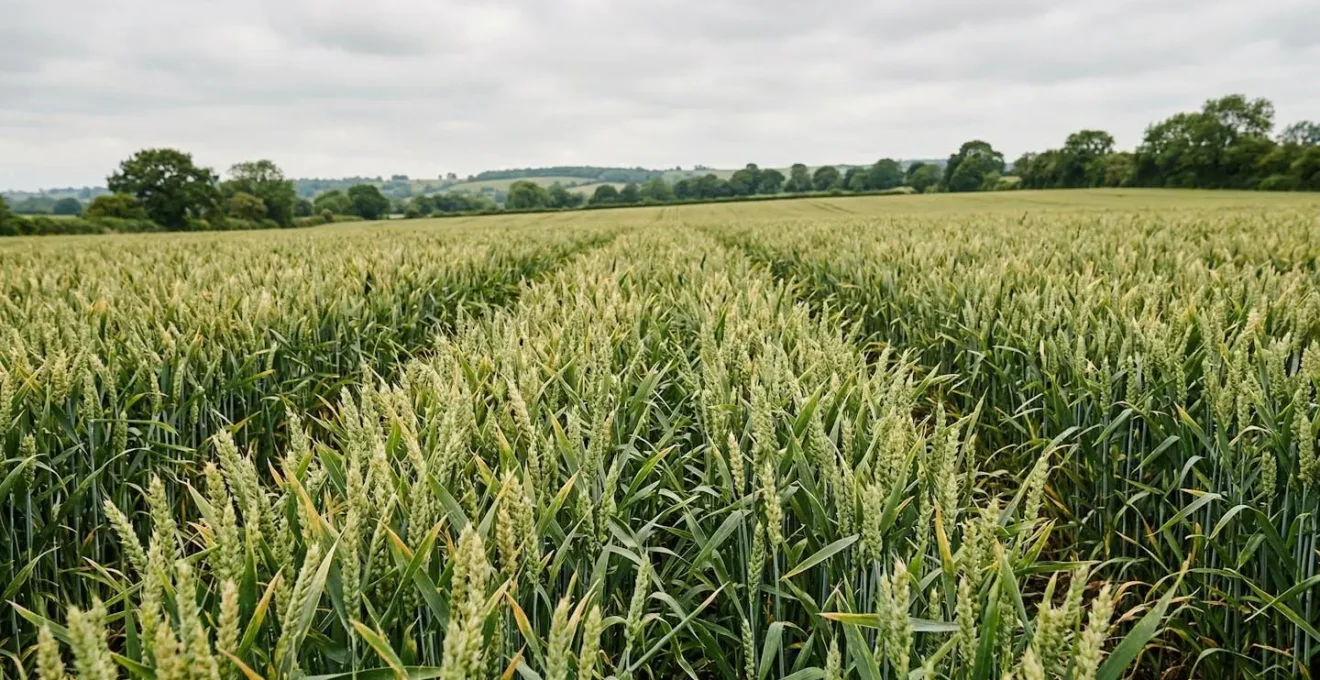
Wheat variety blends offer more than just disease suppression; they represent a calculated strategy to improve yield stability and potentially cut fungicide costs by up to £30/ha.
- By creating a ‘genetic diversification barrier’, blends physically slow the spread of diseases like Septoria tritici.
- Trials show blends can meet milling specifications, provided a proactive dialogue is established with the end-user before drilling.
Recommendation: Shift from blanket fungicide applications to a targeted, data-driven approach by assessing disease risk based on variety resistance and canopy development, reserving chemical interventions for when they deliver a clear return on investment.
For any wheat grower in the West of England, the sight of a sprayer rolling is a familiar, and increasingly expensive, reality. The relentless pressure from Septoria tritici, coupled with growing fungicide resistance, makes every application a high-stakes decision. The standard T1 and T2 programme is often seen as a necessary cost of doing business. We’re told to use integrated pest management (IPM), but what does that look like when you’re staring down a high-risk season?
Many growers have heard of variety blends, often discussed as a “green” or alternative strategy. But this perspective misses the crucial point. What if we reframe this? What if a well-designed blend isn’t just a defensive shield, but a proactive financial instrument? The core idea is simple yet powerful: by introducing genetic diversity into the field, you’re not just fighting a disease; you’re fundamentally changing the rules of the game. This approach can provide a form of yield stability insurance against unpredictable disease pressure, turning a potential cost centre into a calculated agronomic advantage.
This article moves beyond the ‘if’ and delves into the ‘how’. We will dissect the mechanisms that make blends effective, examine the critical data on yield and quality, and provide a framework for adjusting your fungicide strategy to capitalise on the inherent resilience of a mixed stand. It’s about making informed, cost-aware decisions to protect both your crop and your bottom line.
To provide a clear, actionable path, this analysis is broken down into key strategic areas. The following summary outlines the core components we will explore, from the science of spore disruption to the practicalities of crop rotation and targeted spraying.
Summary: A Strategic Guide to Wheat Blends and IPM
- Why Mixing Varieties Confuses Fungal Spores and Slows Spread?
- How to Choose Wheat Varieties with Matching Maturity Dates?
- Blend vs Monoculture: Which Performs Better in a High-Disease Year?
- The Mill Quality Mistake That Rejects Blends at the Intake
- How to Adjust T1 and T2 Sprays When Growing Resistant Blends?
- When to Spray: Using Biomass Maps to Target High-Risk Lush Canopies
- The Rotation Gap You Must Leave to Starve Out Take-All Fungus
- How Multi-Species Rotation Controls Blackgrass Without Chemicals?
Why Mixing Varieties Confuses Fungal Spores and Slows Spread?
The core principle behind a wheat blend’s success against fungal pathogens like Septoria is the creation of a genetic diversification barrier. In a monoculture, every plant is genetically identical, creating a uniform, uninterrupted pathway for a fungal spore. Once a pathogen adapts to that single genotype, it can spread rapidly through the crop like wildfire. A blend disrupts this process fundamentally.
By mixing varieties with different resistance genes, you create a physical and genetic mosaic. A Septoria spore that successfully infects a susceptible plant is less likely to land on another plant it can easily infect. The neighbouring plants may carry resistance genes that the spore cannot overcome, effectively creating a dead end. This slows the rate of epidemic development within the crop, reducing the overall disease pressure and delaying the need for chemical intervention. This isn’t just a theoretical benefit; a comprehensive analysis of wheat cultivar mixing studies shows a significant reduction in pathogen proliferation. The observed 24.1% decrease in disease incidence across numerous trials demonstrates that this “spore confusion” provides a tangible, field-level advantage.
Think of it as introducing hurdles into a race. In a monoculture, the track is clear. In a blend, the pathogen must constantly navigate obstacles, slowing it down and giving the crop a much greater chance to thrive without heavy fungicide reliance. This built-in resilience is the first step toward reducing input costs.
How to Choose Wheat Varieties with Matching Maturity Dates?
A common and valid concern when creating a blend is ensuring agronomic compatibility, with maturity date being the most critical factor. Harvesting a field where one variety is ready and another is still green is a practical nightmare. However, the selection process is more nuanced than simply picking varieties with identical days-to-maturity ratings on a list. Environmental factors, particularly temperature, play a huge role in synchronising development.
As LSU AgCenter Research highlights in their work on wheat maturity, the timing is not always as divergent as one might fear. They note:
Higher temperatures in late spring appear to force wheat varieties to mature at about the same time regardless of heading date. The result is that late-heading varieties have a shorter grain fill period than early-heading varieties.
– LSU AgCenter Research, Wheat Yield and Maturity: Influence of Variety study
This insight is crucial. It suggests that while choosing varieties with close heading dates is a good starting point (e.g., within 2-3 days), the primary focus should be on their grain fill characteristics and overall ripening profile. A late spring heatwave can compress the final stages of maturation, bringing varieties into sync. Therefore, a blend should combine varieties that not only have similar listed maturity but also complementary agronomic traits like standing power and disease resistance profiles that don’t create a management conflict.
The goal is to assemble a team of varieties that work together. Scrutinise regional trial data, speak with breeders, and consider a small-scale trial plot on your own farm. The objective is a blend that ripens evenly for a clean harvest, ensuring the logistical benefits are not compromised by the agronomic ones.
Blend vs Monoculture: Which Performs Better in a High-Disease Year?
In a low-disease year with perfect conditions, a top-performing monoculture might edge out a blend in terms of peak yield. However, farming is rarely about perfect conditions, especially in the West of England. The true value of a blend is revealed when the pressure is on. In a high-disease year, a blend acts as yield stability insurance, mitigating the catastrophic losses a single susceptible variety could suffer.
This isn’t just anecdotal. It’s a repeatedly measured phenomenon. Consider the findings from USDA-ARS trials in North Carolina, which provide a powerful case study:
Case Study: USDA-ARS Winter Wheat Blend Trials
Trials conducted across six environments demonstrated that wheat blends significantly outyielded the average of their component varieties, with a mean advantage of 0.13 Mg/ha (approximately 2 bu/acre). More importantly, the yield stability of blends was demonstrably superior to that of the pure cultivars, even in environments with only moderate disease pressure. This suggests blends provide a crucial buffer against unpredictable stress, making them a less risky proposition than monocultures.
The concept of improved stability is the key takeaway for any cost-aware grower. While the promise of a bumper yield from a monoculture is tempting, the risk of a significant downside in a tough year can be financially devastating. Blends provide a more consistent, reliable return. This is backed by recent trials in Germany which demonstrated that blends offered significantly greater yield stability across all scenarios tested. By buffering against the worst effects of disease, the blend secures a profitable yield, whereas the monoculture might have required multiple expensive fungicide applications just to stay in the game.
The Mill Quality Mistake That Rejects Blends at the Intake
One of the most persistent barriers to the adoption of wheat blends is the fear of rejection by the miller. The conventional wisdom is that mills require the uniform quality of a single variety to meet their specifications for baking, protein content, and Hagberg Falling Number. The mistake is assuming this is an insurmountable obstacle rather than a logistical challenge that can be managed with data and proactive dialogue.
The reality is that many blends, when correctly formulated, show no detrimental effect on milling quality. In fact, multi-environment North Carolina trials found that wheat blends showed no significant difference for test weight, protein content, hardness, or falling number when compared to their component varieties grown as monocultures. The key is to build the blend with the end-user in mind, using varieties from the same milling group (e.g., all Group 1 or all Group 2) that have complementary, not conflicting, quality attributes.
The UK industry is actively working to bridge this information gap, which should give growers confidence to start conversations with their local mills. This is evidenced by a major industry initiative:
Industry Focus: The AHDB Milling Wheat Blend Project
A four-year AHDB-funded project is specifically tackling this issue by conducting dedicated trials on hard milling wheat blends (Groups 1 and 2). The project involves comprehensive grain quality assessments, including milling and baking tests. The explicit goal is to provide clear evidence that carefully constructed variety blends can meet strict milling specifications, demonstrating that a partnership between grower and miller is not only possible but beneficial.
The lesson is clear: don’t let assumptions dictate your cropping choices. Arm yourself with data on your chosen blend’s quality parameters and initiate a conversation with your buyer before drilling. A transparent approach can often overcome initial reluctance.
How to Adjust T1 and T2 Sprays When Growing Resistant Blends?
Growing a resistant blend is not about eliminating fungicides entirely; it’s about optimising their use and maximising their return on investment. The inherent disease suppression of the blend allows you to move from a prophylactic, calendar-based programme to a more responsive, threshold-based strategy. This is where significant cost savings can be realised.
The first casualty of this optimised approach should often be the T0 spray. As the AHDB points out, its value is frequently questionable, especially in a resilient system. Their guidance states, “The T2 fungicide timing is the most crucial, with T1 also targeted at septoria tritici control. However, the T0 spray rarely gives a yield benefit.” In a blend with good resistance ratings, the cost of a T0 application is unlikely to be recovered.
For the critical T1 and T2 timings, the decision to spray should be driven by diligent crop walking and an understanding of the fungicide ROI threshold. The blend gives you breathing room. You are no longer trying to hold back a tidal wave of disease in a susceptible crop. Instead, you are protecting the genetic resilience you have already established. Your decision-making should be focused on protecting the key upper leaves, particularly the flag leaf, as they are the primary engines of grain fill.
This requires a shift in mindset. Instead of spraying because “it’s time,” you spray because scouting has shown disease levels are reaching a threshold that threatens green leaf area and, therefore, yield. The blend’s resilience may mean that in a low or moderate pressure season, you can significantly reduce rates or even skip a spray entirely, pocketing the £30/ha (or more) in savings.
Your Fungicide Strategy Audit for Wheat Blends
- Review Variety Resistance: Select blend components with strong (7+) Septoria resistance scores to build a robust genetic foundation.
- Challenge the T0: Critically assess the need for a T0 spray. In a resistant blend, its ROI is often negligible. Consider it an exception, not a rule.
- Implement Threshold-Based T1: Walk the crop regularly. Apply a T1 spray only when visible disease is present on the lower leaves and weather conditions favour upward spread.
- Prioritise Flag Leaf Protection at T2: The T2 spray is your most critical investment. Its goal is to protect the final flag leaf. Base the decision on disease present on leaf 3, not on the calendar.
- Integrate Biomass Data: Use satellite or drone-based biomass maps to identify thicker, lusher parts of the field which may harbour a higher disease risk and justify targeted or variable-rate application.
When to Spray: Using Biomass Maps to Target High-Risk Lush Canopies
The principle of targeted intervention extends beyond variety choice and into your spray programme’s execution. A uniform, blanket application across an entire field is a blunt instrument. Precision agriculture tools, such as satellite-derived biomass maps (NDVI), allow for a far more surgical and cost-effective approach. This is particularly relevant when managing foliar diseases in a resilient blend system.
Lush, thick areas of the crop create a dense, humid microclimate that is highly conducive to fungal diseases like Septoria. These are your high-risk zones. Conversely, thinner areas of the crop may have better air circulation and lower disease pressure, making a full-rate fungicide application an unnecessary expense. Biomass maps allow you to visualise this in-field variability and act on it. Instead of a single rate for the whole field, you can create a variable-rate application plan that delivers a higher dose to the high-risk lush canopies and a reduced rate (or none at all) to the lower-risk areas.
This strategy ensures you are only spending money where it will deliver a return. Even in low-disease environments, this targeted protection pays dividends. A meta-analysis of 46 low-disease trials showed a significant, albeit modest, yield response from a flag leaf fungicide application. The average 101.6 kg/ha yield response (approximately 1.5 bu/acre) confirms that protecting green leaf area is vital, but it also highlights the need to ensure the cost of application doesn’t outweigh the benefit. By targeting only the areas that need it most, you maximise your chances of achieving a positive ROI on your fungicide spend.
The Rotation Gap You Must Leave to Starve Out Take-All Fungus
While variety blends are a powerful tool for managing foliar diseases within a season, a truly resilient farming system addresses soil-borne pathogens through strategic rotation. Take-all (Gaeumannomyces graminis var. tritici) is a prime example of a disease that cannot be controlled by foliar fungicides or variety choice alone; it must be starved out. The key is implementing a genuine break crop.
The take-all fungus survives on the roots and residues of host crops, primarily wheat and barley. Planting a non-host crop, such as oilseed rape, beans, or a multi-species cover crop, for at least one full season creates a “rotation gap” that breaks the pathogen’s life cycle. Without a host to feed on, the fungal population in the soil dramatically declines. A one-year break is the absolute minimum to see a significant reduction in take-all pressure for the following first wheat.
Interestingly, while a break is the best short-term strategy, long-term research reveals a phenomenon known as “take-all decline” (TAD), where continuous wheat monoculture eventually leads to the natural development of suppressive soils. However, reaching this state can take a decade and involves a devastating peak disease phase. Research into the soil microbiome during this process shows why the break crop is so critical. The study identified a severe disease outbreak phase around year five of monoculture before natural suppression began to build. The rotation gap is a management strategy to prevent your fields from ever reaching that peak outbreak stage. It’s a proactive measure to starve the fungus and reset the soil’s pathogen load.
Key Takeaways
- Genetic diversity in wheat blends acts as a physical barrier, slowing the spread of fungal spores and reducing overall disease pressure.
- The primary financial benefit of blends is often improved yield stability in challenging years, acting as a form of risk management or “yield insurance”.
- Adopting blends enables a shift from a calendar-based to a threshold-based fungicide strategy, where applications are made based on scouting and data, maximising return on investment.
How Multi-Species Rotation Controls Blackgrass Without Chemicals?
The principles of diversity that make wheat blends effective against Septoria also apply to the wider challenge of weed control, particularly for a pernicious problem like blackgrass. A system that relies on a diverse rotation, including different crop types and spring cropping, disrupts the blackgrass life cycle in a way that chemicals alone cannot. But even within a single crop, increasing diversity and vigour can have a powerful suppressive effect.
A dense, healthy, and competitive crop canopy is one of the best weed control tools available. It shades out emerging weeds, outcompetes them for nutrients and water, and reduces the available niches for them to establish. Research has shown that variety blends can contribute directly to creating this more competitive canopy. One comprehensive analysis revealed that mixing cultivars increased key growth metrics; specifically, it found a 5.1% increase in crop biomass, a 7.2% increase in leaf area index, and an 8.5% increase in photosynthetic rate. A more robust, faster-establishing crop canopy is fundamentally more effective at smothering weeds.
This concept of “control by competition” is a cornerstone of non-chemical weed management. By integrating spring-sown crops into the rotation, you disrupt the autumn germination cycle of blackgrass. By using cover crops, you ensure there is always a competitive plant growing, leaving no room for weeds. When you do plant a winter wheat, using a vigorous blend that quickly achieves canopy closure adds another layer of cultural control. This multi-pronged strategy, which combines rotational diversity with in-crop competition, reduces reliance on herbicides and makes the entire system more resilient and sustainable.
The journey from a high-input, reactive system to a resilient, cost-aware IPM strategy is a gradual one. It begins by questioning every input and demanding a clear return on investment. Adopting wheat blends is a significant step on this path. The next step is to move from theory to field-scale evaluation. Assess your highest-risk fields, start the conversation with your miller, and model the financial impact of a strategic fungicide reduction. The data is clear; the opportunity is yours to cultivate.