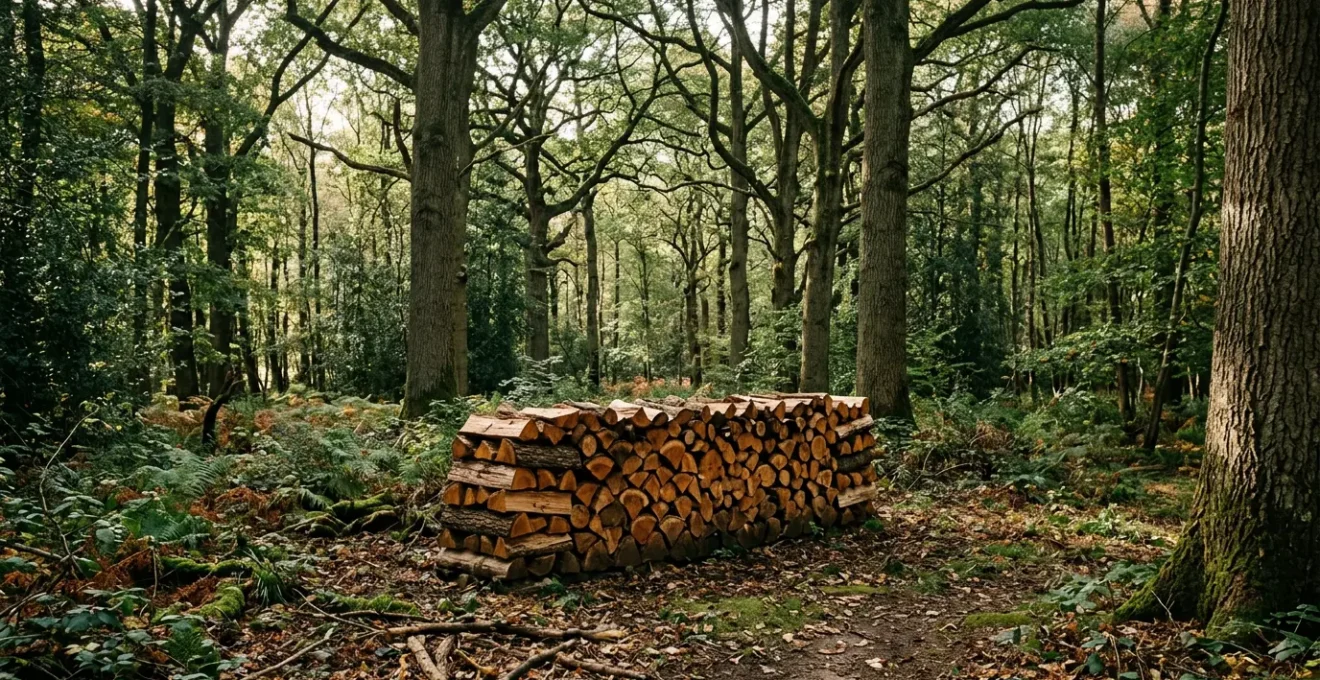
Your farm’s neglected woodland isn’t a liability; it’s a tax-free cash engine waiting to be activated.
- Harvesting diseased ash trees now turns a potential cost into immediate, tax-exempt profit.
- A systematic approach to low-impact extraction, accelerated seasoning, and direct-to-consumer sales creates a recession-proof income stream.
Recommendation: The first step is to create a simple woodland management plan. This document is the key to establishing commercial status and unlocking significant tax advantages from HMRC.
For many farmers, the small copse at the edge of the field is a familiar sight: a tangled, dark patch of land, often seen as a liability or, at best, a source of personal firewood. The conventional wisdom is to leave it alone, perhaps vaguely aware that it offers some form of tax shelter. This passive approach, however, overlooks a significant commercial opportunity. That neglected woodland isn’t just a static asset; it’s a dormant cash-flow machine, capable of generating a steady, recession-proof income stream, especially during the lean winter months.
The key is to shift your mindset from passive ownership to active management. This doesn’t require vast investment or turning your arable operation into a forestry enterprise. It’s about strategic activation. Problems like the relentless advance of ash dieback can be reframed as commercial triggers—a chance to ‘harvest now, replace smart’. By implementing a clear, commercially-focused strategy, you can turn timber into a high-demand product like seasoned firewood, all while benefiting from some of the most generous tax reliefs available.
But how do you navigate the rules set by HMRC and the Forestry Commission? How do you process and sell the timber efficiently? This guide provides a comprehensive framework, moving beyond the simple fact of tax efficiency to the practical ‘how-to’. We will break down the process step-by-step, from proving commercial intent to marketing your final product, turning that overlooked patch of trees into a profitable, integrated part of your farm business.
This article details the complete commercial strategy for a farmer to generate tax-free income from woodland firewood sales. The following sections provide a roadmap covering the financial incentives, practical harvesting, legal compliance, processing, and sales channels.
Summary: A Commercial Framework for Farm Woodland Firewood Production
- Why Commercial Woodlands Are Exempt from Income and Inheritance Tax?
- How to Thin Ash Trees With Dieback While They Still Have Value?
- Tractor Winch or Horse Logger: Which Is Cost-Effective for Small Woods?
- The Volume Limit Mistake That Triggers a Forestry Commission Investigation
- How to Season Firewood in 6 Months Using Polytunnels?
- Fruit or Timber: Which Tree Crop Fits Better with Arable Operations?
- Farm Shop or Wholesaler: Which Route Offers Better Security During a Recession?
- Farm-to-Fork Marketing: Do QR Codes Actually Increase Farm Shop Sales?
Why Commercial Woodlands Are Exempt from Income and Inheritance Tax?
The single most powerful incentive for activating your farm woodland is its unique tax status. Unlike most other business activities, income generated from the sale of timber from a commercially managed woodland is completely free from both Income and Corporation Tax. This isn’t a loophole; it’s a long-standing government policy designed to encourage active forestry. Furthermore, the asset itself benefits from significant Inheritance Tax (IHT) advantages. Under current rules, commercially managed woodland qualifies for 100% Business Relief from Inheritance Tax after 2 years of ownership, meaning it can be passed on to the next generation without an IHT liability.
However, these benefits are not automatic. They hinge on one critical concept: commerciality. You must be able to prove to HMRC that the woodland is managed on a commercial basis with a ‘view to the realisation of profits’. This means demonstrating a business-like approach, with clear intentions and documentation. It’s not enough to simply sell a few logs; you need a paper trail that establishes your woodland as a serious business enterprise, distinct from a hobby or a purely amenity asset. The key is to manage the woodland with the primary objective of making a profit, even if that profit is long-term. This structured approach is what separates a tax-exempt business from a taxable pastime.
Your 5-Point Commercial Woodland Checklist
- Develop a written woodland management plan demonstrating a long-term commercial strategy and profit motive.
- Keep separate woodland accounts, distinct from other farm income, to clearly establish its business status.
- Maintain detailed records of all felling activities, timber sales invoices, and delivery documentation.
- Obtain and file all required felling licenses and permissions with the Forestry Commission for any harvesting.
- Document all revenue streams, including non-timber income like foraging rights, to strengthen your commercial case.
How to Thin Ash Trees With Dieback While They Still Have Value?
Ash dieback (Chalara fraxinea) is a devastating disease sweeping across the UK. With experts predicting that 80% of all ash trees in the UK will be lost, it represents a significant liability for landowners. Infected trees become brittle and unsafe, and the cost of removal can be substantial. However, for the commercially-minded farmer, this crisis presents a clear, time-sensitive opportunity: to harvest the ash for firewood while it still retains its high calorific value. The key is to act before the fungal decay renders the timber useless. As guidance from a joint government report notes, the window is finite.
diseased ash firewood becomes powdery quickly
– Natural England & Forestry Commission, Managing woodland SSSIs and ancient woodland with ash dieback guidance
This “profit from decay” strategy involves identifying infected trees at the right stage. Look for early signs like leaf loss, crown dieback, and the characteristic diamond-shaped lesions on the bark. At this point, the structural integrity and density of the wood are often still high, making it perfect for processing into high-quality logs. Waiting too long results in wood that is not only difficult to process but also has a lower energy output when burned.
By proactively thinning infected ash, you are not only mitigating a future safety hazard and removal cost but also generating a prime source of raw material for your firewood business. This turns a depreciating asset into immediate, tax-free cash flow. It’s a pragmatic first step in activating a neglected copse, clearing the way for replanting with more resilient, commercially viable species for the future.
Tractor Winch or Horse Logger: Which Is Cost-Effective for Small Woods?
Once you’ve identified timber for harvest, the next challenge is extraction. For the small, often sensitive, farm woodlands that are typical in the UK, heavy machinery can be impractical and cause significant damage to the soil and remaining trees. The two most viable options are often a tractor-mounted winch or a professional horse logger. The choice is not just about tradition versus technology; it’s a hard-nosed economic and operational decision. A tractor and winch offer speed and power but come with high capital costs and can cause significant ground compaction. Horse logging, while slower, is exceptionally low-impact and can access areas inaccessible to machinery.
The cost-effectiveness of each method depends heavily on your specific context—terrain, scale, and access. As a comparative analysis of the two methods reveals, the financial break-even point is complex.
| Factor | Horse Logging | Tractor Winch |
|---|---|---|
| Initial Capital Investment | $18,000 (team + cart + harness) | $25,000-$50,000+ (used tractor + winch) |
| Operating Costs | Feed, farrier, veterinary care | Fuel, maintenance, insurance |
| Terrain Suitability | Steep slopes, wet ground, confined spaces | Moderate slopes, dry/frozen ground, wider access |
| Soil Compaction Impact | Minimal (horse hooves ~12 PSI) | Moderate to high (machinery 20-40+ PSI) |
| Production Speed | Slower (selective, careful placement) | Faster (higher volume capability) |
| Residual Stand Damage | Very low (narrow trails, careful maneuvering) | Moderate (requires wider skid roads) |
| Marketing Premium Potential | High (ultra-low impact branding) | Standard commodity pricing |
| Operator Skill Required | High (animal handling + forestry) | Moderate (machine operation) |
For a farmer with an existing tractor, a winch may seem like the obvious choice. However, for a small, steep, or wet copse, the economics can quickly shift in favour of hiring a horse logger, especially when the high setup costs of conventional machinery for small jobs are considered.
Case Study: The Viability of Horse Logging on Small Parcels
Janet Benoit’s 40-acre Idaho woodland provides a compelling example of horse logging’s economic edge on smaller or difficult sites. Conventional logging operators quoted prohibitive setup fees for her steep terrain, making machinery uneconomical. A horse logger, however, was able to complete the job at a lower per-thousand-board-foot cost than the machinery quotes. By successfully navigating terrain the machines couldn’t, the horse logger extracted eight truckloads of timber, proving that this “low-tech” solution can be highly cost-competitive when terrain and scale limit the efficiency of mechanised options.
The Volume Limit Mistake That Triggers a Forestry Commission Investigation
While the tax benefits are attractive, operating a firewood business requires strict adherence to regulations set by the Forestry Commission. The most common and costly mistake is misunderstanding the felling licence exemptions. Many small-scale operators assume they can fell a certain amount of timber without any paperwork, but the rules are precise and cumulative. For most woodlands, Forestry Commission regulations permit the felling of up to 5 cubic metres per calendar quarter for personal use, with a crucial caveat: you can only sell a maximum of 2 cubic metres of that volume in the same quarter.
Exceeding these limits without a felling licence is a criminal offence and can lead to a hefty fine and a formal investigation. The Forestry Commission actively monitors for illegal felling, and ignorance of the law is not a defence. The “calendar quarter” detail is also critical; the allowance resets on 1 Jan, 1 Apr, 1 Jul, and 1 Oct. It is not a rolling 3-month period. This means a farmer could legally fell 5m³ in March and another 5m³ in April, but felling 6m³ in a single quarter without a licence is illegal. For any commercial operation planning to sell more than 8m³ a year (2m³ x 4 quarters), a formal felling licence linked to your management plan is not just advisable; it’s a necessity.
The key to compliance is meticulous record-keeping. A simple digital system is essential. Use a spreadsheet or a dedicated app to track every tree felled, calculating its volume and noting the date. Photos of the stump with GPS data can provide irrefutable evidence of your activities. Set automated alerts to warn you as you approach the quarterly limits. This proactive approach not only ensures you stay on the right side of the law but also forms a crucial part of the paper trail needed to prove your commercial intent to HMRC. In case of an unexpected need to clear more timber, such as after a storm, contacting the Forestry Commission *before* starting work demonstrates good faith and can prevent serious compliance issues.
How to Season Firewood in 6 Months Using Polytunnels?
Harvesting timber is only the first step. To command a premium price and provide a quality product, firewood must be seasoned to a moisture content below 20%. The traditional method of air-drying logs in open-sided barns can take 18-24 months. For a business focused on cash flow, this is a significant bottleneck. A far more efficient method is to use a polytunnel to create a giant solar kiln, accelerating the drying process and enabling you to season wood in as little as six months.
The principle is simple: the polytunnel traps solar radiation, significantly increasing the ambient temperature, while managed ventilation removes the moisture-laden air. According to experts at Woodlands.co.uk, any modern woodburning stove will burn efficiently as long as the wood is sufficiently dry, making the seasoning process the most critical value-adding stage. To achieve this in a polytunnel, stacking is crucial. Logs should be split and stacked in single rows on pallets to allow air to circulate freely around every surface. Leave a generous gap between rows and at the ends of the tunnel to create clear airflow channels. Orienting the tunnel to capture prevailing winds can further enhance ventilation.
This systematic seasoning transforms a slow, passive process into an active, predictable production line. You can fell timber in the winter, process and stack it in the polytunnel by spring, and have it fully seasoned and ready for sale by early autumn, perfectly timed for the peak demand season. This rapid turnaround dramatically improves working capital efficiency and allows a much faster return on your investment in harvesting and processing. It is a cornerstone of an agile and profitable farm-based firewood business.
Fruit or Timber: Which Tree Crop Fits Better with Arable Operations?
For a farmer looking at long-term diversification, integrating trees into an arable system—a practice known as agroforestry—is a powerful strategy. While the AGFORWARD project estimated that only 3% of UK farmed land practiced agroforestry in 2017, interest is growing rapidly. The two main options are typically fruit orchards or timber plantations. The best fit depends entirely on how it integrates with your existing arable operations, particularly regarding labour, machinery, and cash flow.
Fruit orchards can provide a relatively quick return (3-5 years to first harvest) but come with significant challenges. Their peak labour demand for harvesting often clashes directly with the grain harvest, creating a major scheduling conflict. They also require specialised machinery and are highly sensitive to chemical drift from adjacent fields. Timber, on the other hand, integrates far more smoothly. Labour requirements for thinning and harvesting are concentrated in the winter, complementing the arable calendar perfectly. Standard farm machinery can often be used, and mature trees are far more tolerant of chemical drift. While the time to first revenue is longer, the income is less volatile and benefits from the highly favourable tax treatment discussed earlier.
This table breaks down the key integration factors for an arable farmer considering trees as a secondary crop.
| Integration Factor | Timber Plantation | Fruit Orchard |
|---|---|---|
| Machinery Compatibility | High (wide row spacing possible, minimal ground obstruction) | Moderate (requires specialized orchard equipment) |
| Labour Scheduling Conflicts | Low (harvest outside grain season, winter work) | High (peak harvest coincides with grain harvest) |
| Chemical Drift Sensitivity | Low to moderate (established trees tolerant) | Very high (herbicide/fungicide interactions critical) |
| Pest/Disease Vectors | Low overlap with arable pests | Moderate overlap (aphids, fungi) |
| Time to First Revenue | 10-20 years (thinning), 40+ years (timber) | 3-5 years (commercial production) |
| Revenue Volatility | Low (long-term stable demand, climate hedge) | High (weather dependent, market price swings) |
| Stacking Potential (Early Years) | High (grazing, game cover, Christmas trees) | Low (dedicated orchard management required) |
| Tax Treatment | Exempt from income/corporation tax if commercial | Standard farming income taxation |
Farm Shop or Wholesaler: Which Route Offers Better Security During a Recession?
Once you have a supply of quality, seasoned firewood, the final piece of the puzzle is your route to market. The choice between selling wholesale to a larger merchant or developing a direct-to-consumer (D2C) channel through a farm shop or delivery service is a strategic one. While wholesaling offers simplicity and guaranteed volume, it leaves you as a price-taker with thin margins. A direct sales model, however, offers far greater profitability and, counter-intuitively, superior security during a recession.
Firewood is a classic “inferior good” in economic terms; demand for it increases as disposable income falls and consumers look for cheaper ways to heat their homes. This makes it exceptionally recession-proof. When energy prices soar, the demand for local firewood skyrockets, creating a seller’s market where direct suppliers can command premium prices. Wholesalers, by contrast, will continue to squeeze their suppliers on price to protect their own margins. A hybrid model—selling the bulk of your volume wholesale for cash flow and reserving a portion for high-margin direct sales—can offer the best of both worlds.
Case Study: The Recession-Resilient Firewood Sales Model
The UK energy crisis of 2022-2023 was a real-world stress test that proved the resilience of firewood as a product. Soaring gas and electricity prices triggered unprecedented demand for woodburners and logs, with many national suppliers reporting shortages. This crisis highlighted the vulnerability of long supply chains. In contrast, local, farm-based producers with direct-to-consumer channels were able to maintain premium pricing and sold everything they could produce. This validated a hybrid model, where a baseline of wholesale volume provides cash flow stability, while a 20% allocation to direct sales captures windfall profits during periods of high demand, making the entire enterprise more resilient.
An effective D2C strategy is a winter firewood subscription service. This involves offering tiered packages (e.g., a set number of deliveries from October to March) with upfront or direct debit payments. This model guarantees your cash flow before the season even begins, secures your customer base, and allows for highly efficient batching of deliveries by geographic zone. It transforms firewood sales from a reactive, ad-hoc process into a predictable, recurring revenue stream, providing ultimate financial security.
Key Takeaways
- Commercial woodland income is exempt from Income Tax, and the asset gets 100% IHT relief after two years.
- Proving ‘commercial intent’ to HMRC with a management plan and proper records is non-negotiable.
- Proactively harvesting trees with ash dieback turns a liability into an immediate, valuable timber source.
- Direct-to-consumer sales, especially via subscription models, offer higher margins and are exceptionally recession-proof.
Farm-to-Fork Marketing: Do QR Codes Actually Increase Farm Shop Sales?
In a market where firewood can seem like a simple commodity, effective marketing is what allows you to command a premium price. The “farm-to-fork” ethos, which has transformed food marketing, can be directly applied to firewood as “forest-to-fireplace.” The key is storytelling and transparency. A QR code on a barrow bag of logs might seem like a gimmick, but if it links to a compelling story, it can be a powerful sales tool. It’s not the code itself that increases sales; it’s the traceability and authenticity it represents.
Instead of competing on price, you compete on value. A QR code can link to a page on your farm’s website showing a map of the woodland where the tree was grown. It could feature a short video of the low-impact horse logging extraction or the systematic stacking in the polytunnel. It can tell the story of your commitment to sustainable management, biodiversity, and the health of your woodland. This narrative transforms a bag of logs from a simple fuel source into a product with provenance—a product that customers, particularly those who are environmentally conscious, are willing to pay more for.
Case Study: Building a Premium Brand with Traceability
Copper Knoll Farms in the US provides a blueprint for how to use storytelling to add value to firewood. Their marketing doesn’t just sell logs; it sells the story of their documented forest management plan and their commitment to wildlife habitats. They emphasize that every log reflects years of mindful stewardship. By handling all deliveries personally, they create a direct line of accountability and quality assurance. This model proves that a transparent sourcing narrative—which a QR code could perfectly enhance with specific plot data, harvest dates, and tree selection rationale—can elevate a commodity into a premium, branded product that justifies a higher price point.
This level of marketing connects the end-user directly to the land and the sustainable practices you employ. It builds trust and a loyal customer base that isn’t just buying firewood but is investing in your farm’s ecosystem. It’s the final step in the value chain, ensuring the effort you’ve put into management, harvesting, and seasoning is fully reflected in your P&L.
To put these strategies into practice, the essential first step is to formally assess your woodland’s commercial potential and begin drafting a management plan. This foundational document unlocks all the operational and financial benefits, transforming your quiet copse into a dynamic and profitable part of your farm enterprise.