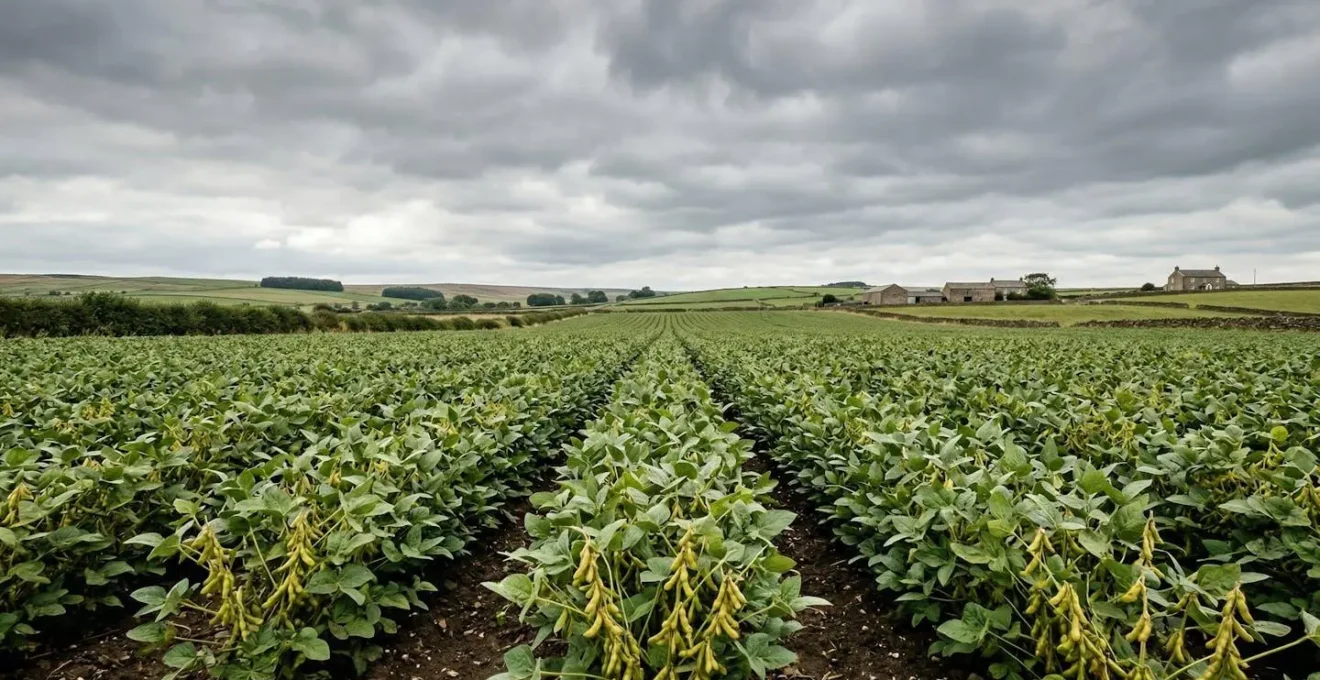
Successfully growing soya in the UK is no longer a gamble on the weather, but a calculated strategy based on heat unit agronomy, not outdated calendar dates.
- The UK climate has fundamentally shifted, providing more Growing Degree Days (GDDs), making previously marginal areas consistently viable for specific soya varieties.
- Modern genetics (ultra-early ‘0000’ varieties) combined with system-based management can reliably mitigate the main risks of late harvest and weed pressure.
Recommendation: Stop thinking about soya as a direct OSR replacement and start treating it as a high-value, climate-adapted system for building farm resilience and tackling blackgrass.
For any arable farmer in the Midlands staring at another variable oilseed rape establishment, the search for a profitable, reliable break crop feels more urgent than ever. Winter floods, summer droughts, and relentless pest pressure have turned a once-dependable staple into a high-risk venture. The conversation often turns to alternatives like beans or linseed, but increasingly, a new contender is mentioned, often with a healthy dose of scepticism: soya.
For decades, soya has been dismissed as a crop for the sunnier climes of the continent, a non-starter for anywhere north of the M4 corridor. The common wisdom dictates that our seasons are too short, our autumns too wet, and the risks too great. But this thinking is anchored in the past. It fails to account for two game-changing factors: a fundamentally altered climate and a revolution in plant genetics. Relying on historical planting dates and weather patterns is no longer just cautious; it’s a high-risk gamble in itself.
This article moves beyond the generic advice. It provides a forward-thinking but realistic agronomist’s framework for evaluating soya not as a hopeful punt, but as a strategic system. The key isn’t to follow a simple recipe but to master a new way of thinking, where accumulated heat, soil resilience, and harvest logistics are the metrics that matter. We will explore how to de-risk the crop from establishment to combining, turning a perceived gamble into a calculated and potentially highly profitable decision for the modern UK farm.
To navigate this complex decision, this guide breaks down the critical strategic points. We will cover everything from understanding the science of heat units to the practicalities of a late October harvest, providing a clear roadmap for any farmer considering this novel crop.
Summary: A Strategic Guide to Soya Viability in the UK
- Why Accumulated Heat Units Matter More Than Calendar Dates for Soya?
- How to Combine Soya in Late October Without Muddying the Grain?
- Early vs Late Maturing Soya: Which Is Safe for Yorkshire Latitudes?
- The Pigeon Risk That Can Decimate Soya at Emergence
- How to Manage Weeds in Soya Without Many Approved Herbicides?
- Why Your Grandfather’s Planting Dates Are Now High-Risk Gambles?
- Linseed or Beans: Which Break Crop Leaves the Best Soil Structure?
- How to Proof Your Farm Against Summer Droughts and Winter Floods?
Why Accumulated Heat Units Matter More Than Calendar Dates for Soya?
The single most important shift in thinking for a prospective UK soya grower is moving from a calendar-based mindset to a data-driven one. Soya development is not governed by the date; it’s governed by temperature. Specifically, it relies on the accumulation of Growing Degree Days (GDDs), a measure of heat accumulation used to predict plant development stages. For soybeans, this calculation uses a base temperature of 10°C (50°F). Every day the average temperature is above this base, the crop accumulates heat units that push it towards the next growth stage, from flowering to pod fill and finally maturity.
Why is this crucial now? Because the UK’s climate is no longer what it was. The old assumption that northern latitudes lack the required heat is being rapidly overturned. Data confirms a significant warming trend, with the UK now experiencing 17% more growing degree days compared to the 1961-1990 baseline. This isn’t a minor fluctuation; it’s a fundamental change in our production environment, effectively moving the viability line for crops like soya further north each decade. Relying on a neighbour’s sowing date from five years ago is ignoring the most critical data point: the actual and forecasted heat accumulation for the current season.
This “heat unit agronomy” approach de-risks the crop. Drilling should only commence when soil temperatures are consistently at or above 10°C to ensure rapid, even emergence. This might be late April in one year and mid-May in another. By tracking GDDs, a grower can more accurately predict harvest windows and select varieties whose GDD requirements match their farm’s specific thermal profile. As Climate Central notes, “For soybeans, a base temperature of 50°F is used,” and matching this requirement to local long-term data is the foundation of success. It’s about replacing guesswork with science.
How to Combine Soya in Late October Without Muddying the Grain?
The fear of a wet harvest is the biggest barrier for many farmers considering soya. The image of a combine sinking in a saturated October field is a powerful deterrent. However, successful harvest is not about luck; it’s about a systematic pre-harvest strategy that begins months earlier. Modern soya genetics and management techniques have fundamentally changed the risk profile. Today’s varieties have thicker, more robust stems and a higher first pod height, significantly reducing the amount of soil and debris taken in by the combine header compared to older varieties.
The key is to let the crop dictate the timeline, not the calendar. Natural senescence is the first step; the leaves will drop, leaving bare stems with hanging, rattling pods. This is the signal to begin final preparations, not to panic. The resilience of the crop is remarkable. A compelling case study from MJ and SC Collins, the UK’s largest soya producer, highlights this. In 2017, 60% of their crop was severely damaged by hail in July. Yet, the crop recovered, and a planned, systematic harvest approach allowed them to still yield a respectable 1.6t/ha in damaged areas versus 2.6t/ha in unaffected sections. This proves that with the right strategy, even significant in-season challenges can be overcome.
A disciplined approach to desiccation and logistics is paramount. The decision to apply a desiccant must be weighed against contract specifications (some prohibit their use) and the weather forecast. The goal is to achieve a uniform dry-down without exposing the crop to a long, wet waiting period. Before a single wheel turns, a full logistical audit is necessary to ensure drying and storage capacity can handle the crop efficiently, preventing bottlenecks that leave combines waiting. It’s a chain of decisions, not a single event.
Your Pre-Harvest Decision Framework for Soya
- Monitor canopy dry-down: Wait for leaves to fall naturally, leaving brown stems with hanging pods (typically late September onwards).
- Apply desiccant strategically: Time application based on the moisture forecast and, crucially, your market contract specifications, as some prohibit desiccant use.
- Assess field trafficability: Calculate the break-even point for using low ground pressure equipment versus the potential quality loss from a delayed harvest.
- Optimize combine settings: Leverage modern varieties with thick stems and higher pod attachment to allow for easier harvesting with reduced soil pickup.
- Plan drying capacity: Map the entire post-combine logistical chain, from the field to the dryer, to identify and resolve any potential bottlenecks before harvest begins.
Early vs Late Maturing Soya: Which Is Safe for Yorkshire Latitudes?
Choosing the right variety is the most critical decision a grower will make, and for northern latitudes like Yorkshire, it’s a non-negotiable factor for success. The maturity group (MG) system classifies soya varieties based on the length of their growing season. The scale runs from the very long season groups (e.g., MG 4-5) grown in the southern US, to the ultra-early groups (MG 0000) suitable for northern climates. For a farmer in the Midlands or Yorkshire, focusing exclusively on the earliest maturity groups is the only way to de-risk the harvest.
The target should be varieties that can reliably reach maturity and be harvested in September, avoiding the higher rainfall risk of October and November. This is where plant breeding has been a game-changer. As Dr David Buckeridge, a leading voice in the industry, states, ” The aim is to breed varieties in the ‘000’ maturity group that can be harvested in September in northern Europe.” This isn’t a future hope; these varieties exist now. Brands like Siverka and Artica fall into the ‘0000’ (ultra-early) category, bred specifically for short-season climates.
While a ’00’ variety might offer a slightly higher yield potential on paper in a perfect year, it carries a significantly higher risk of being caught by a wet autumn. For a farmer new to the crop in a marginal area, the smart play is to prioritize a safe and timely harvest over chasing maximum yield. The following table provides a clear risk assessment for Yorkshire latitudes.
| Maturity Group | Growing Season (days) | Harvest Window | Yorkshire Viability | Risk Level |
|---|---|---|---|---|
| MG 0000 (ultra-early) | 100-110 | Early-Mid September | High | Low |
| MG 000 (very early) | 110-120 | Mid-Late September | Moderate-High | Moderate |
| MG 00 (early) | 120-130 | Late September-Early October | Moderate | Moderate-High |
| MG 0 | 130-140 | October | Low | High |
The data is clear: for growers north of the traditional soya belt, selecting a ‘0000’ or at the very latest a ‘000’ variety is the only responsible choice. It aligns the crop’s lifecycle with the available heat units and brings the harvest forward into a safer weather window, turning a potential gamble into a manageable agronomic plan.
The Pigeon Risk That Can Decimate Soya at Emergence
For any farmer who has battled pigeons on oilseed rape, the thought of introducing another crop they favour is daunting. And make no mistake: pigeons find emerging soya cotyledons irresistible. A flock can wipe out a significant area of a newly sown field in a matter of days. However, the dynamics of pigeon pressure on soya are fundamentally different from OSR, and with the right establishment technique, the risk can be managed far more effectively.
The vulnerability window for soya is much shorter than for OSR. While OSR can be under pressure from October through to March, soya’s risk is concentrated in a brief period during emergence. The key to mitigating this risk is twofold: achieving rapid, even emergence and ensuring a consistent, correct sowing depth. Soya should be drilled at a depth of 25-30mm. This is deep enough to hide the seed from scavenging pigeons pre-emergence and requires the seedling to push through with enough vigour that it quickly becomes unpalatable.
The experience of the UK’s leading growers provides a clear blueprint. John Haynes, farm manager at Collins Farm, offers a powerful testimonial on this very issue:
“Pigeons go nuts for soya beans and a consistent sowing depth is essential to ensure they emerge evenly.”
– John Haynes, CPM Magazine
He goes on to contrast this with their previous experience, noting that controlling pigeons on OSR was ‘a full-time job,’ whereas the faster, more uniform emergence of correctly drilled soya dramatically reduces the period of vulnerability. A crop that emerges evenly and powers through its initial growth stages spends less time as a tender, appealing snack. This turns pigeon management from a winter-long war of attrition into a short, strategic defence during a specific two-week window.
How to Manage Weeds in Soya Without Many Approved Herbicides?
A limited list of approved herbicides can seem like a major drawback for soya, especially for farmers dealing with challenging weed burdens. However, this perceived weakness hides one of soya’s greatest strengths: its natural competitiveness. Modern soya varieties produce a thick, broad-leaved canopy that closes over the rows quickly, creating a dark, hostile environment for later-germinating weeds. This canopy architecture is a powerful, non-chemical weed control tool that is often underestimated.
Furthermore, soya offers a golden opportunity in the fight against one of the UK’s most problematic weeds. According to extensive agronomic research, soya is the very best crop for tackling blackgrass. As a spring-sown broadleaf crop, it allows for a complete break in the lifecycle of winter grass weeds. The stale seedbed window in spring, combined with different herbicide chemistries, provides a highly effective reset in a rotation dominated by winter cereals. This rotational benefit alone can justify its inclusion on farms with severe blackgrass resistance issues.
While the chemical options are fewer than for wheat or OSR, they are effective when used as part of an integrated strategy. The approach relies on a robust pre-emergence application followed by targeted post-emergence control. A typical, effective programme would be:
- Pre-emergence control: Apply a product like Nirvana (pendimethalin + imazamox) as the foundational pre-emergence herbicide to control a range of early weeds.
- Post-emergence broadleaf control: Target broadleaf weeds like charlock with a low-cost sulfonylurea (SU) herbicide around five weeks after sowing (typically late May).
- Grass weed management: If grass weeds such as wild oats or brome appear, apply a specific graminicide two weeks after the post-em spray.
- Leverage competitive advantage: Trust the crop. Once established, the thick canopy of modern varieties will outcompete and suppress a significant amount of potential weed growth, reducing reliance on further chemical passes.
This integrated approach, combining a limited but effective chemical programme with the crop’s natural competitiveness, provides reliable weed control and a powerful tool for managing difficult rotational weeds.
Why Your Grandfather’s Planting Dates Are Now High-Risk Gambles?
For generations, farming knowledge was passed down as a set of reliable calendar dates: plant this crop after the last frost, drill wheat in October, and so on. This wisdom was built on decades of stable, predictable climate patterns. Today, clinging to these historical averages is not just outdated; it’s one of the riskiest strategies a farm can employ. The climate is no longer stable or predictable in the same way, and the data proves it.
The concept of “climate normals”—typically 30-year averages—is becoming an unreliable benchmark for making in-season decisions. The rate of change is accelerating. Regional variability is increasing, with one year bringing a prolonged spring drought and the next a cold, wet May. A fixed planting date on the calendar ignores the single most important factor for a heat-dependent crop like soya: the actual temperature of the soil and the accumulated heat of the season.
This is precisely why a shift to a GDD-based strategy is essential for resilience. It untethers decision-making from a volatile calendar and anchors it to a measurable, biological reality. As the experts at ClimateAi astutely point out, this shift is a necessity in modern agriculture.
“Climate change is making historical averages an unreliable source to measure GDD. This shift, combined with increased regional variability, underscores the growing need for highly localized GDD forecasting.”
– ClimateAi, Growing Degree Day Calculator analysis
Trying to grow soya using a planting date from an old farming textbook is like navigating with a map from the 1980s. The landscape has changed. The old rules of thumb that served previous generations well are now liabilities. Success in the 21st century requires adapting to real-time data and embracing tools and metrics—like GDDs—that reflect the dynamic environment we now farm in. It’s about being responsive, not just repetitive.
Linseed or Beans: Which Break Crop Leaves the Best Soil Structure?
For a farmer looking to replace OSR, the decision often comes down to a choice between established alternatives like faba beans and linseed, versus a novel crop like soya. While gross margin is a key driver, the rotational legacy—specifically the impact on soil structure and health for the following crop—is a critical, long-term consideration. When compared on this basis, soya presents a compelling and often superior profile.
Both beans and soya are legumes, capable of nitrogen fixation, leaving a valuable nitrogen legacy for the following crop and reducing fertiliser bills. However, soya’s root architecture and its impact on problematic weeds can give it an edge. The table below, based on extensive agronomic data, compares the three break crops across key soil-related characteristics.
| Characteristic | Linseed | Beans (Faba/Field) | Soya |
|---|---|---|---|
| Root architecture | Fibrous, shallow | Taproot with nodules | Deeper taproot with lateral branching |
| Mycorrhizal association | Non-mycorrhizal | Mycorrhizal | Mycorrhizal |
| Nitrogen fixation | None | High (150-300 kg N/ha) | Moderate-High (leaves legacy for next crop) |
| Residue C:N ratio | High carbon (slow breakdown) | Low carbon (rapid nutrient release) | Low carbon (rapid nutrient release) |
| Blackgrass control | Moderate | Good | Excellent (best available) |
| Soil compaction relief | Limited | Moderate (taproot penetration) | Good (deeper penetration) |
The data from sources like agronomic trials by Soya UK reveals a clear picture. While beans provide excellent N-fixation, soya combines this with a deeper taproot for better compaction relief and, most importantly, offers an “excellent” rating for blackgrass control—the best available option. Linseed, being non-mycorrhizal and having a high-carbon residue, can be slower to break down and offers limited soil structural benefits compared to the legumes. For a farm battling compaction and resistant blackgrass, soya’s legacy provides both a soil health and a financial benefit that is hard to ignore, creating a cleaner and more friable seedbed for the following wheat.
Key Takeaways
- Soya’s viability in the UK is now a reality due to climate change (more heat units) and advanced, ultra-early genetics.
- Success hinges on a ‘heat unit agronomy’ mindset, where decisions are driven by temperature data, not fixed calendar dates.
- Soya offers significant rotational benefits, including superior blackgrass control and improved soil structure compared to other break crops.
How to Proof Your Farm Against Summer Droughts and Winter Floods?
The increasing volatility of UK weather is the single greatest challenge to farm profitability. The cycle of summer droughts making crop establishment a nightmare, followed by winter floods that damage soil structure and delay fieldwork, demands a new level of resilience. Integrating crops that are inherently better adapted to these extremes is no longer a luxury; it’s a core business strategy. Soya, with its deep taproot and flexible growth habit, is emerging as a powerful tool in this climate-proofing toolkit.
The crop’s drought tolerance is particularly noteworthy. The 2017 season at Collins Farm provides a stark, real-world example. Their soya crop received only 14mm of rainfall from sowing through to harvest. In the same period, their OSR required 24-hour irrigation for three weeks just to establish. Despite this extreme lack of moisture, the undamaged soya still achieved yields of 2.6t/ha. This demonstrates a level of resilience that few other commercial break crops can match, reducing reliance on irrigation and ensuring a harvest even in a dry year.
Looking ahead, the case for soya only gets stronger. Climate models from respected institutions like Rothamsted Research predict a continued northward march of viability. Their research suggests that with rising CO2 levels and temperatures, soya will not only become reliable as far north as southern Scotland but could also see a yield boost.
“Under climate change these varieties are likely to mature as far north as southern Scotland. With greater levels of CO2, yield is predicted to increase by as much as 0.5 t/ha at some sites in the far future.”
– Rothamsted Research, UK soybean climate modeling study
By integrating a spring-sown, drought-tolerant crop like soya, a farm spreads its risk. It creates a buffer against a dry autumn crippling winter crop establishment and provides an excellent entry for a following wheat crop. It’s a strategic move away from a reliance on a few volatile crops and towards a more balanced, resilient, and ultimately more profitable farming system prepared for the climate of the next decade.
By moving beyond outdated assumptions and embracing a data-led, systems-based approach, soya can transition from a speculative crop to a cornerstone of a resilient and profitable arable rotation in the modern UK.