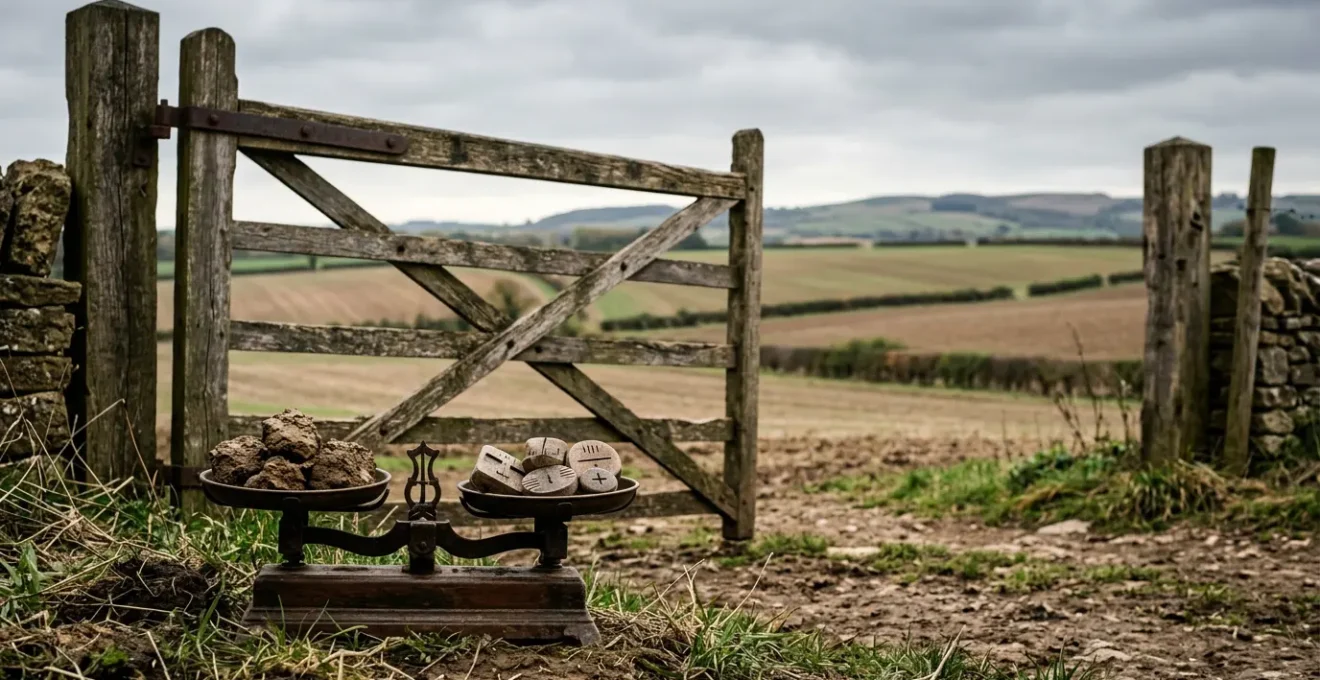
The biggest risk in a soil carbon contract isn’t the carbon price—it’s the ‘permanence’ clause that can lock up your land for decades.
- Long-term contracts (10+ years) create immense liability if you ever need to change land use, effectively making you a tenant on your own property.
- Proving “additionality” and avoiding “double counting” requires careful data management and contract negotiation to retain your rights and avoid future legal conflicts.
Recommendation: Prioritize shorter, 5-year contracts. They aren’t less profitable; they are a critical ‘exit ramp’ that protects your farm’s future flexibility and financial health.
The promise of the carbon market is seductive: get paid for the good work you’re already doing to build soil health. Consultants and brokers paint a rosy picture of a new, reliable income stream, often emphasizing the benefits of practices like no-till and cover cropping. Many farmers, rightfully cynical, see the dollar signs but are wary of the strings attached. They hear the generic advice to “read the contract” but know the devil is in the details—details that are often buried in dense legalese designed to benefit the buyer.
The fundamental question is not ‘how much can I make?’ but ‘how much could I lose?’ The standard 10-year or longer agreements are presented as a sign of commitment, but they are, in reality, a form of asset lock-in. They can severely restrict your operational freedom and expose you to significant financial risk down the line. This isn’t about being anti-environment; it’s about being pro-business and protecting your most valuable asset: your land.
This guide cuts through the noise. We will dissect the hidden liabilities in typical carbon contracts, from permanence clauses that act like liens on your property to the data sovereignty issues that can lead to double-counting nightmares. We will make the case that a shorter, five-year contract is not a sign of weak commitment but a shrewd business strategy—a contractual exit ramp that allows you to capitalize on the market without mortgaging your future.
By understanding the contractual asymmetries at play, you can negotiate from a position of strength. This article provides a strategic overview of the key risk factors and decision points you must consider before signing any agreement. Use this information to build a liability shield around your operation.
Summary: Why a Shorter Soil Carbon Contract Is a Smarter Business Decision
- Why ‘Permanence’ Clauses Can Bankrupt You If You Plough Later?
- How to Prove Your Carbon Sequestration Is ‘Additional’ to Normal Practice?
- Verra vs Gold Standard: Which Certificate Do Corporate Buyers Prefer?
- The Double Counting Mistake That Happens When You Sell Grain and Carbon
- When to Sign: Waiting for the Carbon Price to Hit £50/tonne
- Dumas Combustion vs Loss on Ignition: Which Method Buyers Trust?
- Why Straw Incorporation Alone Won’t Build Stable Humus Rapidly?
- Why Soil Carbon Measurements Fluctuate Wildly Between Labs?
Why ‘Permanence’ Clauses Can Bankrupt You If You Plough Later?
The most dangerous word in any carbon contract is “permanence.” To a buyer, it means the carbon you sequester stays in the ground forever. To you, it should mean a long-term liability tied directly to your land title. Most programs require a commitment to maintain the carbon-storing practices, and this obligation doesn’t just last for the payment period. In fact, carbon contracts typically require farmers to maintain practices for 10-50 years, and sometimes longer. This is the definition of asset lock-in. Imagine a future where market economics or family needs dictate selling a parcel for development or returning a field to a more intensive rotation. A permanence clause could trigger a “reversal,” forcing you to pay back all previously earned credits, often with penalties.
This isn’t a theoretical risk; it’s a financial time bomb. As Tiffany Lashmet, a Texas A&M Extension Agriculture Law Specialist, warns, the danger often lies in the fine print that extends the obligation far beyond the contract’s stated term.
Sometimes in the contracts, maybe it’s a 10-year contract, but there’s a permanent requirement that makes you not do anything to undo the carbon that’s been stored for an additional time.
– Tiffany Lashmet, Texas A&M Extension Agriculture Law Specialist
A 5-year contract provides a crucial “exit ramp.” It allows you to participate in the market and generate revenue while retaining the flexibility to reassess your land-use strategy in the near future. A 10-year or longer contract, by contrast, creates a contractual asymmetry that heavily favors the buyer, leaving you with all the long-term risk for a short-term payment. This could, in a worst-case scenario, make your land un-farmable or unsellable without incurring catastrophic penalties.
How to Prove Your Carbon Sequestration Is ‘Additional’ to Normal Practice?
The concept of “additionality” is a cornerstone of every credible carbon market. It means you only get paid for carbon sequestration that is “additional” to what would have happened anyway. If you’ve been practicing no-till for 15 years, you can’t suddenly sign a contract and claim credit for that existing stored carbon. This immediately creates a frustrating paradox: the market often penalizes the very pioneers of regenerative agriculture. As a common critique of these programs highlights, the additionality requirement often excludes early adopters who have been implementing carbon-forward practices for years, effectively shutting them out from revenue they helped make possible.
For a farmer entering a new contract, this means you must meticulously prove that your new practice—whether it’s adding a multi-species cover crop or extending a rotation—is a genuine change from your established baseline. This is where data sovereignty becomes paramount. You cannot rely on the carbon program’s verifier to be your record-keeper. You must maintain your own independent, detailed, and dated evidence of your “business-as-usual” practices before the contract begins. This includes:
- Historical tillage records and fuel logs.
- Seed and fertilizer purchase invoices.
- Dated photographs and videos of your fields and practices.
- Yield maps and soil tests from previous years.
This documentation is your primary line of defense. Without it, a verifier could argue that your “new” practice was already part of your standard operation, invalidating your credits. By building your own robust baseline of evidence, you shift the contractual asymmetry back in your favor. You are no longer asking them to believe you; you are presenting them with indisputable proof of change, a crucial step in building your liability shield.
Verra vs Gold Standard: Which Certificate Do Corporate Buyers Prefer?
Not all carbon credits are created equal, and the verification standard they are issued under is the primary determinant of their quality, price, and marketability. For agricultural projects, the two dominant players in the voluntary market are Verra (with its Verified Carbon Standard, or VCS) and Gold Standard. Understanding the difference is not just an academic exercise; it dictates who will buy your credits and how much they’re willing to pay. In short, the choice reflects a trade-off between scale and story.
Verra is the market leader in terms of sheer volume, focusing on scalability and market liquidity. This often translates to a more streamlined verification process and lower transaction costs, making it a favorite for buyers who need to offset large volumes of emissions efficiently. Gold Standard, conversely, built its brand on a foundation of “co-benefits.” It requires projects to demonstrate positive impacts on at least three of the UN Sustainable Development Goals (SDGs), such as water quality or biodiversity. This narrative of holistic benefit attracts premium buyers—often from consumer-facing sectors like fashion or tech—who are willing to pay more for credits that bolster their corporate social responsibility (CSR) story. In fact, research shows that removal credits with verified co-benefits attract price premiums of 20-30%.
Your farm business consultant or the carbon program developer will likely have a preference, but it is your business on the line. The following table breaks down the key characteristics that influence buyer preference.
| Characteristic | Verra (VCS) | Gold Standard |
|---|---|---|
| Primary Focus | Scalability & high credit volume | Co-benefits & sustainable development (SDG alignment) |
| Buyer Profile | Cost-efficiency priority, high-volume needs, market liquidity | Net-zero claims with co-benefits, premium ESG buyers |
| Market Share | Largest registry – 1.1 billion credits issued | Smaller – 238 million credits issued |
| Price Point | More competitive/lower pricing | Premium pricing (higher costs but higher value) |
| Verification Costs | Relatively more efficient pathway | Higher upfront and verification costs |
| Best For | Large-scale REDD+, renewable energy, industrial projects | Community-based, agroforestry, social-environmental initiatives |
| Industry Preference | Tech, energy sectors seeking volume | Fashion, consumer goods emphasizing CSR narrative |
Ultimately, the “better” standard depends on your goals. If your operation is geared for maximum efficiency and you prefer a quicker, lower-cost path to market, Verra may be suitable. If you are already implementing practices that deliver clear environmental co-benefits and want to attract premium buyers, the higher verification costs of Gold Standard could be a worthwhile investment.
The Double Counting Mistake That Happens When You Sell Grain and Carbon
One of the most insidious and least-discussed risks in carbon farming is “double counting,” also known as “double-dipping.” This occurs when the environmental benefit of your practice is claimed by two different entities. The classic example: you sell low-carbon grain to a food processor who then makes a “sustainably sourced” claim on their cereal box, while you simultaneously sell the carbon credit from the same field to a tech company to offset their emissions. Because of strict additionality rules, it’s a foundational principle that two companies cannot sell credits for the same carbon unit. If this happens, one of the parties is in breach of contract, and you can be sure the liability will be pushed down to you, the farmer.
This is where data sovereignty and explicit contract language are your only liability shield. Many grain contracts are being quietly updated to include clauses that transfer “all environmental attributes” to the buyer along with the physical commodity. If you sign such a contract, you may have unknowingly sold your right to enter a separate carbon market agreement. You have given away your data sovereignty.
Protecting yourself requires a proactive, two-pronged attack. First, you must scrutinize your grain contracts with the same intensity as your carbon contract. Second, you must negotiate specific clauses in all agreements to clearly delineate who owns what. Your goal is to unbundle the physical commodity (grain) from the environmental attribute (the sequestered carbon). Before signing anything, work with a lawyer to insist on language that achieves the following:
- Explicitly state in grain contracts that you are selling only the physical commodity, retaining all environmental attribute rights.
- Include a ‘stacking prohibition’ review clause – ensure it doesn’t inadvertently prohibit legitimate separate transactions (grain vs. carbon).
- Specify data ownership rights – clarify who owns farm data and how it can be used across different programs.
- Define ‘additionality’ clearly – ensure carbon credit contracts don’t conflict with existing commodity supply agreements.
- Request mutual indemnification clauses to protect against claims arising from a buyer’s misuse of your environmental claims.
Failing to secure these rights in writing is leaving the door open to future litigation. You must assume that if there is ambiguity, it will be resolved in the buyer’s favor. Your guiding principle should be: “If it’s not explicitly my right in the contract, it’s not my right.”
When to Sign: Waiting for the Carbon Price to Hit £50/tonne
For a cynical business owner, the decision of when to enter a market is driven by a simple calculation: is the reward worth the risk and effort? In the current voluntary carbon market, the answer for many farmers is a resounding “no.” While prices are volatile, agricultural credits typically command prices between $10-$35 per tonne, which often fails to cover the costs of new practices, let alone the administrative burden and long-term liability.
This sentiment is backed by hard data. Farmers are not just being difficult; they are being rational. When faced with the numbers, the current incentive structure is simply too weak. Recent research shows that only 3-4% of farmers are willing to change practices at the $10-$20/credit price point. Even at a more robust $40-$70 per credit, a full 50% of farmers surveyed were still unwilling to sign up, indicating a deep-seated perception that the risk outweighs the reward.
So, when is the right time to sign? The answer is not now, for many. Waiting for the market to mature and for prices to rise—perhaps to the £50/tonne mark or higher—is a perfectly valid business strategy. This is not passive waiting; it is an active choice to preserve your options. Every year you wait, you avoid locking in your land at a low price, gather more baseline data, and retain the flexibility to act when the market fundamentals are more favorable.
This is where the 5-year contract as an “exit ramp” becomes so powerful. If you do decide to enter the market now, a shorter contract allows you to benefit from potential price increases sooner. Signing a 10 or 20-year contract at $20/tonne today means you will be watching from the sidelines if the price skyrockets to $80/tonne in year six. A 5-year contract lets you re-enter the market and negotiate a new agreement at the prevailing, higher rate. It transforms your carbon from a low-value, long-term liability into a dynamic asset you can manage strategically.
Dumas Combustion vs Loss on Ignition: Which Method Buyers Trust?
Once you’ve decided to sell carbon, the question becomes: how will it be measured? The credibility of your carbon credits—and thus their value—hinges on the scientific rigor of the measurement methodology. Two common lab methods for determining soil organic carbon (SOC) are Loss on Ignition (LOI) and Dry Combustion (often called Dumas). From a farmer’s perspective, the choice seems simple: LOI is significantly cheaper. However, from a buyer’s perspective, it’s a matter of trust, and they simply don’t trust LOI for high-value carbon accounting.
Loss on Ignition is an indirect estimate. It involves burning a soil sample and measuring the weight loss, which is assumed to be organic matter. It’s quick and affordable but can be skewed by soil type and moisture. Dumas combustion is a direct measurement. It burns the sample at a much higher temperature and uses sensors to directly measure the carbon dioxide released. It is the gold standard for accuracy and repeatability, and it is what premium buyers and verification bodies like Verra and Gold Standard demand. As a farm business consultant, my advice is clear: paying for the cheaper LOI test is a false economy. You may save a few pounds per sample only to find your credits are unsellable in premium markets.
This cost-benefit analysis is crucial for your bottom line. As experts from New Mexico State University note, these direct costs are only part of the financial picture.
Growers might have to pay fees to cover soil sampling or third-party verification, insurance, and/or transaction fees in addition to bearing the costs of the new equipment.
– New Mexico State University Extension, Carbon Credit Markets in Agriculture Guide
The table below outlines the trade-offs. While the initial cost of Dumas is higher, its acceptance by buyers makes it the only viable choice for a serious carbon farming enterprise. Choosing LOI is like building a house on a shaky foundation; it may look fine initially, but it won’t withstand scrutiny.
| Method | Cost Per Sample | Accuracy Level | Buyer Trust | Program Acceptance |
|---|---|---|---|---|
| Loss on Ignition (LOI) | £10-£20 ($15-$25) | Lower precision, estimates organic matter | Lower – not preferred for high-value credits | Limited acceptance in premium programs |
| Dumas Combustion / Dry Combustion | £30-£50 ($40-$60) | High precision, direct carbon measurement | High – mandated by premium buyers | Standard for verification bodies |
| Hybrid Model (Initial + Modeling) | High upfront, lower annual | Calibrated modeling with periodic verification | Growing acceptance | Emerging approach to reduce ongoing costs |
Why Straw Incorporation Alone Won’t Build Stable Humus Rapidly?
A common and dangerous oversimplification in carbon farming is the idea that “adding more organic matter” automatically translates to more sequestered carbon. A farmer might think, “I’m incorporating all my straw, that’s tons of carbon, so I should get paid.” Unfortunately, soil science is more complex. Not all soil organic matter is equal in the eyes of a carbon contract, because not all of it is permanent. Soil scientists differentiate between various carbon pools, but for your purposes, the key distinction is between the “labile” pool and the “stable” pool.
Incorporated straw, fresh manure, or the residues from a cover crop first enter the labile pool. This is the “fast-cycling” carbon. It’s a vital food source for soil microbes, driving nutrient cycling and improving soil structure. However, a large portion of this carbon is quickly respired by those microbes and returned to the atmosphere as CO2, often within a year or two. It’s here today, gone tomorrow. This is not the permanent sequestration that carbon credit buyers are paying for.
The real prize is building stable humus, also known as mineral-associated organic matter (MAOM). This is the “slow-cycling” carbon that can remain in the soil for decades or centuries. It’s formed through complex biological and chemical processes where decomposed organic compounds bind with clay and silt particles, protecting them from microbial breakdown. As research on temporary sequestration shows that only stable mineral-associated organic matter (MAOM) counts for the long-term permanence required by carbon contracts. Building this stable pool is a slow process that requires more than just adding raw organic material. It depends on a diverse microbial community, minimal soil disturbance (like no-till), and continuous living roots from diverse plant species.
Simply incorporating straw is a good start, but it primarily feeds the fast-cycling labile pool. It will not, on its own, rapidly build the stable, verifiable MAOM that underpins a carbon contract. Understanding this distinction is crucial to setting realistic expectations and implementing a systems-based approach that truly builds long-term, bankable carbon.
Key takeaways
- Long-term ‘permanence’ clauses are a major financial liability; prioritize shorter, 5-year contracts as a strategic ‘exit ramp’.
- You must actively manage and retain ownership of your environmental data to avoid ‘double counting’ and prove ‘additionality’.
- The choice of verification standard (Verra vs. Gold Standard) and soil testing method (Dumas vs. LOI) directly impacts your costs, buyer pool, and credit value.
Why Soil Carbon Measurements Fluctuate Wildly Between Labs?
Perhaps the most maddening aspect of soil carbon measurement is its inherent variability. You can take a perfectly homogenized soil sample, split it into two bags, send them to two different certified labs, and get back two significantly different results for soil organic carbon (SOC). As the University of Wisconsin Extension notes, this is a known industry-wide problem: “There is also a lack of scientific consensus on the amount and permanence of carbon stored through conservation practices to consider.” This lack of consensus trickles down to the lab bench. Minor variations in sample preparation, equipment calibration, or even technician protocol can lead to frustratingly different numbers.
For a farmer in a carbon contract, this isn’t an academic curiosity; it’s a massive financial risk. Your payments are based on the measured *change* in SOC over time. If your baseline was measured by Lab A at 2.5% SOC, and your five-year follow-up is measured by Lab B at 2.4% SOC, your contract may show a carbon loss—triggering penalties—when in reality, your soil carbon may have increased. The difference was just lab noise. This contractual asymmetry, where you bear the financial risk of measurement uncertainty, is unacceptable.
You cannot eliminate this variability, but you can manage the risk with a proactive strategy. The “Golden Sample” approach is a powerful form of liability shield that you should deploy *before* signing any contract. It allows you to quantify the measurement uncertainty and select a partner based on consistency, putting you in control of the data from day one.
Your Action Plan: The Golden Sample Strategy for Baseline Assessment
- Collection and Homogenization: Before signing any contract, collect soil from multiple points in the target field and homogenize it thoroughly into a single ‘golden sample.’
- Split Testing: Split the golden sample into 4-5 identical portions and send them to different certified labs simultaneously, all using the Dumas combustion method.
- Variance Documentation: Document the variance in %SOC results between labs. This number (e.g., +/- 0.15% SOC) is your baseline measurement uncertainty. It’s a critical piece of data for negotiation.
- Lab Selection: Select the lab that demonstrates the most consistent and repeatable results. If one lab is a clear outlier, you know to avoid them.
- Contractual Lock-in: Negotiate a clause in your contract specifying that your chosen lab must be used for all future verification events for the entire contract duration. If they refuse, demand a clear dispute resolution protocol that involves a neutral third-party referee lab.
Executing this strategy gives you a powerful tool. It demonstrates to the carbon program developer that you are a sophisticated, data-driven partner and that you will not accept bearing the financial risk of their preferred lab’s inconsistency. It is a fundamental step in rebalancing the power dynamic of any carbon agreement.
To navigate this complex but potentially rewarding market, you must shift your mindset from that of a simple seller to a strategic risk manager. Protect your data, demand shorter terms, and build a contractual liability shield around your farm’s most important asset.