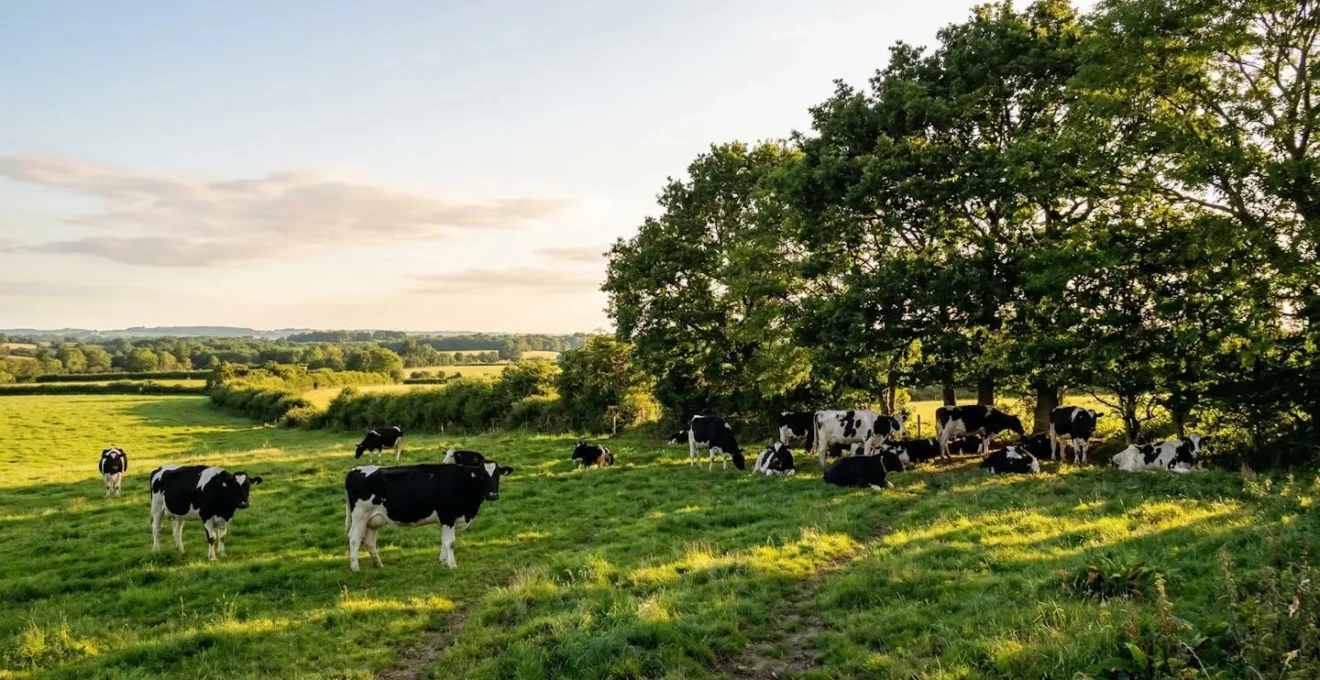
Integrating shelter belts is not an environmental expense but a calculated infrastructure investment that directly counteracts summer milk yield loss.
- Heat stress begins cutting into profits at just 20°C for high-yielding dairy cows, impacting milk solids and fertility long before visible signs appear.
- Strategic East-West planting provides critical afternoon shade while well-managed systems show no decline in forage production and can significantly boost milk output.
Recommendation: Shift from viewing trees as a cost to planning them as a productive, long-term farm asset engineered for specific performance outcomes.
For a UK dairy farmer, a July heatwave isn’t just uncomfortable; it’s a direct hit to the bottom line. As temperatures climb, you see the numbers in the tank drop, and the frustration is palpable. The standard advice often involves expensive fans, misters, or dietary adjustments—solutions that treat the symptom, not the source. Many consider tree planting a purely environmental or aesthetic choice, a “nice-to-have” that’s too slow and complex to justify the investment against immediate production pressures.
But this perspective overlooks a crucial reality. What if the most resilient and cost-effective cooling system wasn’t a piece of machinery, but a living, appreciating farm asset? The key is to stop thinking about planting trees and start thinking about engineering an agroforestry system. This isn’t about scattered saplings; it’s about a deliberate, long-term infrastructure investment designed to mitigate the specific, measurable risk of heat stress on animal performance and your farm’s profitability.
This article moves beyond the generic benefits of shade. We will dissect the return on investment of shelter belts by treating them as a managed asset. We’ll analyse the precise point at which heat begins to erode your profits, how to design a system that maximizes cooling without creating new problems like mud, and the critical management steps to protect and integrate this investment into your operation. This is a consultant’s-eye view of turning trees into a powerful tool for economic and environmental resilience.
This guide breaks down the essential considerations for integrating shelter belts into your dairy operation, focusing on practical management and economic returns. The following sections provide a roadmap for planning, implementing, and managing trees as a productive farm asset.
Summary: A Practical Guide to the ROI of Trees for Dairy Heat Stress
- Why Cows Begin to Suffer Heat Stress at Only 20°C?
- How to Orient Trees to Provide Shade Without Creating Mud Baths?
- Cactus Guards or Electric Fencing: Which Protects Saplings from Curious Heifers?
- The Acorn Poisoning Risk and How to Manage Oak in Pastures
- When to Let Cows Back In: The Trunk Diameter Rule for Silvopasture
- Native Breeds vs Continental: Which Cattle Survive Best in Heatwaves?
- Why Root Pruning Is Essential to Stop Trees Stealing Crop Water?
- Planting Trees on Arable Land: How to Minimize Yield Loss at Headlands?
Why Cows Begin to Suffer Heat Stress at Only 20°C?
The term “heat stress” often conjures images of cows panting heavily in scorching 30°C+ weather. However, for a high-yielding dairy cow, the economic damage starts far earlier. The critical yield-depression threshold can be as low as 20°C to 22°C, a common temperature during British summers. This is because a modern dairy cow is a metabolic powerhouse. The very process of digestion, particularly rumination, generates a significant amount of internal heat. She is essentially running a furnace to convert forage into milk.
When external temperatures rise, the cow struggles to dissipate this internal thermal load. Her thermoneutral zone—the temperature range where she doesn’t need to expend energy to stay warm or cool down—is surprisingly low. Once ambient temperatures exceed this zone, her body must divert energy away from production and towards cooling. This triggers a cascade of negative effects long before you see overt panting.
The first casualty is dry matter intake (DMI). Cows eat less to reduce the metabolic heat produced by digestion. This directly impacts milk volume. Subsequently, changes in blood flow and rumination patterns can depress butterfat and protein content, hitting the quality of your milk cheque. Beyond the tank, heat stress is a major factor in reduced conception rates and increased risk of metabolic disorders like acidosis. Therefore, mitigating heat stress isn’t about comfort; it’s about protecting the core drivers of your farm’s profitability: milk production, component quality, and reproductive efficiency.
How to Orient Trees to Provide Shade Without Creating Mud Baths?
Simply planting trees for shade is not enough; poor design can lead to soil compaction, pasture damage, and muddy congregation areas that trade one problem for another. Effective “agroforestry engineering” requires a strategic approach to placement and orientation. The primary goal is to provide shade during the hottest part of the day, typically from noon to late afternoon, when the sun is in the southern and western sky in the Northern Hemisphere.
To achieve this, the most effective design is to plant shelter belts or tree clusters in a predominantly East-West orientation. This layout acts like a long, moving parasol, casting a deep shadow to the north of the belt during the peak heat of the day. As the sun moves across the sky, this band of shade slowly sweeps across the pasture, encouraging cows to move with it. This dynamic shade prevents cattle from standing in one spot all day, which is the primary cause of soil compaction and the creation of unsanitary mud baths.
Drainage and airflow are equally critical. As experts from Agriculture Victoria note, shelter belts “should be thinned evenly to allow wind flow.” A dense, wall-like planting can block cooling breezes, creating a stagnant, humid microclimate. By thinning lower branches and ensuring adequate spacing between trees, you maintain air circulation that helps dry the ground and provides evaporative cooling for the animals. The ideal system provides a permeable screen, not an impermeable wall, balancing sun protection with essential ventilation.
Action Plan: Designing Your Shelter Belt
- Orientation: Plan main shelter belts along an East-West axis to maximise midday and afternoon shade.
- Spacing: Determine tree spacing based on mature canopy size to achieve 30-50% shade coverage, not 100%. This allows for airflow and grass growth.
- Species Selection: Choose a mix of fast-growing species (e.g., poplar, willow) for quick results and long-lived hardwoods (e.g., oak) for durability.
- Drainage: Assess the site’s natural drainage. Avoid planting in low-lying, wet areas or design swales to direct water away from congregation zones.
- Management Access: Ensure your layout allows for machinery access for future management, such as thinning or root pruning.
Cactus Guards or Electric Fencing: Which Protects Saplings from Curious Heifers?
Once you’ve invested time and capital in planting saplings, protecting this future asset becomes the single most important factor for success. Dairy cattle, especially inquisitive heifers, can destroy a young plantation in a single afternoon through rubbing, browsing, and trampling. The choice of protection method is a balance of upfront cost, long-term durability, and labour. It’s a classic operational decision where the cheapest option is rarely the most cost-effective.
Individual tree guards or tubes offer targeted protection but come with a high per-tree cost and a limited lifespan. They are effective against rubbing but may not stop a determined animal from pushing them over or browsing exposed leaves. At the other end of the spectrum, high-tensile electric fencing is a significant capital outlay but offers the most robust and long-term protection for an entire block or belt of trees. Its per-tree cost becomes highly economical when protecting a large number of saplings.
For a data-driven decision, a cost analysis is essential. The following comparison, based on principles from livestock system analyses at Iowa State University, breaks down the typical trade-offs. While costs are illustrative, the relative differences provide a clear framework for evaluating the return on investment for each protection strategy over a five-year period, which is a critical establishment window.
| Protection Method | Initial Cost per Tree/Linear Foot | Lifespan | Labor Intensity | Cost per Surviving Tree (5-year) |
|---|---|---|---|---|
| Individual Tree Guards | $8-$25 per tree | 3-7 years | Low (one-time install) | $12-$35 |
| High-Tensile Electric Fence | $1.21 per linear foot | 25+ years | Moderate (maintenance) | $0.60-$1.50 per tree |
| Polywire Temporary Fence | $0.30-$0.50 per linear foot | 4-5 years | High (frequent moving) | $2-$4 per tree |
| Bio-protection (Nurse Shrubs) | $15-$30 per shrub cluster | Permanent | Low (self-maintaining) | $20-$40 (creates habitat) |
Ultimately, the decision hinges on the scale of your project. For a handful of trees, individual guards may suffice. For a serious shelter belt project, the economic case for high-tensile electric fencing is compelling. It provides superior asset protection and, when amortised over its long lifespan, represents a much lower cost per surviving tree, ensuring your initial investment reaches maturity.
The Acorn Poisoning Risk and How to Manage Oak in Pastures
Oak trees are an excellent choice for UK silvopasture systems, offering durable, long-lived shade and valuable habitat. However, many farmers are wary due to the well-known risk of acorn poisoning. Acorns contain tannins which, if consumed in large quantities, can cause severe kidney damage and even death in cattle. This risk is highest in autumn when large amounts of green acorns fall after a storm, or when other forage is scarce, leading cattle to gorge on them. However, this manageable risk should not rule out the use of such a valuable tree species.
The key to safely integrating oak into a dairy pasture is not avoidance, but precision management. The toxicity risk is a function of dose and timing. A cow consuming a few ripe, brown acorns is unlikely to suffer any ill effects. The danger comes from large-scale consumption of green acorns. Therefore, the solution lies in controlling access during high-risk periods through effective rotational grazing.
By fencing off oak-dense areas of the pasture during the main acorn drop in autumn (typically September-October), you can completely eliminate the risk. The pasture can then be safely grazed again after the main drop is over and the acorns have been cleared by wildlife or have started to degrade. This turns a potential liability into a scheduled management task, no different from managing access to lush spring grass to prevent bloat.
Case Study: Fiddle Creek Dairy’s Managed Oak System
A practical example of this principle is seen at Fiddle Creek Dairy in Pennsylvania. The farm integrated thousands of trees, including bur and cow oak varieties, into their pastures. As detailed in a report by Ambrook, a platform focused on farm finance, they use rotational grazing to manage livestock access. By keeping cattle out of the oak zones during the autumn high-risk window, they successfully leverage the benefits of oak trees while completely mitigating the poisoning risk. This approach demonstrates that with proper management, oak can be a cornerstone of a diversified and resilient silvopasture system.
When to Let Cows Back In: The Trunk Diameter Rule for Silvopasture
After years of protecting your saplings, the decision to finally remove the fences and integrate the trees into the grazing rotation is a critical milestone. Re-introducing cattle too early can result in significant damage, undermining your entire investment. As the Washington State University Extension service highlights, “Cattle can damage trees by chewing on foliage, branches, or bark… They may also rub on the bark and trample or even uproot seedlings.” The question is, when is a tree strong enough to withstand this pressure?
While there’s no single magic number, a widely accepted guideline in silvopasture management is the Trunk Diameter Rule. Most experts recommend waiting until a tree’s trunk has reached a diameter of at least 4-6 inches (10-15 cm) at breast height before allowing full, unrestricted access for mature dairy cattle. This size indicates that the root system is well-established enough to resist pushing and trampling, and the bark is thick and tough enough to withstand rubbing and casual browsing.
This rule is a proxy for overall tree maturity and resilience. A larger trunk diameter corresponds with a more robust structure. You can visually assess this: the bark should be deeply furrowed and rough, not smooth and tender like that of a young tree. For more delicate or valuable species, or with particularly “pushy” herds, waiting until the trunk reaches 6-8 inches (15-20 cm) provides an additional margin of safety. Phasing the re-introduction, perhaps by first allowing younger, lighter stock like heifers in for short periods, can be a sensible intermediate step to test the trees’ resilience.
Native Breeds vs Continental: Which Cattle Survive Best in Heatwaves?
While providing shade is a universal benefit, not all cattle respond to heat in the same way. There are significant genetic differences in thermotolerance between breeds. The high-yielding Holstein-Friesian, the backbone of the UK dairy industry, is of Northern European origin (a continental breed) and is exquisitely adapted for converting feed into milk in cool climates. However, this high metabolic rate makes it more susceptible to heat stress compared to other breeds.
In contrast, breeds like the Jersey, while still a high-performer, have a higher surface-area-to-body-mass ratio, which helps them dissipate heat more effectively. Native UK breeds, such as the Ayrshire or the English Longhorn (though less common in intensive dairy), often possess greater hardiness and adaptability to variable conditions. While their peak milk yield might be lower than a top-performing Holstein, their production may be more stable during a heatwave, leading to a smaller relative drop in output.
However, regardless of breed, the economic benefit of providing shade is undeniable and substantial. It is the single most effective intervention for mitigating heat stress across the board. The impact on production is not trivial; as research from multiple universities demonstrates, providing shade can result in cows producing up to 9 lbs (approximately 4 litres) more milk per day. This is a direct, measurable return on investment. For a 200-cow herd, that’s a potential 800 litres per day that would otherwise be lost to heat stress—a powerful economic incentive that applies to any breed in your herd.
Key Takeaways
- Heat stress begins to impact milk yield and fertility at just 20°C, making it a regular economic issue, not a rare event.
- Strategic East-West tree planting provides moving shade that prevents soil compaction and mud, while thinning maintains crucial airflow.
- For shelter belts, high-tensile electric fencing offers the lowest long-term cost per surviving tree, making it the superior investment over individual guards.
Why Root Pruning Is Essential to Stop Trees Stealing Crop Water?
A common and valid concern when planting trees on productive pasture is competition for resources, particularly water and nutrients. A tree’s root system can extend far beyond its canopy, potentially “stealing” moisture from the surrounding sward and impacting forage growth, especially during dry periods. This is not an insurmountable problem but one that requires proactive management, with root pruning being the most effective tool.
Root pruning involves cutting the tree roots along the edge of the shelter belt, typically to a depth of 2-3 feet (60-90 cm). This is done using a subsoiler or a specialised tractor-mounted blade. By severing the shallow, lateral roots that are in direct competition with the pasture’s root zone, you encourage the tree to develop a deeper, more vertical root system. This forces the tree to draw water from lower soil profiles, leaving the topsoil moisture for the forage crop. This practice, typically performed every 2-4 years, effectively creates a “firewall” for resources below ground.
Interestingly, the overall effect of trees on soil moisture is more nuanced than simple competition. Research from the University of New Hampshire Agricultural Experiment Station found that while silvopastures can be slightly drier than open pastures in spring, they provide a buffering effect in summer, preventing excessive drying. Trees reduce soil temperature and wind speed, lowering evaporation from the soil surface. Furthermore, this research highlights a significant co-benefit: converting pasture to silvopasture can lead to a 35-50% reduction in soil greenhouse gas emissions. Root pruning, therefore, is not just about preventing water theft; it’s about managing the underground interface to ensure both trees and pasture thrive.
Planting Trees on Arable Land: How to Minimize Yield Loss at Headlands?
The ultimate test of an agroforestry system on a productive dairy farm is its net effect on total farm output. The fear that shade will inevitably lead to a significant loss of forage yield is the primary reason many farmers hesitate to plant trees on their best ground. While it is true that very dense shade will suppress grass growth, a well-engineered silvopasture system is designed to avoid this, maintaining or even enhancing overall productivity.
The key is managing the percentage of shade coverage. The goal is not to create a dark forest floor but a mosaic of light and shade. By selecting appropriate tree species, managing their spacing, and using practices like coppicing or pollarding to keep canopies high and open, you can control the amount of light reaching the pasture. This creates a microclimate that can be more beneficial for forage growth during hot, dry summers than a fully exposed field.
Crucially, research shows that pasture grasses are more resilient to moderate shade than often assumed. A comprehensive review of silvopasture research demonstrates that forage production often shows no decline under shade levels of up to 30%. In some cases, forage quality can even improve, as shaded grasses may have higher protein content and digestibility. The slight reduction in grass volume in the immediate vicinity of the tree is often more than compensated for by the significant increase in milk production from cows that are not suffering from heat stress. The system’s output must be measured in litres of milk, not just tonnes of forage.
By viewing shelter belts through the lens of asset management, risk mitigation, and return on investment, the decision to plant trees becomes a strategic business choice. It is an investment in the productive longevity of your herd and the long-term resilience of your entire farm operation. To fully realise this potential, the next step is to move from concept to a concrete plan tailored to your specific farm layout and goals.