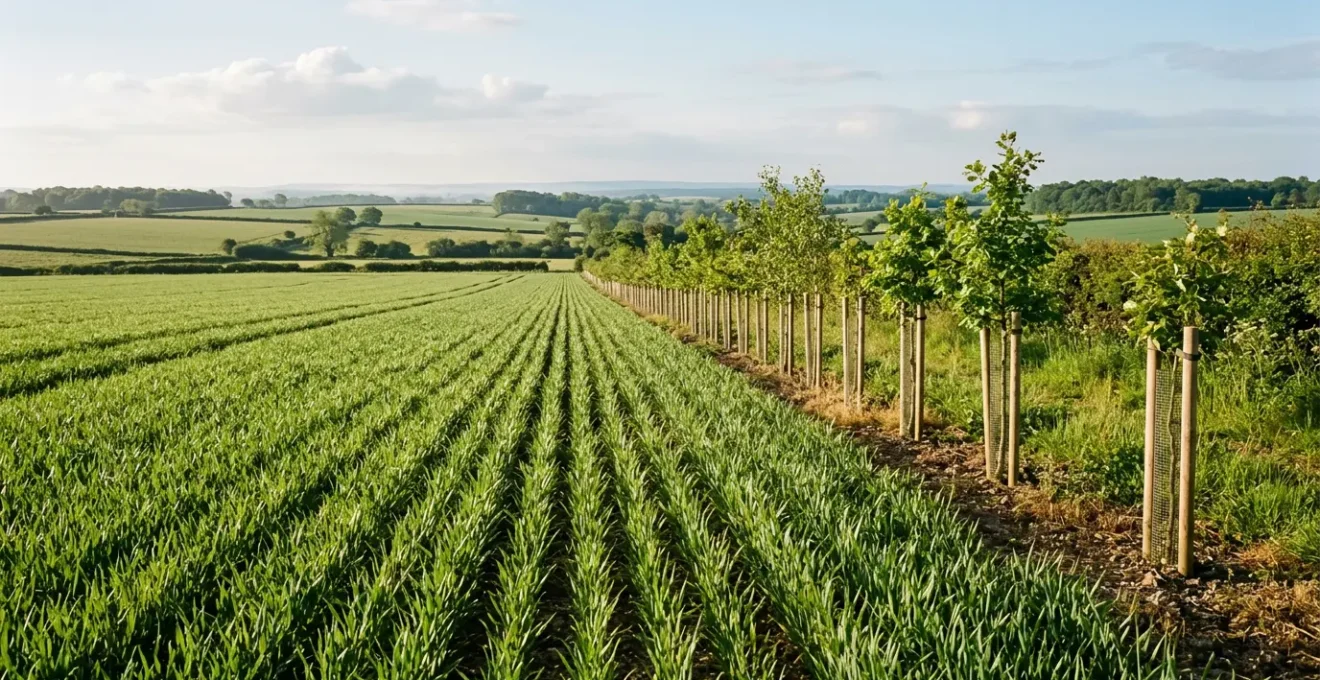
Integrating trees on your farm doesn’t have to mean sacrificing crop yield; it’s a solvable engineering problem.
- Light and water competition are not agricultural inevitabilities but addressable issues of “hydraulic isolation” and “photosynthesis budgeting”.
- System design must be dictated by your existing machinery’s dimensions, not arbitrary spacing, to maintain operational efficiency.
Recommendation: Treat agroforestry as a design challenge. By applying precise, mathematically rigorous principles, you can de-risk the investment and unlock stacked financial and ecological benefits.
For the conventional arable farmer, the idea of planting trees in a perfectly productive field can feel like an act of self-sabotage. The immediate fear is tangible: shadows creeping across a ripening wheat crop, valuable moisture wicked away by thirsty tree roots, and combine harvesters struggling to navigate new, awkward obstacles. The conversation around agroforestry is often dominated by ecological benefits like biodiversity and carbon sequestration, which, while important, don’t pay the bills or calm the nerves of a farmer focused on tonnes per hectare.
The common advice to “choose the right species” or “ensure proper spacing” is often too vague to be actionable. It misses the fundamental point that for a modern farm, integrating trees is not a horticultural project but a complex systems engineering challenge. It requires a shift in mindset: from seeing trees as a yield threat to viewing them as a new, manageable asset class that must be integrated with mathematical precision into an existing, highly-optimised industrial process.
This is where the engineering approach comes in. Instead of fearing shade, we can budget for it. Instead of worrying about water competition, we can design for “hydraulic isolation”. And instead of guessing at layouts, we can use a “machinery-first” design principle. This guide will move beyond the ecological platitudes to provide a rigorous, practical framework for designing an arable agroforestry system that protects your yields, works with your equipment, and aligns with UK financial incentives.
This article provides a detailed roadmap for integrating trees into your arable system with an engineer’s precision. We will deconstruct the key challenges—water, light, machinery, and finance—and offer quantifiable solutions for each. Explore the sections below to build a system that enhances your farm’s resilience without compromising its productivity.
Summary: Planting Trees on Arable Land: An Engineer’s Guide to Eliminating Yield Loss
- Why Root Pruning Is Essential to Stop Trees Stealing Crop Water?
- How to Align Tree Rows North-South to Maintain Crop Photosynthesis?
- Fruit or Timber: Which Tree Crop Fits Better with Arable Operations?
- The Spacing Mistake That Makes Spraying Impossible in Alley Systems
- How to Combine Woodland Creation Grants with BPS on the Same Field?
- Scrub Belts or Flower Margins: Which Connector Scores Higher for Birds?
- How to Break Plough Pans Using Roots Instead of Subsoilers on Heavy Clay?
- How to Design Alley Cropping Systems for Standard UK Combines?
Why Root Pruning Is Essential to Stop Trees Stealing Crop Water?
The primary subsurface conflict between trees and annual crops is the battle for water. Tree roots are perennial, aggressive, and can extend far into the crop alley, intercepting moisture and nutrients intended for your cash crop. Simply planting trees and hoping for the best is a recipe for significant yield drag in the rows closest to the trees, especially on lighter soils or in dry years. The solution is not to avoid trees, but to enforce a clear boundary through a process of “hydraulic isolation” achieved by mechanical root pruning. This involves cutting a narrow trench along the tree line to a specific depth, severing the lateral roots and forcing the tree to draw its resources from the dedicated tree strip.
This isn’t just theory; it’s a proven method to mitigate competition. In fact, research from Nebraska agroforestry systems shows that root pruning can lead to a 3.3% increase in soil water content at a distance of 0.75 times the tree height (H) into the alley. This directly translates to more available water for your crop precisely where competition would be fiercest. The practice also has a secondary benefit, as the microclimate created by the trees can reduce wind speed, which in turn increases the water use efficiency of the crops within the alleys. This creates a more resilient system overall.
As the image demonstrates, this is a targeted, surgical intervention. A specialized blade, often mounted on a subsoiler leg, is run annually or biennially to a depth of 30-60cm. This severs the shallow, competitive roots while leaving the deeper, structural roots intact. However, precision is key, as demonstrated by an important field trial.
A Warning from Uganda: The Limits of One-Sided Pruning
A multi-year study in Uganda on five different tree species provided a crucial insight for system design. When tree roots were pruned only on one side (the crop side), the tree simply compensated by increasing root activity on the unpruned side. While tree growth was minimally affected (a mere 4% reduction in diameter), the competitive effect was not eliminated but merely redistributed. This highlights a critical design principle: for effective hydraulic isolation in a farming context, root pruning must be performed on both sides of the tree line to prevent roots from simply extending further into the next alley. It confirms that half-measures yield limited results.
How to Align Tree Rows North-South to Maintain Crop Photosynthesis?
Once water competition is managed, the next critical factor is light. The fear of shading is the most common objection to agroforestry, and it’s a valid one if not managed through design. The goal is to conduct “photosynthesis budgeting”—a design process that minimises the “cost” of shade on your cash crop while maximising light for both trees and crops. The single most powerful tool for this in temperate climates like the UK is the orientation of your tree rows. By aligning rows on a North-South axis, you synchronise the movement of shade with the sun’s daily path, dramatically reducing the impact on the adjacent crop alleys.
Think of it in terms of solar geometry. During the middle of the day, from late morning to early afternoon, the sun is at its highest and most intense. This is the peak period for crop photosynthesis. With a North-South orientation, the shadows cast by the trees are at their shortest and fall directly within the tree row itself or on the very edge of the alley. The bulk of your crop receives full, direct sunlight when it matters most. In the early morning and late afternoon, when the sun is low, the long shadows will stretch across the alleys, but the light intensity is much lower, so the negative impact on the crop’s total daily energy capture is significantly minimised. Orienting rows East-West, by contrast, would cast a long, slow-moving shadow across the northern alley for the entire day, creating a permanent zone of reduced yield.
This principle is a cornerstone of modern agroforestry design, backed by extensive modelling. As leading researchers confirm, this orientation is fundamental to balancing light distribution. As Donat et al. state in their analysis of the ShadOT modelling tool:
For the maximum reduction of shading effects, a north-south orientation of tree rows is recommended for temperate systems, since the shadow of the tree rows falls into its own row in the most radiation-rich part of the day.
– Donat et al., PMC article on tree row orientation modeling (ShadOT tool)
Ultimately, a North-South alignment is the first and most critical step in designing a light-efficient system. It doesn’t eliminate shading entirely, but it manages it intelligently, ensuring that the “cost” of shade is paid when the “currency” of sunlight is at its lowest value.
Fruit or Timber: Which Tree Crop Fits Better with Arable Operations?
Choosing the right tree is about more than just species; it’s a strategic decision between two fundamentally different business models: short-cycle, high-intensity fruit/nut production versus long-cycle, low-intensity timber production. The “best” fit depends entirely on your farm’s existing operational logistics, your appetite for risk, and your investment timeline. There is no single right answer, only the right answer for your specific context. A conventional arable farmer must analyse this choice not as a gardener, but as an operations manager.
Timber trees, such as walnut, oak, or fast-growing poplar, represent a long-term, low-intensity investment. After the initial establishment phase, management is minimal—often limited to periodic pruning for clear wood and thinning. They integrate seamlessly with arable operations, as their management calendar has virtually no overlap with drilling or harvest. The main operational demand is at the very end of the rotation (20-40+ years). Fruit or nut trees, like chestnuts, apples or pecans, offer a much faster return on investment, with significant harvests possible within 5-10 years. However, this comes at the cost of high operational intensity. They require annual pruning, pest and disease management (often involving specialised sprayers), and a dedicated, time-sensitive harvest. This can create significant logistical conflicts with autumn drilling or other field operations.
The following table, based on extensive analysis, breaks down the operational trade-offs. It is a critical tool for deciding which model aligns with your farm’s capacity and goals, as shown in a comparative analysis of alley cropping systems.
| Criterion | Timber Trees (e.g., Walnut, Oak, Poplar) | Fruit/Nut Trees (e.g., Chestnut, Pecan) |
|---|---|---|
| Revenue Timeline | 20-40 years to harvest; long investment period | 5-10 years to first significant harvest; earlier cash flow |
| Management Intensity | Low; minimal pruning, no spraying after establishment | High; requires seasonal pruning, pest management, fertilization |
| Specialized Equipment | Standard farm equipment sufficient; harvester needed at rotation end | Sprayers (orchard-specific), pruning platforms, harvest crews/shakers |
| Market Risk | Moderate; timber prices stable but market access can be limited | High; fruit prices volatile; strict harvest window; quality-dependent pricing |
| Biological Risk | Low-Moderate; less susceptible to pests; drought tolerant when established | High; frost damage, disease pressure, insect pests require constant monitoring |
| Compatibility with Arable Rotation | High; minimal conflict with planting/harvest schedules | Moderate; fruit harvest may coincide with autumn drilling; spraying windows overlap |
The decision is therefore a strategic one. Timber offers simplicity and low operational drag, making it an excellent “hands-off” diversification for a busy arable unit. Fruit offers faster cash flow but essentially requires adding a whole new, intensive horticultural enterprise to your existing business.
The Spacing Mistake That Makes Spraying Impossible in Alley Systems
The single most catastrophic and irreversible error in designing an alley cropping system is getting the spacing wrong. This mistake isn’t about being off by a few centimetres; it’s about a fundamental failure to apply a “machinery-first” design principle. Many agroforestry plans are drawn up with arbitrary, neat-looking numbers—like 20 or 30 metres—that have no relationship to the operational widths of the farm’s actual equipment. The result is operational chaos: partial sprayer passes, excessive overlap, wasted inputs, increased field time, and immense frustration for the operator.
The golden rule is simple: alley width must be an exact multiple of your widest implement’s working width. If your sprayer boom is 24m, your alleys must be 24m, 48m, or 72m. If your combine header is 12m, a 48m alley allows for exactly four passes. This eliminates partial passes and ensures every square metre of the alley is covered efficiently. You must design for the widest piece of equipment you own or plan to own in the next 15 years. It’s far easier to make two passes with a 24m sprayer in a 48m alley than it is to navigate a 30m alley, which would require one full pass and a wasteful, awkward 6m partial pass.
The second component of spacing is the headland. It’s often dramatically underestimated. A 20-tonne combine with a 12m header needs a significant amount of space to turn safely and efficiently without compacting the crop or, worse, hitting a tree. A rough formula is to take the total length of your longest rig (e.g., tractor + seeder) and multiply it by 1.5 to get a minimum turning radius, then add a 2-3 metre buffer from the tree line. For large UK equipment, this often means headlands of 15 to 20 metres are required. Skimping on headlands creates a daily operational bottleneck that will cost far more in lost time and efficiency than the small area of land “saved”.
Finally, consider the vertical dimension. A mature tree canopy can interfere with GPS signals, creating “dead zones” for auto-steer systems. It’s wise to plan for a 1-2 metre buffer strip next to the trees where operators may need to switch to manual control. You must also account for the maximum operating height of your equipment, like the combine’s grain auger, and ensure your tree pruning plan maintains at least a metre of clearance at full tree maturity.
How to Combine Woodland Creation Grants with BPS on the Same Field?
A significant barrier to agroforestry adoption is the perceived financial hit: taking land out of production and potentially losing eligibility for farm payments. However, in the UK, the current grant landscape is specifically designed to overcome this through a strategy of “financial stacking.” It is now possible to receive payments for establishing trees while continuing to claim the equivalent of Basic Payments (under the new SFI schemes) on the same parcel of land. This transforms the financial model from a cost-centre into a multi-layered revenue stream.
The key is to understand the different thresholds and schemes. For large-scale tree planting, the England Woodland Creation Offer (EWCO) provides extremely generous funding, offering up to £10,200 per hectare for capital costs, which can be stacked with additional payments for public benefits (like biodiversity or water quality) up to a further £12,700. While traditionally for dedicated woodland blocks, these grants can be used for wide-spaced agroforestry or blocks of trees on less productive parts of a field, such as steep banks or awkward corners.
The real game-changer is how these grants interact with the Sustainable Farming Incentive (SFI). The SFI includes specific actions for in-field agroforestry that allow the land to remain classified as “agricultural,” and thus eligible for ongoing annual payments. This creates a powerful financial synergy.
Financial Stacking in Practice: The SFI Agroforestry Scheme
The UK’s Sustainable Farming Incentive (SFI) offers a direct route to funded in-field agroforestry. The scheme pays farmers an annual rate for maintaining trees in arable or pasture fields. For instance, the very low-density option offers £248 per hectare per year, specifically designed to allow farmers to continue receiving their main agricultural payments on that land. For slightly denser systems, the rate increases to £385 per hectare. Crucially, a farmer can use an EWCO grant to fund the establishment of a woodland block on one part of their holding, while simultaneously enrolling the main arable fields into the SFI agroforestry scheme. This “stacking” on a single holding, though on different parcels, allows a farmer to draw from multiple government funding streams, effectively getting paid to establish the capital asset (the trees) and then receiving an annual payment to maintain it, all while continuing to farm the land and receive their core agricultural subsidies.
Scrub Belts or Flower Margins: Which Connector Scores Higher for Birds?
While the primary focus of agroforestry design for an arable farmer is agronomic and economic, the biodiversity benefits are a significant co-benefit, often with financial incentives attached. When designing habitat connectors like headlands or buffer strips, a common question is whether to plant scrub belts or flower-rich margins. For bird populations, the answer is clear: scrub belts provide a far greater value. While both are beneficial, they serve different ecological functions, and scrub offers the critical elements that birds need for survival and reproduction.
Flower-rich margins are excellent for pollinators and provide a source of insect and seed food for some bird species, particularly finches and buntings, during certain times of the year. Their primary value is as a foraging resource. However, their low structural complexity means they offer little in the way of shelter from predators or harsh weather, and they provide few, if any, suitable nesting sites for most farmland bird species. They are a valuable component, but they are only one piece of the puzzle.
Scrub belts, on the other hand, provide three-dimensional structure. A mix of thorny shrubs like hawthorn and blackthorn, interspersed with taller saplings, creates a complex habitat that offers:
- Nesting Sites: The dense, thorny structure provides safe, predator-proof locations for species like Dunnock, Yellowhammer, and Linnet to build their nests.
- Shelter and Refuge: The thick cover is an essential escape route from predators like sparrowhawks and a vital thermal refuge during cold winter months.
- Year-Round Food: Scrub provides a sequence of food sources, from insects in the spring and summer to berries and hips in the autumn and winter, offering a more reliable food supply than the seasonal boom-and-bust of an annual flower margin.
A truly optimal design would integrate both: a central scrub belt for structure and safety, flanked by flower-rich margins for additional foraging. But if forced to choose one for maximising avian biodiversity, the structural complexity and year-round resources of a scrub belt make it the superior option.
How to Break Plough Pans Using Roots Instead of Subsoilers on Heavy Clay?
On heavy clay soils, plough pans and other compaction layers are a chronic problem, impeding drainage, restricting root growth, and costing a fortune in diesel and steel to remedy with subsoilers. Agroforestry offers a biological solution: “root engineering”. This is the strategic use of deep-rooting trees to create permanent biological channels through compacted layers, performing the work of a subsoiler every single day, for free. The deep, powerful taproots of certain tree species act as natural drills, punching through dense soil layers that annual crop roots cannot penetrate.
When these roots die back and decompose, they leave behind stable, macropore channels lined with organic matter. These channels become superhighways for water infiltration and aeration, and they provide easy pathways for subsequent crop roots to explore deeper into the soil profile. This improves the drought resilience of your entire system. Species like oak, wild cherry, and even certain poplar clones are excellent candidates for this role. Their root systems are designed by nature to anchor massive structures, and in doing so, they perform a valuable tillage service. The power of this biological action is immense and persistent.
Even when managed with root pruning, the vertical root development can be substantial. For instance, studies on acacia hedgerows demonstrate that tree roots pruned at a depth of 0.3m showed vigorous regrowth and could recolonise the soil profile within a single season. This demonstrates their incredible capacity to explore and structure the soil. By planting trees, you are essentially installing a permanent, self-maintaining deep-tillage system. Over years, this “root engineering” can fundamentally transform the structure of a heavy clay soil, increasing its friability and workability far more effectively and sustainably than periodic, fossil-fuel-intensive mechanical intervention.
This process of biological decompaction is a long-term investment in your farm’s foundational asset: its soil. It reduces your reliance on heavy machinery, cuts fuel costs, and builds a more resilient and productive soil structure from the ground up.
Key takeaways
- Hydraulic Isolation: Actively manage water competition by severing lateral tree roots with annual root pruning to protect crop moisture.
- Photosynthesis Budgeting: Align tree rows North-South to ensure shadows fall within the tree line during peak sunlight, maximising light for your cash crop.
- Financial Stacking: Design your system to be eligible for both SFI agroforestry payments and EWCO establishment grants to create multiple revenue streams on the same holding.
How to Design Alley Cropping Systems for Standard UK Combines?
We’ve established the core principles of water, light, and finance. Now we arrive at the most practical and irreversible stage: final system design, tailored for the realities of UK farming equipment. This is where the “machinery-first” approach becomes a non-negotiable blueprint. The layout you commit to will define your operational efficiency for decades. The goal is to create a system that your current and future fleet of machines can navigate with zero compromise. It requires rigorous measurement and calculation, not guesswork.
The entire design process must be driven by the dimensions of your largest machinery—typically your sprayer or combine. This determines everything from alley width to headland size. The objective is to eliminate inefficiencies like partial passes and tight turns that waste time, fuel, and inputs, and increase operator stress. An agroforestry system should feel like it was always meant to be there, not like an obstacle course. This involves a simple, but strict, set of design steps that translate your equipment’s physical footprint into a functional and efficient field layout.
A poorly designed system can inflict a permanent 5-10% efficiency penalty through wasted inputs from overlaps and increased turning times. Modelling these “shadow costs” is crucial. Using farm telematics data, you can quantify the financial penalty of non-optimal layouts. For example, a 5% overlap on a 100-hectare field can easily cost over £1,000 annually in wasted seed and fertiliser alone, a cost that recurs every single year. A correctly designed system avoids this from day one.
Your Action Plan: Designing for Standard UK Machinery
- Measure Your Widest Implement: Record the precise working width of your combine header, sprayer boom, and seeder. Use the largest of these measurements as your “base unit” for all calculations.
- Apply the ‘Multiple Rule’ for Alleys: Calculate your alley width as a direct multiple of your base unit (Alley Width = Base Unit × N, where N is a whole number like 2, 3, or 4). For a 36m sprayer, alleys must be 36m or 72m. This guarantees zero partial passes.
- Calculate Headland Space: Determine your minimum headland width using the formula: (Tractor Length + Implement Length + 3m Buffer) × 1.5. For a large UK combine, this will likely require a minimum of 15-18 metres for a comfortable, efficient turn.
- Map GPS Buffer Zones: Designate and map 1-2m “manual control strips” adjacent to the tree lines. This acknowledges that GPS signal reliability can degrade near a mature canopy and prepares operators for it.
- Quantify the Cost of Inefficiency: Before finalising, use your farm data to model the annual cost of a 5% input overlap. This figure will powerfully demonstrate the long-term financial value of getting the layout right from the start.
By shifting from a mindset of ecological compromise to one of rigorous engineering design, you can integrate trees into your arable system in a way that is not only agronomically sound and operationally efficient but also financially astute. The next logical step is to take these principles and begin mapping them onto your own fields. Start by measuring your equipment and identifying the less productive areas that could serve as the initial template for your new, resilient, and diversified farm landscape.