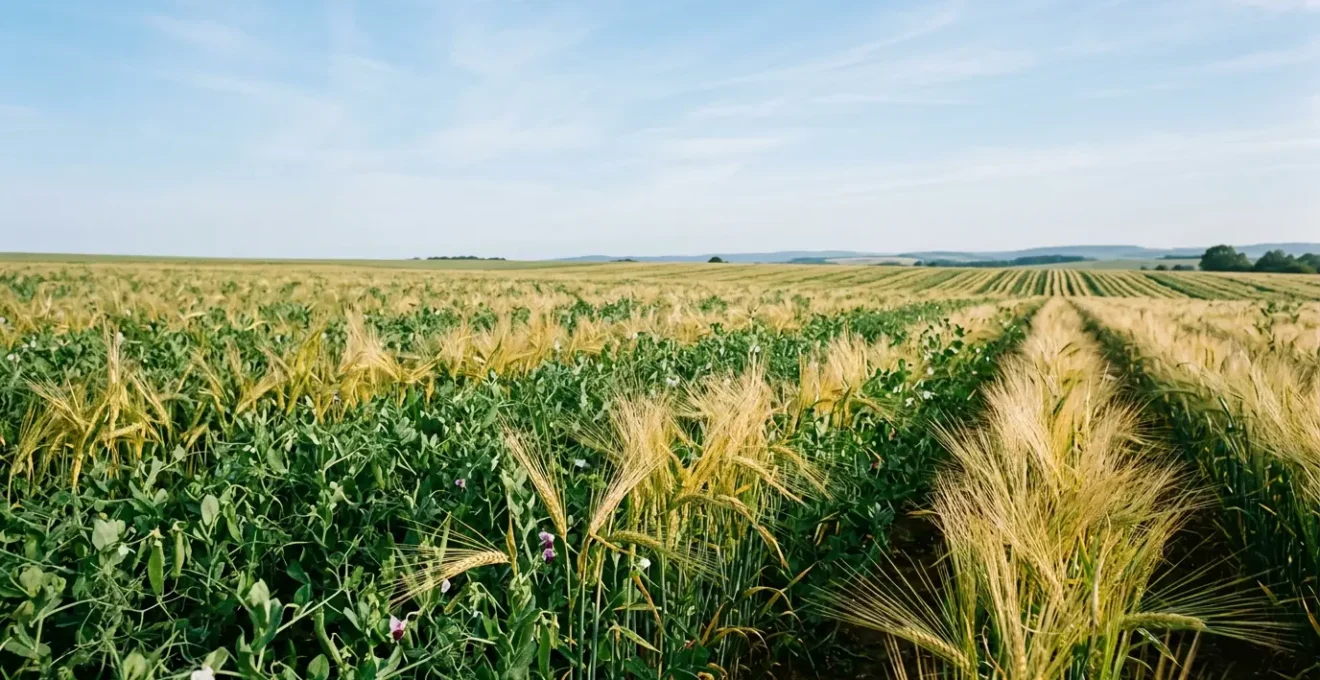
Intercropping pea and barley is more than just mixed planting; it’s a field-scale protein factory that can significantly reduce reliance on purchased feed and synthetic fertilizers.
- By leveraging natural nitrogen fixation and competitive growth, this system produces high-protein silage with a superior land equivalent ratio.
- Success hinges on engineering the system correctly: from seed ratios and harvest timing to non-chemical weed control and closing the nutrient loop with manure.
Recommendation: Adopt a systems-thinking approach, viewing the intercrop not as a single crop, but as an integrated part of your farm’s entire nutrient and feed cycle to maximize profitability.
For livestock farmers, the relentless rise in feed prices, particularly for protein supplements like soya, is a constant pressure on the bottom line. The conventional response is to seek out cheaper suppliers or absorb the cost, but this strategy offers little long-term security. Many agricultural advisors suggest diversifying crops or improving soil health with vague promises of resilience, often overlooking the core economic problem: the farm’s dependence on external inputs for protein and nitrogen.
But what if the solution wasn’t about finding a cheaper external source, but about creating an internal one? What if a field could be engineered to function as its own self-sufficient protein factory, capturing nitrogen from the air and converting it into high-quality animal feed? This is the promise of pea and barley intercropping, but its success isn’t magic; it’s a matter of precise agronomic engineering. It moves beyond simply planting two crops together and into the realm of managing a complex, symbiotic ecosystem for maximum output.
This article deconstructs that system. We will move from the fundamental science of nitrogen fixation to the practical engineering of seed ratios, harvest timing, and weed control. Finally, we’ll close the loop, demonstrating how to integrate livestock manure back into the system to create a truly sustainable and profitable on-farm nitrogen cycle. It’s a blueprint for turning a simple field into a powerhouse of home-grown protein.
To navigate this comprehensive guide, the following summary outlines the key engineering and management points we will cover, from the biological engine of the system to closing the farm’s nutrient loop.
Summary: Pea and Barley Intercropping: A System for On-Farm Protein
- Why Legumes Fix More Nitrogen When Planted Next to Cereals?
- How to Separate Mixed Grains Cheaply If You Don’t Have a Rotary Cleaner?
- 50:50 or 70:30: Which Seed Ratio Prevents Barley from Smothering Peas?
- The Harvest Timing Mistake That Leads to Mouldy Peas in the Clamp
- How to Control Broadleaf Weeds in a Cereal-Legume Mix Without Sprays?
- How Buckwheat Root Exudates Solubilize Phosphate for the Next Crop?
- Why Your Muck Heap Is Worth £20 Per Tonne in Fertilizer Value?
- How to Close the Nitrogen Loop Using Livestock Manure Effectively?
Why Legumes Fix More Nitrogen When Planted Next to Cereals?
The core principle behind a pea-barley intercrop is a concept known as ‘facilitation’. It seems counterintuitive: wouldn’t two plants compete for resources? While they do, the dynamic creates a net benefit. The barley, being a nitrogen-hungry cereal, rapidly scavenges available nitrogen from the soil. This creates a low-nitrogen environment around the pea roots. In response, the symbiotic rhizobia bacteria on the pea roots are triggered to work overtime, fixing vast amounts of atmospheric nitrogen (N₂) to compensate. Essentially, the barley’s “greed” forces the pea to become a more efficient nitrogen factory.
This process goes beyond simple root-level interactions. Beneath the soil surface, a vast, invisible network is at play. The plants’ root systems are interconnected by arbuscular mycorrhizal fungi (AMF), forming a common mycelial network. This network acts as a subterranean trading highway, transferring nutrients between the two species. The barley, with its extensive fibrous root system, is adept at exploring the soil for phosphorus (P) and other nutrients, which can then be shared with the pea plant via this fungal bridge. In return, the pea provides a surplus of fixed nitrogen to the network, some of which benefits the barley.
This underground economy makes the entire system more efficient than a monoculture. The plants aren’t just co-existing; they are engaged in a managed, competitive partnership that drives the pea’s nitrogen fixation to its maximum potential. The result is a higher total biomass and protein yield from the same parcel of land, without the need for synthetic nitrogen fertilizer, which is the foundational principle of a successful land equivalent ratio (LER).
How to Separate Mixed Grains Cheaply If You Don’t Have a Rotary Cleaner?
One of the primary logistical hurdles for farmers considering a pea-barley intercrop for grain is the separation process. Commercial rotary cleaners are expensive and may not be a viable investment for smaller-scale operations. However, the physical differences between the round, heavy pea seed and the oblong, lighter barley grain lend themselves to several effective, low-cost separation methods. The key is to leverage physics—gravity, shape, and aerodynamics—rather than expensive machinery.
For those committed to separation, several DIY or low-tech options exist. Spiral separators, for example, use gravity and the different rolling characteristics of the seeds to achieve separation. As the mix flows down a series of spiral flights, the round peas gain more momentum and are thrown to an outer channel, while the barley grains slide more slowly and remain in an inner channel. Alternatively, a homemade air screen cleaner can be constructed with basic workshop materials to separate seeds based on weight. For farmers willing to forego separation altogether, the most cost-effective solution is to utilize the crop as a whole-mix feed, which can be formulated directly into a balanced TMR (Total Mixed Ration) for livestock.
It’s also worth noting that in some regions, a commercial solution may be accessible without capital investment. For instance, in Switzerland, grain handlers offer commercial separation services for complex mixes, handling up to three crop components simultaneously. This provides a valuable service for farmers who want the benefits of intercropping without the on-farm processing challenges. This option highlights a potential business model for co-operatives or contractors in other regions.
Action Plan: Low-Tech Grain Separation Methods
- Spiral Separator Method: Use gravity to channel seed through spiral columns, which separate round pea seeds from oblong barley grains based on shape differences.
- DIY Air Screen Method: Construct a simple air-powered cleaner using a bucket, rod, chain section, and electric drill to separate crops based on weight and aerodynamic properties.
- Fanning Mill Winnowing: Employ traditional hand-winnowing with a box fan set to multiple speeds, adjusting airflow to separate lighter chaff while retaining heavier viable seeds.
- Direct Mixed-Feed Strategy: Skip separation entirely by formulating a complete on-farm livestock ration using the high-protein pea/barley blend, eliminating need for expensive protein supplements.
50:50 or 70:30: Which Seed Ratio Prevents Barley from Smothering Peas?
Determining the correct seeding ratio is the most critical engineering decision in a pea-barley system. It’s not a simple case of mixing seeds 50:50. The goal is to create a ‘competitive balance’ where the barley provides structural support to the vining pea, preventing lodging, but doesn’t grow so aggressively that it outcompetes the pea for light and smothers it. The ideal ratio is not a fixed number but a function of your goal, variety choice, and local conditions.
A valuable starting point comes from extensive field trials. An influential Swiss Organic Farming Pea-Barley Ratio Study established a practical baseline by combining 80% of the normal pea seeding density with 40% of the normal barley density. This 80:40 approach, tested from 2009-2015, consistently produced stable yields and a good balance, with the final harvested pea proportion varying based on the season. The key was pairing semi-leafless, short-stemmed pea varieties with barley, which provided a trellis-like structure without excessive shading.
The optimal ratio is ultimately a strategic choice based on your primary objective, whether it’s maximizing protein for silage or producing a balanced grain mix. The following table breaks down the trade-offs of different strategies, based on a comprehensive analysis of pea-barley seeding ratios.
| Seeding Ratio (Pea:Barley) | Primary Advantage | Risk Factor | Recommended Use Case |
|---|---|---|---|
| 80:40 (High Pea) | Maximum protein content and N-fixation | Increased lodging risk in wet conditions | Organic systems targeting high-protein silage |
| 50:50 (Balanced) | Stable yield across variable conditions | Moderate protein dilution from barley | Mixed grain harvest for on-farm feed |
| 40:60 (High Barley) | Maximum cereal yield and structural support | Lower overall protein percentage | Commercial grain sale with minimal pea content |
Ultimately, starting with an 80:40 (Pea:Barley) ratio based on monoculture rates is a scientifically-backed approach for high-protein forage goals. Farmers should then be prepared to adjust this in subsequent years based on observed performance and specific field conditions.
The Harvest Timing Mistake That Leads to Mouldy Peas in the Clamp
Harvesting a pea-barley mix for silage is a high-stakes balancing act. The single most common and costly mistake is timing the harvest based on the barley alone, leading to immature, high-moisture peas entering the clamp. This creates a perfect storm for spoilage, undermining the very protein and energy you’ve worked all season to produce. As experts from the Practical Farmers of Iowa explain, it’s a disastrous combination.
The combination of high moisture from immature peas and the hollow stems of barley traps oxygen, which prevents the necessary anaerobic fermentation and instead fuels the growth of mould and yeast, burning off valuable protein and energy.
– Practical Farmers of Iowa – Small Grains Research, Small Grains Equipment Essentials Guide
When the clamp fails to achieve a rapid drop in pH to below 4.2, aerobic spoilage organisms thrive. This not only results in visible mould but also burns off the most digestible nutrients, leaving you with a feed that is lower in both energy and protein. The key is to monitor both crops and target a harvest window where their moisture contents are compatible for successful ensiling. This often means harvesting when the barley might seem slightly past its prime for a monoculture crop, to allow the peas to reach the correct stage.
To avoid this critical error, a multi-indicator approach is necessary. Relying on a single visual cue is risky. Instead, a combination of moisture targets, visual indicators for both crops, and post-cutting management will ensure a stable, high-quality fermentation. The following checklist outlines a professional protocol for timing the harvest perfectly.
Action Plan: Harvest Timing Checklist for Pea-Barley Silage
- Target Moisture Content: Harvest when barley reaches 35-40% moisture content (hard dough stage) while peas are at 40-45% moisture to achieve compatible ensiling conditions.
- Visual Cue – Barley: Monitor barley heads for the hard dough stage, where kernels resist thumbnail pressure but show no milky liquid when squeezed.
- Visual Cue – Peas: Check for a specific pod color transition from bright green to a lighter green-yellow, with seeds filling the pods but not yet fully hardened.
- Wilting Strategy: Cut the crop and allow 24-48 hours of field wilting in a swath to equalize moisture content between species before chopping, preventing oxygen pockets.
- Inoculant Application: Apply a legume-cereal specific silage inoculant immediately at chopping to accelerate the pH drop and inhibit mould growth.
How to Control Broadleaf Weeds in a Cereal-Legume Mix Without Sprays?
The inability to use broadleaf herbicides is often cited as a major drawback of intercropping peas and barley. However, a well-managed intercrop can be a powerful tool for weed suppression in its own right, often eliminating the need for chemical intervention. The strategy shifts from chemical control to cultural control, using crop competition as the primary weapon. The principle is simple: create a dense, vigorous crop canopy that closes quickly, starving emerging weeds of sunlight.
This isn’t just theory; it’s backed by research. Canadian organic farming research confirmed that field pea intercrops with barley significantly reduced weed biomass compared to pea monoculture. The combination of the barley’s early ground cover and the pea’s later climbing growth creates a multi-layered canopy that is highly effective at intercepting light. To maximize this effect, several non-chemical techniques can be combined into a robust strategy.
The goal is to give the crop every possible advantage over the weeds from day one. This involves pre-planting preparation to reduce the initial weed seed bank, followed by planting techniques that promote rapid canopy closure. Mechanical options can also be used, but their timing is critical to avoid damaging the more sensitive pea crop. A successful non-chemical approach is a multi-pronged attack, not a single solution.
Action Plan: Non-Chemical Weed Control Strategy
- False Seedbed Preparation: Cultivate the seedbed 2-3 weeks before planting to stimulate a flush of weed germination, then destroy these emerged weeds with shallow cultivation immediately before drilling the intercrop.
- Canopy Competition Maximization: Increase the overall seeding rate by 10-15% above standard rates and reduce row spacing to achieve rapid canopy closure. Select aggressive tillering barley varieties.
- Tine Weeder Timing: If available, deploy a flexible-tine harrow when the barley reaches the 3-leaf stage but before the pea vines begin extensive growth, to control weeds in their white-thread stage with minimal crop damage.
- Cross-Seeding Pattern: Consider drilling half the seed mixture in one direction, then the remaining half perpendicularly to create a dense, multi-directional canopy that intercepts light more effectively.
How Buckwheat Root Exudates Solubilize Phosphate for the Next Crop?
While the pea-barley mix is a powerhouse for nitrogen, a truly resilient farm system must also manage other key nutrients, particularly phosphorus (P). Phosphorus is often locked up in the soil, bound to minerals like calcium, making it unavailable to plants. This is where strategic crop rotation, incorporating “scavenger” crops like buckwheat, becomes a vital part of the system’s engineering. Buckwheat is not just a cover crop; it’s an active biological tool for unlocking soil-bound nutrients.
The mechanism is a fascinating piece of plant chemistry. Buckwheat roots release powerful organic acids into the soil, a process explained in detail by soil scientists. As noted in research on plant-soil interactions, this is a chelation process.
Buckwheat roots exude primarily citric and oxalic acid which perform chelation by binding to cations like calcium, iron, and aluminum that lock up phosphate in the soil, thereby releasing phosphate ions into a plant-available form.
– Common Mycorrhizal Network Research, PLOS One Article on Arbuscular Mycorrhizal Fungi Nutrient Transfer
By planting buckwheat as a catch crop after the pea-barley harvest, you are effectively “priming” the soil for the next crop in the rotation. The solubilized phosphorus remains in the soil profile, available for uptake. This synergy is further enhanced by a healthy soil microbiome. For instance, Canadian prairie research demonstrated that arbuscular mycorrhizal fungi increased phosphorus and nitrogen uptake by 2.3 times in organic wheat. A system that combines nutrient-mobilizing crops like buckwheat with practices that foster a healthy fungal network creates a powerful engine for nutrient cycling, reducing the need for purchased P fertilizers.
Key Takeaways
- Intercropping success is not accidental; it requires ‘engineering’ the competitive balance between peas and barley, typically starting with an 80:40 seed ratio.
- The biggest risk is silage spoilage. Harvest must be timed for pea moisture content, not just barley, to prevent mould and nutrient loss in the clamp.
- A closed-loop system is the ultimate goal: using the high-protein forage to feed livestock, then returning composted manure to non-legume crops to complete the nitrogen cycle.
Why Your Muck Heap Is Worth £20 Per Tonne in Fertilizer Value?
In a closed-loop system, livestock manure is not waste; it is a critical asset. The muck heap is the battery pack of the farm’s nutrient cycle, storing the nitrogen, phosphorus, and potassium processed by your animals. Assigning a financial value to this resource is essential for making sound management decisions. While the exact value fluctuates with synthetic fertilizer prices, a conservative estimate often places the nutrient value of cattle manure at around £20 per tonne, and it can be significantly higher for nutrient-dense poultry manure.
This value is derived from its content of the three major plant nutrients: Nitrogen (N), Phosphate (P₂O₅), and Potash (K₂O). However, not all manure is created equal. The nutrient content varies significantly based on the livestock type, the bedding material used, and the method of storage. For example, poultry manure is far more concentrated in nitrogen and phosphorus than cattle farmyard manure (FYM). Furthermore, composting manure, while it involves some initial nitrogen loss, creates a more stable, slow-release product that improves soil structure and biology.
The following table, with data synthesized from agronomic reviews on legume-cereal intercropping, provides a breakdown of the typical available nutrient content from different manure sources, illustrating why it is such a valuable on-farm resource.
| Manure Source | Available N (kg/tonne) | P₂O₅ (kg/tonne) | K₂O (kg/tonne) | Additional Benefits |
|---|---|---|---|---|
| Cattle (Straw Bedding) | 3-6 | 2-4 | 8-12 | High organic matter, improves soil structure |
| Poultry (Deep Litter) | 15-25 | 12-20 | 10-15 | Rapid nutrient availability, higher micronutrient content |
| Composted Heap | 6-10 | 4-7 | 10-14 | Stabilized nitrogen, reduced ammonia loss, enhanced microbial activity |
| Slurry Lagoon | 2-4 | 1-3 | 4-8 | Liquid application ease, faster nutrient release |
Viewing the muck heap through this financial lens transforms it from a disposal problem into a key component of your farm’s fertility program. By analyzing and understanding its content, you can strategically reduce your reliance on expensive, imported synthetic fertilizers.
How to Close the Nitrogen Loop Using Livestock Manure Effectively?
Closing the nitrogen loop is the final step in engineering a truly self-sufficient farm system. It involves taking the nitrogen fixed from the atmosphere by the pea-barley crop, feeding it to livestock, and then strategically returning the nitrogen excreted in manure back to the fields to grow the next crop. However, effective implementation is more nuanced than simply spreading muck on the nearest field. The wrong application can be counterproductive, wasting nutrients and even inhibiting the very process you want to encourage.
The most critical principle is to avoid applying high-nitrogen manure directly before planting another legume-cereal mix. As research on grain legume intercropping revealed, high available nitrogen in the soil from a recent manure application inhibits the pea’s nitrogen-fixing symbiosis. The plant will preferentially take up the “easy” nitrogen from the soil rather than expending energy to fix it from the atmosphere. This negates one of the primary benefits of the intercrop. The most effective strategy is to apply the composted manure to a heavy-feeding, non-legume crop in the rotation, such as a field of wheat or maize, where its full nutrient value can be utilized without compromise.
To maximize the efficiency of this cycle, a systematic approach is required, from growing the crop to the final application of the composted manure. It’s a five-step process that ensures minimal nutrient loss and maximum benefit at each stage.
Your Action Plan: Closing the Farm’s Nitrogen Loop
- Grow High-Protein Forage: Grow a pea-barley intercrop targeting high land productivity and a protein content of 130-137 g/kg dry matter for top-quality silage.
- Feed for Production: Feed the high-protein silage to livestock, allowing animals to efficiently process the nitrogen-rich forage without the need for imported protein supplements.
- Compost to Stabilize: Compost the resulting manure with high carbon materials (like straw) to stabilize nitrogen, reducing ammonia volatilization losses and creating a balanced fertilizer.
- Apply Strategically: Apply the composted manure to a heavy-feeding cereal crop (e.g., wheat, maize) in the rotation, NOT directly before the next pea-barley crop, to avoid inhibiting nitrogen fixation.
- Incorporate Rapidly: Use shallow disc injection or incorporate the manure within 24 hours of application, preferably during cool, damp weather, to maximize nitrogen retention in the soil.
By adopting this complete system—from engineering the crop in the field to managing the nutrient cycle back to the soil—you transform your farm from a consumer of expensive inputs into a self-reliant producer of high-value protein. It’s a strategic shift that builds both economic and ecological resilience for the long term.