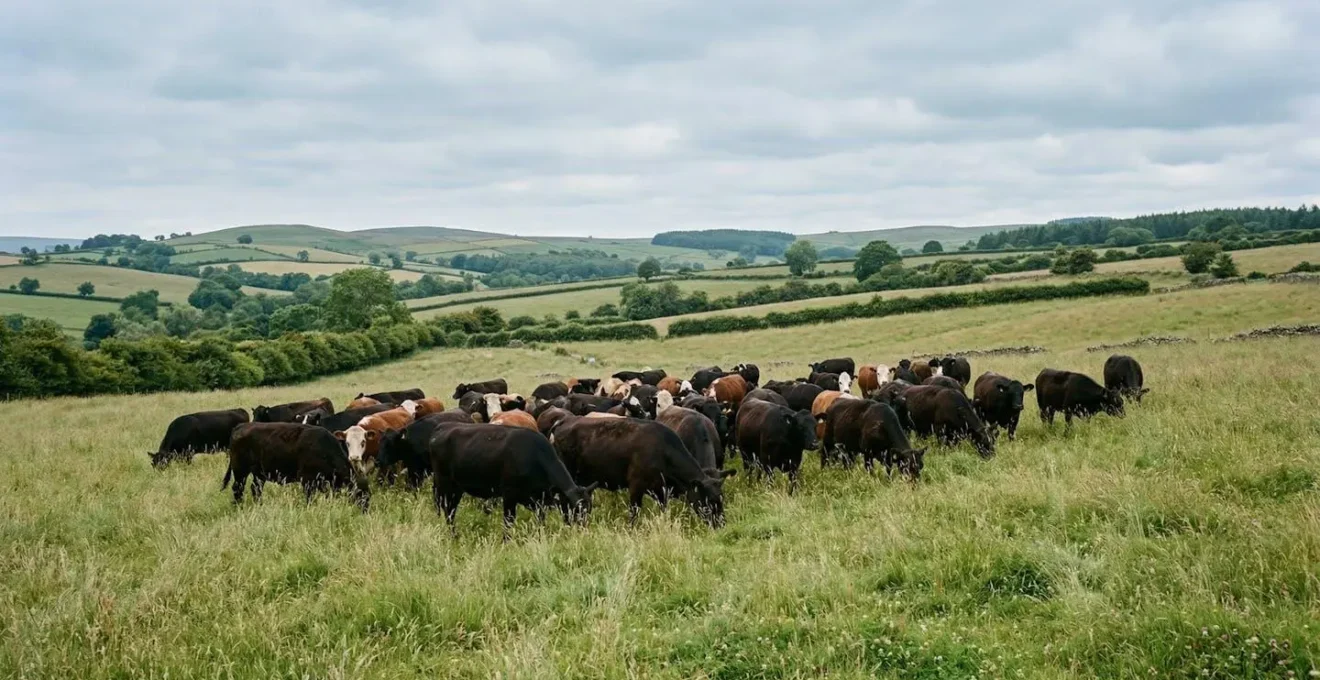
For UK beef farmers, mob grazing consistently outperforms set stocking in both pasture regeneration and profitability, often paying back initial infrastructure costs in as little as one season.
- Real-world UK trials show Daily Live Weight Gain (DLWG) increases of up to 0.4kg/day in mob-grazed cattle.
- Soil organic matter can triple in a decade, drastically improving water retention and pasture resilience.
- Outwintering on stockpiled grass can eliminate up to five months of winter housing costs.
Recommendation: Start with a small-scale trial on a single field to master the ’20-minute paddock shift’ and measure the tangible results for your own operation before scaling up.
As a UK beef farmer, you’ve likely stood at the gate, looking at a pasture that seems to have hit a plateau. The grass growth isn’t what it used to be, and you’re wondering if all the buzz around “regenerative agriculture” and “mob grazing” is just another trend, or if there’s something to it. You hear the talk of “mimicking nature,” but your bottom line depends on tangible results like Daily Live Weight Gain and finishing dates. The idea of moving fences every single day feels like a huge investment of time and effort for an unproven benefit.
The common advice is often too simplistic. You’re told set stocking is “bad” and high-density grazing is “good,” without a practical roadmap for the realities of a UK farm. This thinking misses the fundamental point. The true power of planned grazing isn’t about ideology; it’s about mastering the levers of biology. It’s about understanding that pasture health isn’t dictated by the number of animals, but by the time plants are exposed to them and, crucially, the time they are allowed to recover.
This article moves beyond the abstract concepts to provide a practical, evidence-based guide for the skeptical UK farmer. We will demonstrate that adopting a mob grazing system is a calculated business decision that improves your land’s core productivity and resilience. We’ll break down the what, why, and how—from the science of grass recovery to the economics of animal performance—to show you how to regenerate your pastures faster and build a more profitable, future-proof farm.
To navigate this comprehensive analysis, we will explore the core principles and practical applications of mob grazing within the UK context. The following sections will provide a step-by-step examination of the system’s impact on your pasture, your animals, and your finances.
Summary: A UK Farmer’s Practical Guide to Mob Grazing
- Why Overgrazing Is a Function of Time, Not Animal Numbers?
- How to Set Up Electric Fencing for Daily Moves in Under 20 Minutes?
- DLWG on Tall Grass: Does Mob Grazing Finish Cattle as Fast as Ryegrass?
- The Worming Error That Kills Dung Beetles and Stalls Decomposition
- How to Bale Graze Through a Wet January Without Poaching the Field?
- Cactus Guards or Electric Fencing: Which Protects Saplings from Curious Heifers?
- Why Straw Incorporation Alone Won’t Build Stable Humus Rapidly?
- Reducing Heat Stress in Dairy Cattle: The ROI of Planting Shelter Belts?
Why Overgrazing Is a Function of Time, Not Animal Numbers?
The single most important principle to grasp in planned grazing is this: overgrazing is a function of time, not animal numbers. A single cow left in a field for months can cause more damage than a hundred cows that are there for just one day. The damage happens when a plant, trying to regrow after being bitten, is grazed again before it has fully recovered its root reserves. This second bite is what weakens the plant, thins the sward, and allows weeds to establish. Set stocking, where animals have continuous access to the entire pasture, makes this selective re-grazing of the tastiest plants almost inevitable.
The key is controlling time. Specifically, the recovery period. The speed of grass regrowth varies dramatically with the seasons in the UK. For instance, in May, perennial ryegrass produces a new leaf every 4-5 days, meaning a full recovery might take 20-30 days. In midwinter, however, it can take 30 days to produce a single new leaf, demanding rest periods of 90 days or more. Mob grazing forces you to manage this by moving animals based on the grass’s recovery, not a fixed schedule, ensuring each plant has the time it needs to rebuild.
This management of time and density creates a cascade of positive effects. The high stock density for a short period encourages cattle to eat everything, not just the “ice cream” plants, leading to a more even grazing pressure. More importantly, their hooves trample a significant portion of the remaining forage onto the soil surface, creating a protective “armour” that feeds soil life and conserves moisture. This process is the engine of biological compounding. In a compelling UK example, farmer Tom Chapman has practiced mob grazing since 2010. His system, which involves daily moves and 40-100 day recovery periods, has resulted in fields with up to 10% organic matter, compared to just 3.5% in adjacent set-stocked fields. This is not just a number; it represents a fundamental shift in the pasture’s ability to hold water, resist drought, and produce abundant forage.
How to Set Up Electric Fencing for Daily Moves in Under 20 Minutes?
The biggest perceived barrier to mob grazing is the labour of daily fencing. The reality is that with the right system, a daily paddock shift becomes a routine, 20-minute task. The key is investing in lightweight, modern equipment designed for portability. This isn’t about building permanent fences; it’s about creating a flexible, temporary infrastructure that works for you. This is “grazing as an infrastructure investment,” and it pays dividends quickly.
As the image shows, the process involves simple, step-in posts and geared reels that allow you to put up and take down a fence line in minutes. The Balcaskie Estate in Fife, Scotland provides a powerful case study. They invested approximately £8,000 in electric fencing and mobile water infrastructure to establish their system. This initial outlay enabled them to outwinter their cattle, saving five months of winter housing costs, which paid for the investment many times over. Your goal is to create a “20-minute paddock shift,” a system so efficient it becomes a simple morning chore, not an all-day struggle.
Action Plan: Your UK Mob Grazing Fencing Starter Kit
- Energiser System: Choose a reliable energiser from a UK supplier like Gallagher. A 1-joule output typically covers 10km of fencing. Aim for 7,000 volts on the line (minimum 3,000V) and decide on a power source: mains, battery, or solar.
- Post System: For temporary lines, use lightweight pigtail or plastic step-in posts (£1.50-£5 each) spaced about 40ft apart. For more permanent perimeter or subdivision lines, use high-tensile wire with posts spaced 10-15m apart, supported by solid wooden strainer posts at the ends and corners.
- Fencing Material: Invest in geared reels (£70-£100) loaded with braided wire or polytape. Geared reels make winding up the fence three times faster, which is crucial for daily moves.
- Mobile Water System: This is non-negotiable. Use either a towable water bowser or, for a more permanent solution, lay semi-permanent surface pipes with quick-attach hydrants (like Kiwitech) that connect to a portable drag trough. This ensures cattle always have water in their daily paddock.
DLWG on Tall Grass: Does Mob Grazing Finish Cattle as Fast as Ryegrass?
One of the most pressing questions for any beef farmer is about performance. Can cattle really finish well on the tall, diverse, and sometimes lignified swards typical of a mob grazing system? The evidence from UK farms is a resounding yes, and in many cases, they perform even better. The logic is simple: while the average energy value of the sward may be lower than a leafy ryegrass pasture, the cattle are offered a fresh, clean, high-quantity “salad bar” every single day. They are not expending energy walking the field searching for palatable bites, and their intake is massive.
A fantastic Welsh example is Penrhiw Farm in Ceredigion. They trialled rotational grazing against their set-stocked history. After an initial investment of £3,827 in fencing and water, their rotationally grazed cattle achieved a Daily Live Weight Gain (DLWG) of 1.0kg/day. This was a significant increase from the farm’s historical average of 0.6kg/day under set-stocking. This 0.4kg/day improvement generated an additional £6,161 in value over just four months, paying off the infrastructure investment 1.6 times in a single season. Furthermore, their stocking rate more than doubled from 2.1 to 4.08 cattle/ha.
This isn’t an isolated case. More formal research backs up these on-farm results. For example, a four-year Rothamsted trial on dairy-beef cattle in Devon found cell grazing achieved 890kg liveweight/ha of output compared to just 585kg liveweight/ha for set-stocking. The cell-grazed system supported double the stocking rate and achieved 76% pasture utilisation versus 63% for the set-stocked group. This demonstrates that a well-managed grazing system doesn’t just grow more grass; it translates that grass into more kilograms of beef per hectare, which is the ultimate measure of productivity.
The Worming Error That Kills Dung Beetles and Stalls Decomposition
An often-overlooked benefit of mob grazing is the dramatic improvement in herd health and the reduced need for veterinary inputs, particularly wormers. The long rest periods (60-100+ days) naturally break the life cycle of many gut parasites, as the larvae die off on the pasture before it is grazed again. However, a common mistake can completely undermine the system’s natural health benefits: the routine, calendar-based use of certain anthelmintics, especially macrocyclic lactones (like ivermectin).
These chemicals pass through the animal and are excreted in the dung, where they remain toxic to the very insects that are critical for pasture health: dung beetles. These incredible creatures are your unpaid workforce. By burying dung, they aerate the soil, cycle nutrients, and reduce parasite availability on the pasture surface. The University of Bristol Veterinary Parasitology Research Group highlights their importance in a study published in the Journal of Applied Ecology:
Dung beetles reduce livestock gastrointestinal parasite availability on pasture by approximately 30% over a summer grazing season, but macrocyclic lactone residues excreted in faeces have toxic effects on dung-colonising insects.
– University of Bristol Veterinary Parasitology Research Group, Journal of Applied Ecology study on dung beetles and parasite control
Killing off your dung beetle population means dung pats sit on the surface for months, smothering the grass beneath and locking up nutrients. This stalls the entire decomposition cycle. The economic cost is staggering; research estimates dung beetles save the UK cattle industry £367 million annually through their ecosystem services. The solution is to move to a targeted worming strategy based on faecal egg counts (FEC) and to choose wormer products that are less harmful to dung fauna when treatment is necessary. By protecting your dung beetles, you accelerate nutrient cycling and boost the natural resilience of your herd and pasture.
How to Bale Graze Through a Wet January Without Poaching the Field?
The thought of keeping cattle out on pasture during a wet UK winter, especially in January, often brings to mind one image: a muddy, poached field. However, with a planned approach, outwintering through bale grazing can be done successfully, saving enormous costs on housing, bedding, and labour while simultaneously improving the field for the next growing season. The key is turning the field into a “Living Larder,” a pre-planned resource for winter feed.
This requires a significant mindset shift. Instead of seeing it as a sacrifice area, you designate a specific field for outwintering—ideally one that is well-drained and needs a fertility boost. Throughout the summer, this field’s growth is stockpiled; it is left ungrazed to build up a large bank of standing forage. Before winter sets in, you strategically place your winter hay or silage bales across the field at a calculated spacing. When the time comes, you use temporary electric fences to give the cattle access to one or two bales at a time, along with a strip of the stockpiled grass. They are moved to a new section every few days.
The trampled hay, dung, and urine create a thick, carbon-rich mat on the soil surface. This layer acts as a temporary platform for the cattle, significantly reducing poaching, and serves as a massive nutrient deposit that will feed the soil biology through the spring. The Balcaskie Estate in Fife successfully uses this system to eliminate five months of winter housing costs. By combining mob grazing in the growing season with planned bale grazing and stockpiled forage, the estate cut costs by £380 per livestock unit, removing a total of £200,000 in annual expenses from their operation. This isn’t just surviving winter; it’s using winter to actively build soil and slash overheads.
Cactus Guards or Electric Fencing: Which Protects Saplings from Curious Heifers?
Integrating trees into pasture—a practice known as silvopasture—is a powerful way to build long-term resilience. Trees provide shade and shelter for livestock, can be a source of fodder, and improve water infiltration. But the immediate challenge is protecting vulnerable saplings from curious and hungry cattle. While inventive ideas like “cactus guards” exist, the most practical and scalable solutions in the UK revolve around conventional tree guards and, most effectively, electric fencing.
The best method depends on your planting design and budget. For individual trees scattered across a field, high-quality, robust tree tubes or guards are essential. However, for alley cropping or planting trees in rows or blocks, temporary electric fencing is often the most cost-effective and flexible solution. It allows you to integrate the tree alleys directly into your paddock rotation, grazing the grass between the rows while the trees are protected. The following table compares common UK options, with costs and suitability considered, giving a clearer picture of the investment required.
| Protection Method | Cost per Tree | Suitable UK Native Species | Lifespan | Grant Compatibility | Mob Grazing Integration |
|---|---|---|---|---|---|
| Tuley Tubes (Standard) | £3-£8 | Oak, Ash, Willow, Alder | 3-5 years | ELMS & EWCO eligible if biodegradable | Good – allows controlled access once established |
| Temporary Electric Fencing | £15-£25 per tree area | All species, ideal for grouped plantings | Reusable 10+ years | ELMS eligible for agroforestry spacing | Excellent – integrates into paddock rotation system |
| Dense Planting Method | £2-£4 per tree (no guards) | Willow, Poplar (fast-growing coppice species) | N/A – accepts browse damage | Compatible with low-input grassland objectives | Excellent – trees become rotational fodder source |
Why Straw Incorporation Alone Won’t Build Stable Humus Rapidly?
Many farmers understand the importance of adding carbon to the soil, often by incorporating straw or other high-carbon materials. However, this action alone is often slow and inefficient at building stable humus, the dark, spongy, and highly valuable component of soil organic matter. The reason lies in a fundamental biological principle: the carbon-to-nitrogen (C:N) ratio. Decomposer microbes need nitrogen as an energy source to break down carbon. Straw has a very high C:N ratio (around 80:1), meaning there isn’t enough nitrogen available for the microbes to do their work effectively. They may even draw nitrogen from the soil, temporarily robbing the next crop.
This is where mob grazing becomes a powerful humus-building engine. The system delivers the perfect recipe for rapid decomposition. The trampled green grass provides a balanced C:N ratio, and the cattle add a potent biological activator right on top. As the Soil Association Scotland’s Mob Grazing Programme notes:
Mob-grazing cattle, by trampling green grass and adding nitrogen-rich dung and urine, provide the perfect biological activator to break down the carbon and build humus.
– Soil Association Scotland Mob Grazing Programme, Mob Grazing Field Lab Documentation
This combination of trampled forage (carbon) with dung and urine (nitrogen and microbes) creates the ideal conditions for soil life to thrive and convert that organic material into stable humus. This is the mechanism behind the dramatic results seen by farmers like Tom Chapman in Hertfordshire. His mob-grazed fields, reaching up to 10% organic matter, are a testament to this process. It’s not just about adding carbon; it’s about providing the complete, balanced diet that the soil ecosystem needs to build its own long-term fertility. This is the essence of biological compounding—a living system that builds on itself year after year.
Key takeaways
- Mob grazing is not about ideology but about controlling time to allow for full plant recovery, which is the true driver of pasture regeneration.
- The initial investment in fencing and water is a business decision with a rapid ROI, often realized within a single season through increased cattle performance and reduced wintering costs.
- Protecting your soil’s “unpaid workforce,” like dung beetles, by adopting targeted worming strategies is crucial for nutrient cycling and natural parasite control.
Reducing Heat Stress in Dairy Cattle: The ROI of Planting Shelter Belts?
While this guide focuses on beef cattle, the principles of building farm resilience apply equally, if not more, to dairy operations. As UK summers become hotter, heat stress is an increasing concern. Stressed cattle eat less, produce less milk, and have poorer fertility. One of the most effective long-term strategies to combat this is the planting of shelter belts and incorporating silvopasture. Trees provide natural shade, lowering the ambient temperature and allowing cattle to continue grazing comfortably during the hottest parts of the day.
Quantifying the return on investment (ROI) of planting trees can seem abstract, but we can connect it to tangible metrics. Healthier, less-stressed cows are more productive cows. They maintain their appetite, utilise pasture more effectively, and convert grass into milk more efficiently. This improved pasture utilisation directly translates to more tonnes of dry matter (DM) consumed per hectare. The Agriculture and Horticulture Development Board (AHDB) provides a clear economic value for this.
According to their data, every extra tonne of grass DM utilised is a significant financial gain. The latest figures from AHDB’s 2025 Forage for Knowledge data shows one extra tonne of dry matter per hectare is worth approximately £334/year to UK dairy farms. By reducing heat stress, shelter belts directly contribute to maintaining or increasing DM intake from pasture during summer, which in turn boosts this key profitability metric. The initial investment in trees becomes a long-term strategy for mitigating climate risk and securing the productivity of your herd and land for decades to come.
Ultimately, transitioning from set stocking to a planned mob grazing system is about shifting from a passive to an active management style. It’s about viewing your farm not just as a piece of land, but as a complex biological system that you can influence to build soil, improve animal health, and increase profitability. Start small, measure your results, and let the health of your land and the performance of your cattle guide your decisions.