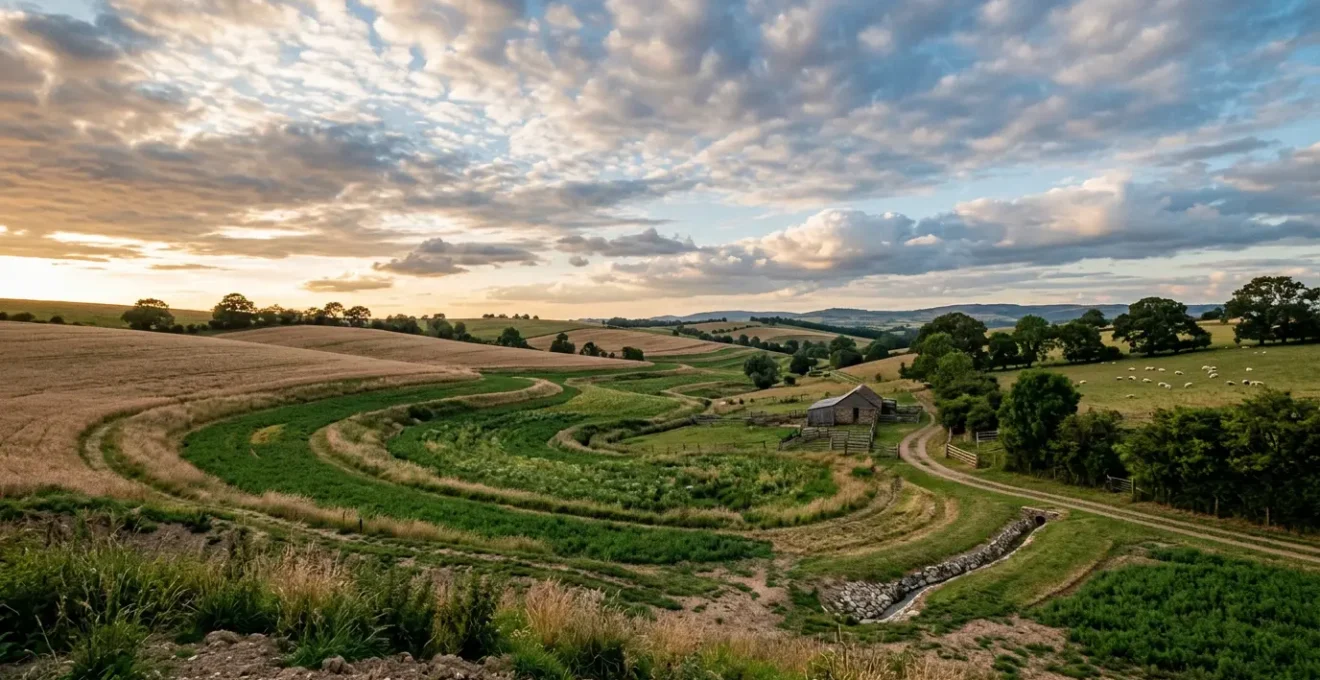
The survival of your farm no longer depends on reacting to weather, but on systematically re-engineering your land to manage extreme water volatility—from drought to deluge.
- Old agricultural calendars are now dangerous liabilities; data-driven tools are essential for timing.
- Resilience is built from the ground up by transforming your soil into a massive water reservoir and designing drainage for unprecedented rainfall.
Recommendation: Shift focus from short-term yield protection to long-term investment in soil health and water management infrastructure as your primary business insurance.
If you’re looking at your fields in East Anglia, swinging from baked-hard clay in August to a waterlogged quagmire in January, you know the old certainties are gone. For generations, farming has been a partnership with predictable seasons. That partnership is now broken. The weather is no longer a partner; it’s a volatile adversary. Many will advise you to simply plant cover crops or diversify a little, treating this as just another cycle. But this isn’t another cycle. This is a fundamental shift in our climate’s operating system, and patching the old model won’t work.
The time for incremental adjustments is over. The real key to securing your farm’s future is not about weathering the next storm or surviving the next drought. It’s about a radical shift in thinking: you must stop managing for the ‘average’ year and start engineering your entire farm for permanent volatility. This means taking control of every drop of water that falls on your land, transforming your soil into a resilient sponge, and rethinking everything from genetics to harvest timings. This guide is not a list of suggestions; it is an urgent strategic briefing on how to rebuild your farm’s core systems to be profitable and resilient in the face of climatic extremes.
This article outlines the critical systems you must reassess, from planting schedules and drainage engineering to the very genetics of your livestock and the economic structure of your enterprise. We will explore how to build a farm that not only survives extreme weather but is fundamentally designed to handle it.
Summary: A Farmer’s Strategic Guide to Climate Volatility Engineering
- Why Your Grandfather’s Planting Dates Are Now High-Risk Gambles?
- How to Design Drainage Systems That Handle 50mm of Rain in One Hour?
- Native Breeds vs Continental: Which Cattle Survive Best in Heatwaves?
- The Monoculture Trap That Wipes Out 100% of Profit in One Bad Season
- When to Harvest: Adjusting Moisture Thresholds for Unpredictable Autumns
- Why Increasing Organic Matter by 1% Holds 20,000 Extra Litres Per Hectare?
- Why Slowing Water Flow Reduces Peak Flood Levels Downstream?
- How to Double Your Soil’s Water-Holding Capacity Before Summer?
Why Your Grandfather’s Planting Dates Are Now High-Risk Gambles?
The familiar rhythm of the farming calendar, passed down through generations, is one of the most dangerous tools on your farm today. Relying on “the third week of April” for planting is a bet against a stacked deck. Climate change isn’t just making things warmer; it’s scrambling the signals crops use to grow. The primary metric for this is Growing Degree Days (GDD), a measure of heat accumulation that dictates a plant’s lifecycle. An analysis by Climate Central found that 97% of 246 U.S. weather stations showed increased GDDs since 1970. This trend is global. Your crops are reaching maturity at different times, and the weather windows for crucial activities are shifting and shrinking.
Continuing to use fixed dates means you risk planting into soil that’s too cold and wet, or missing the new, earlier window for optimal germination. This isn’t theoretical. The Climate Smart Farming program at Cornell University moved away from rigid 30-year climate averages to a dynamic GDD calculator using a 15-year moving average. This allows farmers to see what’s happening now, not what happened in the 1980s. Their work documented how farmers who stuck to old schedules in a cool, wet 2019 faced a cascade of problems, from delayed planting to compromised harvests. The old almanac is a relic; volatility engineering requires you to adopt dynamic, data-driven tools to make timing decisions. Your most valuable asset is no longer your calendar, but real-time climatic data.
How to Design Drainage Systems That Handle 50mm of Rain in One Hour?
Your farm’s drainage system was likely designed to handle the ‘normal’ rainfall of the 20th century. Today, it must cope with intense, short-duration deluges that dump a month’s rain in a few hours. A system designed simply to get water off the field as fast as possible is now a liability. It accelerates erosion, washes away valuable topsoil and nutrients, and contributes to downstream flooding. The modern challenge requires a new philosophy: hydrological sovereignty. This means designing a system to slow, capture, and hold water, not just expel it. It’s about turning a threat into an asset.
A resilient system capable of handling an extreme event like 50mm in an hour is a multi-layered defence. It starts on the surface with techniques like contour ploughing and grassed waterways to slow runoff. The next layer is a robust subsurface system, but with a modern twist.
As this cross-section illustrates, modern drainage isn’t just about pipes. It’s an integrated system. It involves using larger diameter pipes, but also incorporating ‘control’ structures—weirs or gates within your drainage network that can be adjusted. In dry periods, you can raise them to hold water in the soil profile, creating a form of subsurface irrigation. During a deluge, you can lower them to allow for controlled evacuation. This two-tier approach of surface slowing and controlled subsurface management transforms your drainage from a simple disposal network into a sophisticated water management tool, crucial for buffering both floods and droughts.
Native Breeds vs Continental: Which Cattle Survive Best in Heatwaves?
The focus on maximising yield has led to widespread adoption of Continental breeds selected for meat or milk production in stable, temperate climates. However, under the increasing frequency and intensity of heatwaves, this single-minded focus on production becomes a critical vulnerability. Heat stress is not just an animal welfare issue; it’s a severe economic drain. In the US dairy industry alone, research published in Frontiers in Veterinary Science shows annual heat stress losses range from $1.69 to $2.26 billion. As temperatures climb, these high-production animals suffer, with reduced fertility, lower milk yields, and increased mortality.
This is where the concept of genetic resilience becomes paramount. Native UK breeds, such as the English Longhorn or the Galloway, evolved in this landscape. They may not have the top-line production figures of a Charolais or Holstein, but they possess innate hardiness and an ability to thrive with less intensive inputs and in more challenging conditions. The choice is no longer simply “production vs. hardiness.” It’s about finding a balance that ensures a viable enterprise. Ground-breaking work is also being done on introducing specific heat-tolerance traits, such as the “slick gene,” into high-production breeds. John Church, a cattle researcher at Thompson Rivers University, noted in Smithsonian Magazine, “We believe we’ve created an animal that’s going to be much more climate-resilient and able to handle some of these climate extremes.” A case study on a Puerto Rico dairy farmer who bred the slick gene into his herd reported getting 1,800 pounds more milk per lactation from these resilient cows. The future of livestock farming lies in selecting genetics for survival and performance within a volatile climate, not just for sheer output in an ideal one.
The Monoculture Trap That Wipes Out 100% of Profit in One Bad Season
The modern agricultural landscape has been built on the principle of efficiency, which has often translated into vast fields of a single crop: monoculture. While this system offers economies of scale in a stable climate, it is a house of cards in the face of volatility. Betting your entire farm on a single crop, a single harvest window, and a single set of climatic needs is the definition of high-risk. One poorly timed drought, one unseasonal flood, or one new pest that thrives in the changing conditions can obliterate your entire year’s profit. The scale of this gamble is immense; agricultural studies show that monoculture plots cover 80% of arable land worldwide.
Escaping this trap requires moving from a mindset of efficiency to one of resilience. This means embracing diversification not as a hinderance, but as a core business strategy. This doesn’t necessarily mean planting dozens of small, different crops. Strategic diversification could involve: integrating a different crop with a different water or temperature requirement, such as moving from 100% winter wheat to 70% wheat and 30% spring barley or beans; planting multi-species cover crops; or integrating strips of perennial plants or trees in an agroforestry system. These strategies create a portfolio effect. A weather event that harms one crop may be neutral or even beneficial to another. As a research team noted in the journal *Global Challenges*, “Crop diversification plays a critical role in stabilizing food production and reducing the risks associated with monoculture systems.” This isn’t about sacrificing profit; it’s about protecting it from profit volatility and ensuring you have a business left to run next year.
When to Harvest: Adjusting Moisture Thresholds for Unpredictable Autumns
Just as planting dates have become unreliable, so have harvest timings. An unpredictable autumn with short, infrequent dry spells sandwiched between prolonged wet periods can turn a promising crop into a write-off in the field. The traditional approach of waiting for grain to reach the ideal moisture content in the field is now a high-stakes gamble against the weather forecast. The risk of shattering, lodging, and mould development increases with every day of delay. This new reality demands a more calculated, proactive approach to harvesting decisions.
The decision is no longer a simple “wait-or-go” based on the calendar. It’s a complex calculation of competing risks. You must weigh the cost of artificially drying wetter grain against the potential for catastrophic field loss if you wait for a “perfect” day that may never come. This requires a shift in mindset and infrastructure. Success in this volatile environment depends on a four-part decision matrix: tracking crop maturity with tools like GDD instead of the calendar; running a clear financial calculation of drying costs versus the quantifiable risk of field loss; prioritising fields for harvest based on real-time maturity and quality indicators, not a rigid schedule; and, most critically, investing in on-farm storage with aeration. This infrastructure investment is transformative. It decouples your harvest operation from the whims of the weather, turning a reactive gamble into a proactive quality management strategy. It gives you the power to harvest when the crop is at its peak quality, regardless of moisture, securing your profit before the weather can take it.
Why Increasing Organic Matter by 1% Holds 20,000 Extra Litres Per Hectare?
In the new climate reality, your soil is no longer just a medium for growing crops; it must become your primary water reservoir. The single most powerful tool you have to achieve this is increasing soil organic matter (SOM). SOM acts like a sponge, creating a porous, aggregated soil structure that can absorb and hold vast quantities of water. The numbers are staggering: for every 1% increase in organic matter, each hectare of your land can hold approximately 20,000 additional litres of water. In a drought, this is the difference between a failed crop and a harvestable one. In a deluge, this is the difference between water infiltrating harmlessly and it running off, causing erosion and flooding.
This is the heart of systemic resilience. Building healthy soil is the ultimate act of future-proofing. It simultaneously buffers against both extremes of the water cycle. But the benefits go even further. Healthy, covered soil is also cooler soil. Research from the USDA Climate Hub demonstrates that on a hot day on a New York farm, near-surface soil temperatures varied by 45°F (25°C) depending on whether the soil was bare or covered by plant residue. Bare soil gets hot enough to cook the life within it, increasing water loss through evaporation and stressing plant roots. Covered, high-SOM soil remains cooler, protecting the microbial ecosystem and conserving precious moisture.
This image of a farmer’s hands holding rich, dark, aggregated soil is more than just an ideal; it’s a portrait of resilience. The crumbly structure, the visible life, the retained moisture—this is your farm’s greatest defence. Investing in your soil’s health is the single most effective investment you can make in the long-term viability of your business.
Why Slowing Water Flow Reduces Peak Flood Levels Downstream?
For decades, the goal of land drainage was to move water off the landscape as quickly as possible. We now know this “efficient” approach is a primary cause of the destructive, flashy floods that inundate downstream towns and villages. Every field, every ditch, and every stream on your land is part of a larger catchment area. By engineering your farm to slow the flow of water, you are not just protecting your own soil from erosion; you are providing a critical public service and playing a role in national flood defence. This is the macro-scale application of hydrological sovereignty.
The principle is simple: every bend in a stream, every leaky dam made of fallen wood, and every patch of rough vegetation acts as a brake on water. By increasing the “residence time” of water on your land, you allow more of it to infiltrate into the soil (recharging your soil moisture) and you desynchronise the peak flow. Instead of all the water from a storm arriving at the main river at once, it is released slowly, over a longer period, keeping the river within its banks. As Harrison Wood, filmmaker of the documentary ‘Farming The Flood’, observed:
By working with nature rather than against it, they’re demonstrating how farming can be a key player in tackling environmental challenges.
– Harrison Wood, Interview about Farming The Flood documentary
The documentary showcases British farmers on Dartmoor implementing exactly these kinds of natural flood management techniques. They are installing leaky dams, re-meandering streams, and planting trees along riverbanks. The Environment Agency’s Tom Dauben noted that these techniques, while filmed on Dartmoor, are applicable across the country, stating “Every field has a part to play”. Crucially, many of these initiatives can be funded through government and private grants, meaning you can become part of the solution without bearing the full cost. By slowing the flow, you build resilience for everyone.
Key takeaways
- Resilience is an active engineering process, not a passive reaction to weather.
- Your soil’s capacity to hold water is your most valuable insurance against both drought and flood.
- Shifting from calendar-based traditions to data-driven, responsive management is non-negotiable for survival.
How to Double Your Soil’s Water-Holding Capacity Before Summer?
Understanding the importance of soil organic matter is one thing; building it is another. The good news is that there are rapid and effective strategies to significantly boost your soil’s health and its ability to function as a water reservoir. The goal is to kickstart a virtuous cycle: more plant life leads to more organic matter, which improves soil structure, which supports more plant life. You are not just adding material; you are cultivating a living ecosystem beneath your feet. This is the practical application of volatility engineering, starting from the ground up.
Doubling your soil’s water-holding capacity is an ambitious goal, but making significant gains before the next dry season is entirely achievable with a concerted effort. It requires a multi-pronged attack that focuses on four key principles: keeping the soil covered, minimising disturbance, maximising living roots in the ground, and strategically adding high-impact amendments. Forget thinking in terms of years or decades; with the right techniques, you can see measurable improvements in infiltration and resilience within a single season. The following plan outlines the most effective strategies for rapid improvement.
Your action plan: Rapid soil water-holding improvement strategies
- Implement no-till or reduced tillage: Leave last year’s plant residue in the field to cover soil, reducing temperatures and water loss while building soil organic matter that improves water holding capacity.
- Establish cover crops immediately: Cover crops keep soil covered and cooler while increasing organic matter. They create biopores through root growth that rapidly increase water infiltration when combined with no-till.
- Apply strategic amendments in targeted areas: Use biochar and humic substances as ‘super-sponges’ in zones needing accelerated water retention gains, moving beyond basic compost for high-impact results.
- Integrate planned rotational grazing: Use livestock impact through mob grazing to trample organic matter into the soil surface, rapidly kickstarting the biological soil-building cycle.
- Maintain soil cover with mulch: Mulching substantially lowers soil temperature and reduces evaporation – critical during drought. Natural mulch materials break down to increase soil organic matter and water holding capacity.
The time for small, incremental changes is over. The strategies outlined here are not just ‘best practices’; they are the new fundamentals for a viable farming business in a volatile climate. Building systemic resilience is the most critical investment you will make in the future of your land and your livelihood. Begin today by evaluating which of these systems represents the greatest weakness on your farm and make a plan to transform it into a strength.