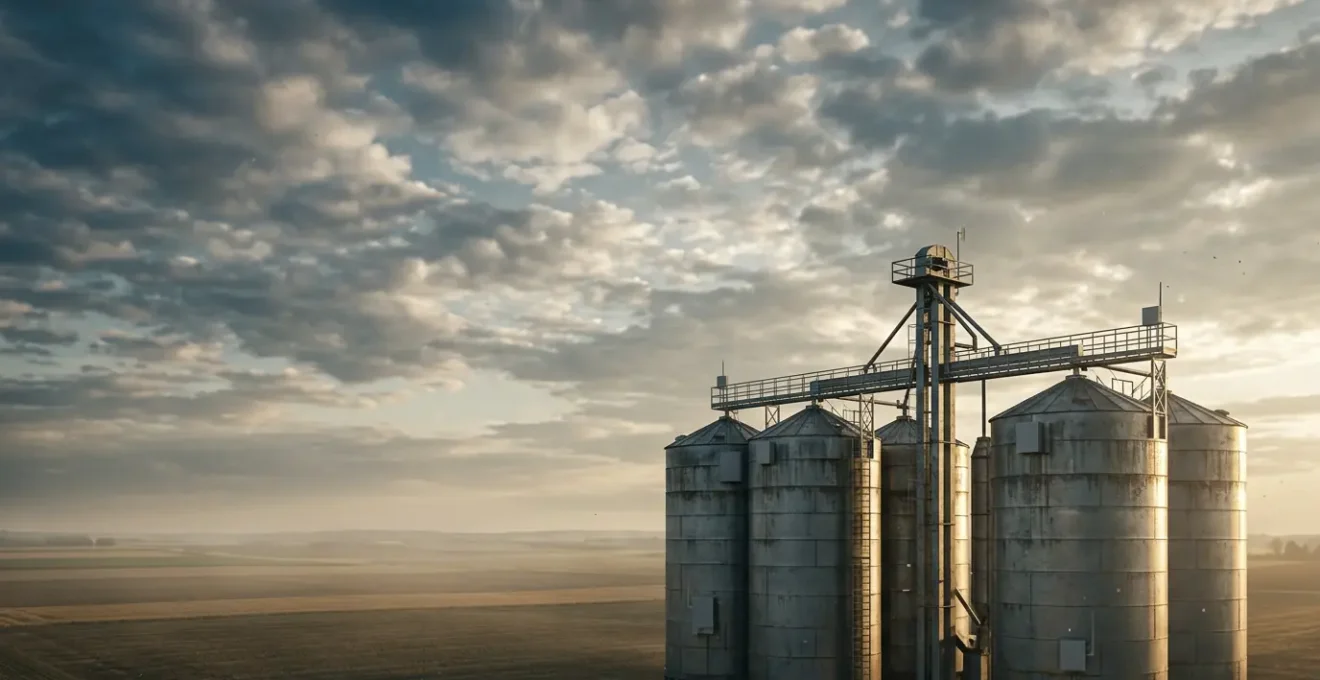
Self-heating in grain isn’t a random accident; it’s a predictable physical process that a well-designed remote monitoring system can consistently outsmart.
- The core danger lies in moisture migration, a natural convection cycle that concentrates dampness into dangerous hotspots, even in grain that was initially stored dry.
- Effective prevention relies on strategic sensor placement to eliminate ‘dead zones’ and automated fan controls that use temperature differentials, not guesswork.
Recommendation: Transition from reactive, manual temperature checks to a proactive, automated defense system that understands and counteracts the thermal dynamics of your grain store.
For any manager overseeing a thousand tonnes or more of grain, the silent threat of self-heating is a constant, low-level anxiety. A single hotspot, undetected, can rapidly lead to spoilage, quality degradation, and, in the worst-case scenario, a devastating fire. The common advice is to “monitor your grain” and “run your fans,” but this simplistic approach often fails because it ignores the underlying physics at play. Manually checking temperatures is sporadic and prone to missing the very ‘dead zones’ where risk accumulates, while improper fan usage can actively worsen the problem by pumping damp air into a stable grain mass.
The true key to asset protection is not just about installing technology; it’s about deploying a strategic, automated defense system. This means moving beyond simple temperature readings to master the invisible forces within your store: the thermal dynamics of moisture migration, the science of airflow, and the logic of data-driven automation. This article provides a framework for building such a system. We will dissect the mechanisms that create hotspots, detail how to position sensors for total coverage, and explain when—and when not—to activate your aeration systems. The goal is to transform your monitoring from a reactive chore into a proactive, intelligent guardian of your most valuable asset.
This guide breaks down the essential components for building an effective and automated grain safety system. We will explore the physics of spoilage, the strategy behind sensor placement, the technology that connects it all, and the operational logic required to prevent disaster while optimizing energy use.
Summary: An Expert’s Guide to Preventing Grain Spoilage and Fires
- Why Moisture Migration Creates Hotspots Even in Dry Grain?
- How to Position Wireless Spears to Cover ‘Dead Zones’ in Flat Stores?
- LoRaWAN vs 4G: Which Sensor Protocol Penetrates Concrete Walls Best?
- The Fan Control Error That Pumps Damp Air into Warm Grain
- When to Run Fans: Using Automated Differentials to Save Electricity
- When to Harvest: Adjusting Moisture Thresholds for Unpredictable Autumns
- How to Calculate the kW Output Needed to Dry 500t of Wheat?
- Biomass Boilers: How to Heat Your Grain Store Using Waste Timber?
Why Moisture Migration Creates Hotspots Even in Dry Grain?
The most misunderstood threat in grain storage is that hotspots are not random. They are the predictable result of a powerful physical process: moisture migration. Even if grain is brought into the store at a safe moisture level, temperature differences between the core of the grain mass and the colder outer walls initiate a slow but relentless convection cycle. This is especially pronounced in autumn and winter, when outside air temperatures drop significantly. The core of the grain, still retaining residual warmth from the harvest, heats the air within the interstitial spaces.
This warm, moist air slowly rises through the grain mass. When it reaches the cooler top surface, it condenses, much like breath on a cold window. This condensation dramatically increases the moisture content in the top layer of grain, creating a perfect breeding ground for mould, insects, and spoilage. This is not a minor effect; research shows that a 30-50°F temperature differential between the grain core and bin walls is enough to drive this destructive cycle. The process concentrates moisture in a specific area, creating the very hotspots that lead to fires.
As this diagram of the condensation process illustrates, the danger isn’t evenly distributed. The core may remain stable while the top layer becomes critically compromised. Without sensors capable of detecting this specific upper-layer temperature increase, a manager could believe their entire store is safe while a fire is essentially kindling just below the surface. Understanding this thermal convection loop is the first step to defeating it. The goal of a monitoring system is not just to find heat, but to detect the temperature gradients that *create* the conditions for it.
How to Position Wireless Spears to Cover ‘Dead Zones’ in Flat Stores?
A monitoring system is only as good as its coverage. The primary failure of traditional manual probing is the creation of vast, unmonitored areas, or ‘dead zones’, where hotspots can develop undetected. In large flat stores, achieving comprehensive coverage requires a strategic grid of wireless sensor spears, not a random scattering. The goal is to create a three-dimensional temperature map of the entire grain mass. This requires thinking about both horizontal and vertical placement.
Horizontally, spears should be laid out in a grid pattern. The exact spacing depends on the grain type and store size, but a common starting point is a 5-to-8-metre grid. The key is to ensure no part of the grain mass is too far from a sensor. Placement should prioritize historically problematic areas, such as near walls, under fill points, or in locations known for poor airflow. Vertically, modern multi-point spears are essential. A single-point sensor only tells you the temperature at one depth, while the real danger from moisture migration often occurs in the top third of the grain pile.
Case Study: 3D Visualization with Multipoint Spears
A deployment of Quanturi’s wireless monitoring system in commercial silos demonstrated the effectiveness of multipoint spears. Using spears up to 4 meters long with sensors spaced every 1 meter vertically, the system created a complete 3D thermal profile of the grain. This detailed visualization allowed managers to instantly identify the formation of temperature gradients and hotspots in real-time via a cloud platform, enabling early intervention long before spoilage could take hold.
Ultimately, the objective is to eliminate blind spots. Before installation, you must map your store and plan the grid, considering all structural and operational factors. This systematic approach is the only way to guarantee that you have true visibility into the health of your entire asset, not just a few convenient data points.
Action Plan: Auditing Your Sensor Coverage for Dead Zones
- Map Your Store: Create a detailed floor plan of your grain store, including all fill/empty points, structural supports, and aeration ducts.
- Identify High-Risk Zones: Mark areas known for issues: corners, sections near exterior walls (especially south-facing), and the central top layer where moisture migration concentrates.
- Overlay Your Sensor Grid: Plot the intended or current locations of your sensor spears on the map. Measure the distance between each sensor.
- Calculate Coverage Radius: Assuming an effective monitoring radius for each spear (e.g., 3-4 meters), draw circles around each sensor location. Identify any significant gaps or ‘dead zones’ in the grid.
- Develop an Action Plan: Prioritize adding new sensors to the largest and most high-risk dead zones to achieve comprehensive 3D coverage.
LoRaWAN vs 4G: Which Sensor Protocol Penetrates Concrete Walls Best?
Once sensors are in place, the data they collect must be reliably transmitted out of the store. Concrete, steel, and the grain itself create a challenging environment for wireless signals. The choice of connectivity protocol is therefore a critical decision that impacts reliability, cost, and scalability. The two dominant technologies for this application are cellular (like 4G/LTE-M or NB-IoT) and LoRaWAN (Long Range Wide Area Network).
Cellular-based sensors (4G/LTE-M, NB-IoT) are essentially small mobile phones. Each sensor has its own SIM card and communicates directly with the nearest cell tower. This is simple to deploy, as it leverages existing infrastructure. However, it relies on having strong carrier coverage at the farm’s location, can have higher subscription costs per device, and the signal may struggle to penetrate deep inside large, thick-walled concrete or metal bins. NB-IoT is a variant specifically designed for better penetration and lower power consumption than standard 4G, making it a strong contender in the cellular space.
LoRaWAN operates differently. It is a low-power protocol where sensors communicate with a private, on-site gateway, which then connects to the internet. While it requires installing a gateway, this gives the farm manager full ownership and control of the network. There are no monthly data fees, and a single gateway can support thousands of sensors across a range of up to 15 km in rural areas. Its signal characteristics are excellent for penetrating dense materials, making it highly reliable for concrete silos. A comparative analysis highlights the key differences:
| Criteria | LoRaWAN | 4G/LTE-M | NB-IoT |
|---|---|---|---|
| Battery Life | 5-10 years on single battery | 1-3 years | 3-5 years |
| Range (Rural) | Up to 15 km | 5-10 km | 10-15 km (with deep penetration) |
| Wall Penetration | Good (unlicensed spectrum) | Moderate | Excellent (optimized for deep indoor) |
| Network Ownership | Private gateway option (full control) | Carrier-dependent | Carrier-dependent |
| Data Subscription Cost | None (private) / Low (public) | $2-5 per device/month | $1-3 per device/month |
| Number of Bins Covered | Thousands per gateway | Unlimited (cellular tower) | Unlimited (cellular tower) |
The choice depends on the specific farm’s context. For a single, remote silo with good cell service, NB-IoT might be sufficient. For a large farm with multiple bins, poor cell reception, and a desire to avoid ongoing subscription fees, a private LoRaWAN network offers superior control, scalability, and long-term cost-effectiveness.
The Fan Control Error That Pumps Damp Air into Warm Grain
Aeration fans are a powerful tool for managing grain temperature, but when used incorrectly, they become an engine of spoilage. The most common and costly mistake is running fans when the outside air is warmer or more humid than the grain itself. This creates a scenario known as the ‘Dew Point Trap’, which actively pumps moisture *into* your store.
Imagine your grain is cooled to a stable 10°C. If you run fans on a warm, humid afternoon where the air’s dew point is 15°C, that warm, moist air will be forced through the cool grain mass. As the air cools, it will drop its moisture, leading to condensation directly on the grain kernels. This is the exact opposite of what aeration is meant to achieve. It re-wets the grain, undoing all the work of drying and creating ideal conditions for mould and spoilage. This is not a theoretical risk; studies indicate that improper aeration can cause a 4-8 percentage point moisture increase in the spoilage-prone top zone of the grain.
This error is most common with manual or timer-based fan control. A manager might set fans to run at night, assuming the air will be cooler. However, an unseasonably warm or foggy night can still have a high dew point, making the operation counterproductive. Relying on guesswork or fixed schedules is a gamble. Without real-time data on both the ambient weather conditions (temperature and humidity) and the temperature of the grain itself, you are essentially flying blind. Any fan operation that isn’t based on a measured, favourable differential between the grain and the air poses a significant risk to the stored crop.
When to Run Fans: Using Automated Differentials to Save Electricity
The solution to the ‘Dew Point Trap’ is to remove guesswork entirely. Modern grain management systems use automated differential control to ensure fans operate only when it is both safe and effective. This approach links the in-grain temperature sensors directly to an on-site weather station and the fan control system. The system’s logic is simple but powerful: it will only activate the fans when the outside air temperature is a set number of degrees cooler than the grain temperature.
This automated approach has two profound benefits. First, it guarantees that you are always cooling the grain and never accidentally adding heat or moisture. It constantly compares ambient conditions to the grain mass, waiting for the ideal moment to run the fans, whether that’s at 3 PM or 3 AM. This eliminates the human burden of manual checks and the risk of human error. Second, it leads to significant electricity savings. Fans are among the highest energy consumers on a farm. An automated system runs them only for the precise number of hours needed to achieve the target temperature, rather than on a fixed, often wasteful, schedule.
The economic impact can be substantial, extending even to optimizing grain moisture for sale. By carefully controlling aeration with moist night air, some systems can perform automated rehydration, increasing the saleable weight of the grain. This turns a cost centre (aeration) into a profit centre.
Case Study: Revenue Generation Through Automated Aeration
A case study using the GSI GrainVue system on a 40,000-bushel soybean bin showed dramatic results. The system’s ability to automatically rehydrate the grain from 10% to a safe 13% moisture level generated an additional $12,600 in revenue from the 3% weight increase alone. This covered the entire cost of the management system in a single season by running fans exclusively when outside conditions were favourable, maximizing efficiency and eliminating the manual labour of managing fan schedules.
By adopting automated differential control, a farm manager shifts from being a reactive operator to an overseer of an intelligent system. The system handles the tactical decisions of fan control, freeing up the manager to focus on overall strategy, secure in the knowledge that their assets are being protected in the most efficient way possible.
When to Harvest: Adjusting Moisture Thresholds for Unpredictable Autumns
Effective grain storage begins before the grain ever enters the bin. The decisions made during harvest, particularly regarding moisture content, have a direct and lasting impact on storability. While the goal is always to harvest at the optimal moisture level, unpredictable autumn weather—with unexpected rain, humidity, or shortened drying windows—can force difficult compromises. Harvesting grain that is too wet significantly increases the drying cost and the immediate risk of spoilage, while waiting for perfect conditions can risk field losses to weather or pests.
Knowing the maximum safe moisture content for your intended storage duration is therefore critical for risk management. Grain that will be sold by spring can be stored at a higher moisture level than grain intended for long-term storage of a year or more. This knowledge allows a manager to make informed decisions when faced with a challenging harvest. If the forecast is poor, it may be more economical to harvest slightly wetter grain and incur the drying costs, rather than risk losing a portion of the crop in the field.
This decision-making process requires accurate, reliable moisture data both in the field and during intake. These thresholds are not guidelines; they are hard limits based on the biological reality of how grain behaves in storage. Exceeding them dramatically shortens the safe storage window and places immense pressure on your aeration and drying systems. As an authoritative resource, Purdue University Extension provides clear guidelines for various grain types and storage durations:
| Grain Type | Storage Duration | Maximum Safe Moisture % |
|---|---|---|
| Shelled corn/sorghum | Sold by spring (#2 grade) | 15.5% |
| Shelled corn/sorghum | 6-12 months | 14% |
| Shelled corn/sorghum | More than 1 year | 13% |
| Soybeans | Sold by spring | 14% |
| Soybeans | Up to 1 year | 12% |
| Soybeans | More than 1 year | 11% |
| Wheat, oats, barley | Up to 6 months | 14% |
| Wheat, oats, barley | More than 6 months | 13% |
| Sunflower | Up to 6 months | 10% |
| Sunflower | More than 6 months | 8% |
Ultimately, a remote monitoring system is your last line of defense. The first line is bringing grain into the store in a condition that is as stable as possible. Adjusting harvest timing and being prepared for post-harvest drying based on these established moisture thresholds is a fundamental part of an integrated asset protection strategy.
How to Calculate the kW Output Needed to Dry 500t of Wheat?
When grain comes in over the safe moisture threshold, immediate drying is not optional—it’s a race against time. The energy required for this process is substantial, and accurately calculating the necessary kilowatt (kW) output is crucial for both operational efficiency and financial planning. An undersized drying system will fail to remove moisture fast enough, leading to spoilage, while an oversized system represents a significant and unnecessary capital expense. The calculation itself is a factor of three main variables: the mass of the grain, the percentage of moisture to be removed, and the desired speed of drying.
A simplified formula to estimate the energy needed is based on the latent heat of vaporization of water—approximately 2,260 kilojoules per kilogram (or about 0.63 kWh/kg). To dry 500 tonnes (500,000 kg) of wheat from 18% to a safe 14% moisture, you need to remove 4% of its weight in water. That’s 20,000 kg of water. This would theoretically require 12,600 kWh of energy. However, this calculation ignores the efficiency of the heater and fan system, which is never 100%. A more realistic estimate often assumes 50-70% efficiency, pushing the required energy closer to 18,000-25,000 kWh.
The urgency of this process cannot be overstated. High-moisture grain is an extremely perishable commodity. As one agricultural technology analysis notes, the entire system must work in concert. In their report on IoT solutions, Morning Ag Clips states:
A lack of temperature monitoring and ventilation control infrastructure (for drying and cooling) facilitates insect growth and increases the impact of moisture.
– Morning Ag Clips agricultural technology analysis, IoT Solutions for Smart Grain Temperature Management
This highlights that the heating element is just one part of a system. The fan’s airflow (measured in CFM per bushel) must also be sufficient to carry the moist air out of the grain mass. Calculating the required kW output is therefore a critical exercise in matching your equipment’s capacity to your operational risk, ensuring you have the power to win the race against spoilage.
Key Takeaways
- Moisture migration is a predictable physical process driven by temperature differences, not a random occurrence. Understanding its mechanism is key to prevention.
- Strategic sensor placement is more critical than sensor quantity. The goal must be to create a complete 3D thermal map and eliminate all ‘dead zones’ where hotspots can form undetected.
- Automated fan control, based on real-time temperature and humidity differentials, is the only reliable way to ensure aeration is always cooling the grain and never adding moisture, while simultaneously optimizing energy costs.
Biomass Boilers: How to Heat Your Grain Store Using Waste Timber?
While calculating drying energy is critical, the source of that energy is becoming an equally important strategic consideration. Traditional drying systems relying on propane or natural gas are effective but expose the farm operation to volatile fossil fuel prices and carry a significant carbon footprint. An increasingly viable alternative is the use of biomass boilers, which can provide the necessary heat for grain drying by utilizing on-farm or locally sourced waste timber, wood chips, or other organic materials.
A biomass boiler functions by burning this fuel to heat water, which is then pumped to a heat exchanger integrated into the grain dryer’s aeration system. The fan pulls ambient air across the hot exchanger, heating it to the required temperature before it’s forced through the grain. This approach decouples the farm’s drying costs from the fossil fuel market, creating long-term economic stability. For farms with access to their own woodlands or waste timber from land clearing, the fuel can be virtually free, dramatically reducing one of the largest variable costs in post-harvest operations.
Integrating a biomass system elevates the grain storage facility from a simple holding area to a component of a larger, circular farm economy. It transforms a waste product into a valuable input, enhances sustainability, and builds operational resilience. With post-harvest losses being a major global issue— research indicates that spoilage can affect up to one-third of total annual global grain production—adopting more sustainable and cost-effective drying technologies is a crucial step. It represents the final piece of the puzzle: an integrated system that not only monitors and protects the grain but does so in an economically and environmentally sustainable manner.
By shifting from a mindset of reactive problem-solving to one of proactive, systems-level design, you can transform your grain storage from a source of anxiety into a secure, efficient, and profitable pillar of your operation. The first step is to conduct a thorough audit of your current monitoring and aeration capabilities to identify your specific risks and opportunities.