In summary:
- Ploughing is a manageable “calculated disturbance,” not an automatic catastrophe for soil biology.
- Minimise damage by controlling depth (shallow skim ploughing), implement choice (power harrow over rotavator), and timing (cultivating at optimal soil moisture).
- Support recovery by waiting for soil to settle before applying inoculants and leaving undisturbed “refuge strips” to act as biological reservoirs.
- Strip-tillage offers a superior compromise, preserving up to 85% of the field’s fungal network while preparing an effective seedbed.
For an organic farmer, the decision to plough can feel like a betrayal. You spend years nurturing a vibrant, living soil, only to face a weed burden so severe that cultivation seems like the only pragmatic choice. The conventional wisdom shouts “don’t till,” but this ignores the reality of managing a productive, profitable farm. This tension between weed control and soil health is a significant challenge, especially when considering the delicate, intricate web of mycorrhizal fungi that underpins your soil’s fertility and resilience.
The standard advice often falls short, offering black-and-white solutions in a world of complex agronomic trade-offs. You’re told to use cover crops or to simply stop ploughing, but this doesn’t help when you’re facing a critical infestation of docks or thistles that threatens your certification or yield. What if the conversation shifted? Instead of viewing ploughing as an absolute evil, what if we approached it as a calculated disturbance? By understanding the precise mechanisms of damage, we can develop strategies not just to survive the plough, but to minimise its impact and accelerate the recovery of our vital fungal allies.
This guide moves beyond the simplistic “tillage is bad” narrative. It’s a pragmatic framework for farmers who must occasionally cultivate, rooted in the science of soil ecology. We will explore how to make intelligent choices about tillage depth, implement selection, timing, and recovery protocols. The goal is to transform an act of necessity into a manageable event, ensuring your soil’s biological engine can rebound quickly and continue to support a healthy, productive farm.
This article provides a detailed, science-based framework for making intelligent tillage decisions. The following summary outlines the key principles and practical strategies discussed to help you protect your soil’s most valuable asset.
Summary: A Pragmatic Guide to Fungi-Friendly Tillage
- Why Fungal Networks Take 3 Years to Recover After a Single Deep Plough?
- How to Skim Plough at 4 Inches to Cut Weeds Without destroying Subsoil Fungi?
- Rotavator vs Power Harrow: Which Is More Destructive to Hyphae Networks?
- The Inoculation Mistake: Applying Mycorrhiza Before the Soil Settles
- When to Cultivate: The Moisture Window That Protects Soil Structure and Biology
- Why Bacteria and Fungi Are the Engine of Nutrient Cycling?
- Min-Till vs Strip-Till: Which Preserves the Fungal Network Better?
- How to Protect Mycorrhizal Networks During Tillage Operations?
Why Fungal Networks Take 3 Years to Recover After a Single Deep Plough?
The profound and lasting impact of a single deep ploughing event stems from its complete disruption of the soil ecosystem. It’s not merely a “cutting” of fungal hyphae; it’s an inversion of the entire soil profile. This process buries the oxygen-loving (aerobic) fungi from the topsoil deep into an anaerobic environment where they suffocate and die. Simultaneously, it brings low-activity subsoil to the surface, exposing it to harsh environmental conditions it’s not adapted to. This is a full-system reset. The intricate physical structure of soil aggregates, held together by fungal glues like glomalin, is shattered, and the vast, interconnected communication and nutrient transport network is obliterated.
Recovery is not a simple matter of hyphae regrowing. The entire soil food web must re-establish itself from scratch. This slow, generational process involves the gradual return of bacteria, protozoa, and eventually, the pioneering fungi that can survive in such a disturbed environment. The often-cited three-year recovery period reflects the time it takes for a complex, mature, and diverse fungal community to re-establish its “fungal scaffolding” and restore its critical functions. The fragility is stark; research shows a 40% reduction in mycorrhizal abundance just from leaving land fallow, which is far less destructive than deep ploughing. A single pass with a mouldboard plough effectively sets the biological clock back to zero.
How to Skim Plough at 4 Inches to Cut Weeds Without destroying Subsoil Fungi?
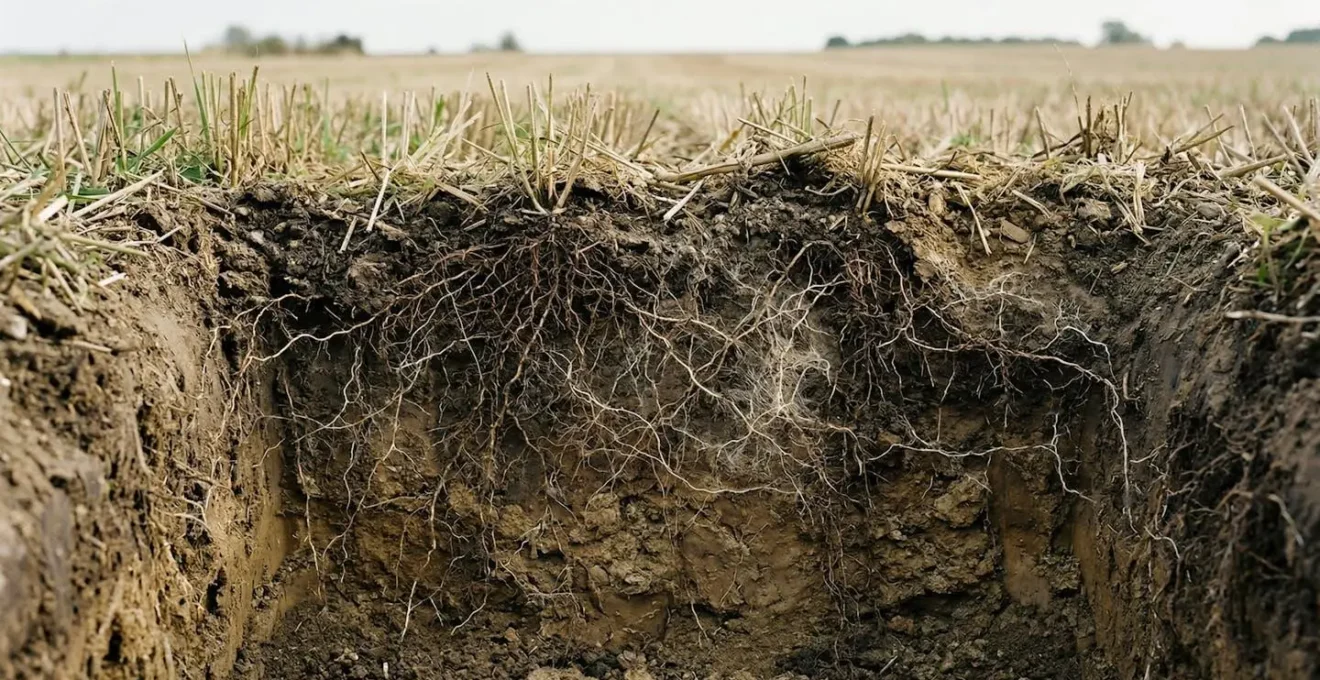
If deep ploughing is a full system reset, shallow skim ploughing is a calculated haircut. The key to this strategy lies in understanding the vertical distribution of soil life. The vast majority of the beneficial mycorrhizal fungi, the powerhouse of your soil’s nutrient network, resides in the topsoil. Specifically, studies confirm that most of the mycorrhizal biomass is concentrated in the top 4 to 6 inches (10-15 cm) of the soil profile, where oxygen, organic matter, and plant roots are most abundant.
By setting your plough to operate at a depth of just 4 inches (10 cm), you can effectively slice through the root crowns of perennial weeds like docks and thistles without inverting the entire soil profile. This action achieves the primary agronomic goal—weed control—while fundamentally changing the nature of the disturbance. Instead of burying the active fungal layer, you are merely stirring a portion of it. The deeper, more established fungal networks below the 4-inch mark remain largely intact, acting as a crucial biological reservoir or “inoculum bank.”
This preserved subsoil network is the key to rapid recovery. The intact hyphae can quickly recolonise the disturbed upper layer once conditions stabilise, drastically shortening the biological recovery window compared to deep tillage. You are essentially decapitating the weeds while preserving the vital “fungal scaffolding” that maintains your soil’s structure and fertility engine just below the surface. This makes shallow cultivation a powerful tool in a pragmatic farmer’s arsenal for damage limitation.
Rotavator vs Power Harrow: Which Is More Destructive to Hyphae Networks?
When tillage is necessary, the choice of implement is as crucial as the depth. Not all cultivation tools are created equal in their effect on soil biology. The primary difference between a rotavator and a power harrow lies in their mechanical action, which translates directly to the level of destruction inflicted upon fungal networks and soil structure. The rotavator is, without question, the more destructive of the two.
A rotavator employs high-speed, rotating tines that aggressively shear, churn, and pulverise the soil. This intense action causes catastrophic hyphal fragmentation, essentially blending the delicate fungal strands into microscopic pieces. It obliterates soil aggregates, the small clumps held together by fungal glues, turning structured soil into a fine, homogenous dust. This not only destroys the fungal network but also eliminates the very habitat it needs to recover, leading to compaction, erosion, and a near-complete loss of biological function. It creates a seemingly perfect seedbed that is, in reality, a biological desert.
A power harrow, by contrast, has a fundamentally different action. Its vertical tines rotate on a horizontal axis, lifting, stirring, and breaking down soil clods rather than pulverising them. While it still disrupts the soil and breaks fungal hyphae, the action is far less violent and shearing. It tends to fracture soil along its natural planes of weakness, preserving a greater degree of soil aggregation. For the pragmatic farmer, this makes the power harrow the clear choice for the lesser of two evils. It performs the task of creating a seedbed while leaving some semblance of soil structure and a greater potential for fungal recovery.
The Inoculation Mistake: Applying Mycorrhiza Before the Soil Settles
In the rush to repair the biological damage after tillage, a common and costly mistake is to apply mycorrhizal inoculants immediately onto freshly cultivated soil. This is akin to planting a forest during a landslide. Tillage, especially with aggressive implements, creates a physically and biologically unstable environment. The soil is a loose, fluffy mass of disconnected particles, lacking the stable micro-aggregates and pore spaces that fungal hyphae need to establish and thrive. Applying expensive inoculants into this chaotic environment is often a waste of time and money, as the fungi simply cannot find a stable foothold.
For an inoculation to be successful, the soil must first undergo a period of physical settlement and structural re-formation. This typically requires at least one significant rainfall or irrigation event to help the soil particles settle, followed by a period of rest. This allows for the natural re-establishment of some basic soil structure, creating the necessary pore spaces and contact points for fungal hyphae to begin their journey. Only after the soil has “settled” can the fungi effectively colonise root systems and begin to rebuild their network. Applying inoculants prematurely exposes them to desiccation, UV radiation on the soil surface, and a lack of host roots, leading to very low efficacy.
Action Plan: Post-Tillage Mycorrhizal Inoculation Protocol
- Wait 1-3 weeks after tillage for soil to settle and micro-aggregates to reform after a rainfall or irrigation event.
- Apply mycorrhizal inoculants after the harvest of non-mycorrhizal crops (e.g., beets, mustard, canola) to prepare for the next mycorrhizal crop.
- Use a seed coating method: coat seeds of the subsequent crop or cover crop with the inoculant so germinating roots provide an immediate host and “drive” the fungi into the soil.
- Combine inoculants with biostimulants: apply them with humic acids, seaweed extracts, or molasses to provide an accessible energy source for the microbes.
- Avoid spring pre-plant tillage in inoculated fields to protect the vulnerable, newly-established fungal networks.
When to Cultivate: The Moisture Window That Protects Soil Structure and Biology
Beyond depth and implement choice, the single most critical factor you can control is the timing of your cultivation, specifically in relation to soil moisture. Working the soil when it is too wet or too dry is a recipe for long-term structural damage that can negate all other efforts to protect your fungal networks. There exists an optimal “moisture window” where tillage causes the least harm.
Tilling soil that is too wet leads to compaction and smearing. The weight of machinery on saturated soil squeezes out air and water, creating dense, impenetrable layers (plough pans) that are hostile to root growth and fungal life. The smearing action of a plough or tine seals the soil pores, creating an anaerobic barrier that effectively suffocates the aerobic fungi you are trying to protect. On the other hand, tilling soil that is too dry and brittle results in pulverisation. The soil structure shatters into dust, destroying the aggregates that fungi have worked so hard to build. This fine dust is highly susceptible to wind and water erosion and creates a poor environment for biological recovery.
The ideal time to cultivate is when the soil is in a friable state—moist but not wet. A simple and effective method to determine this is the hand squeeze test. Take a handful of soil from your intended tillage depth and squeeze it firmly. If it forms a muddy ribbon or sticks to your hand, it’s too wet. If it crumbles into dust immediately, it’s too dry. The “just right” moment is when the soil forms a clump that holds its shape but readily crumbles into small aggregates when you poke it. At this moisture level, the soil will fracture along its natural fault lines, preserving a degree of structure and minimising the damage to the biological community.
Why Bacteria and Fungi Are the Engine of Nutrient Cycling?
To understand why protecting the fungal network is so critical, one must see the soil not as an inert growing medium, but as a living ecosystem powered by a vast, microscopic workforce. At the heart of this system are bacteria and fungi, the true engines of nutrient cycling. They form a complex food web that decomposes organic matter and unlocks minerals, making them available to plants in a form they can actually use. Without this biological engine, even the most mineral-rich soil would be effectively sterile and infertile.
Bacteria are the primary decomposers, breaking down simple organic compounds and holding onto nutrients in their biomass, preventing them from leaching away. Fungi, particularly mycorrhizal fungi, play a different but equally vital role. They form a symbiotic partnership with over 90% of plant species, creating a vast, filamentous network that acts as a living extension of the plant’s root system. This network can explore a volume of soil hundreds of times larger than roots alone, efficiently mining for water and nutrients. They are especially crucial for acquiring immobile nutrients like phosphorus; research indicates that fungi can be responsible for up to 80% of a plant’s phosphorus uptake.
In exchange, the plant provides the fungi with carbon from photosynthesis, fuelling the entire system. This partnership is the foundation of a healthy soil ecosystem. Practices that support this life, such as reduced tillage, have a profound effect; a global meta-analysis found that conservation tillage leads to a 37% increase in overall microbial biomass. When you plough, you are not just turning dirt; you are disrupting this fundamental engine of fertility.
Min-Till vs Strip-Till: Which Preserves the Fungal Network Better?
For farmers looking to move beyond conventional ploughing but still requiring some soil disturbance for seedbed preparation, minimum tillage (min-till) and strip-tillage represent two popular approaches. While both are vast improvements over full-width, deep inversion ploughing, strip-till offers a clear and measurable advantage in the preservation of the mycorrhizal network.
Min-till is a broad term that typically involves shallow, full-width cultivation. While it avoids the destructive inversion of deep ploughing, it still disrupts the entire soil surface, fragmenting the fungal network across the whole field. Strip-till, by contrast, is a much more precise and targeted system. It involves tilling only a narrow band, or “strip,” of soil where the crop will be planted, leaving the soil between the rows completely undisturbed. This is the critical difference. With strip-till systems that typically disturb only 15-30% of the field area, the remaining 70-85% of the soil acts as a massive, intact reservoir of fungal life.
These undisturbed inter-row zones become powerful “fungal highways” or inoculum banks, allowing for the rapid recolonization of the tilled strips by the established network. This provides the new crop with immediate access to the benefits of the mycorrhizal symbiosis, which is particularly important for nutrient uptake in the early stages of growth.
Case Study: The Yield Advantage of Strip-Till in Low Phosphorus Soil
In a field study conducted on low phosphorus soil, strip-till demonstrated superior performance compared to no-till systems. The strip-tilled area achieved yields of 43.5 bushels per acre (2,925.5 kg/hectare), compared to 41.5 bushels per acre (2,791 kg/hectare) in the no-till system. This 5% yield advantage demonstrates that strip-till successfully combines the benefits of soil warming and aeration in the seed row while preserving fungal networks in the undisturbed inter-row zones, resulting in better nutrient availability and plant establishment than uniform no-till management.
Key takeaways
- Ploughing is a manageable “calculated disturbance,” where understanding the mechanism of damage is the first step to mitigating it.
- Depth and timing are your most powerful levers: shallow skim ploughing at optimal soil moisture preserves the subsoil’s biological integrity.
- Implement choice matters: a power harrow’s stirring action is far less destructive to soil structure and hyphae than a rotavator’s pulverising force.
How to Protect Mycorrhizal Networks During Tillage Operations?
Protecting mycorrhizal networks when tillage is unavoidable is not about a single magic bullet, but a holistic strategy of damage limitation and recovery enhancement. It requires viewing the soil as a living entity and every pass of a machine as a surgical intervention to be performed with care. The cumulative evidence is clear: studies demonstrate that conventional tillage can cause up to a 40% decrease in the diversity of arbuscular mycorrhizal (AM) fungi, weakening the entire soil ecosystem.
The core principles of this protective strategy are to be as shallow, infrequent, and targeted as possible. As we’ve seen, working at a depth of 4 inches or less, choosing less aggressive implements like power harrows, and cultivating only within the optimal moisture window are the foundational tactics. However, we can go further by thinking spatially. Instead of tilling a field edge-to-edge, consider implementing a strategy of biological refuge strips—permanent, untilled bands of land within or around fields. These strips act as living libraries of your farm’s specific soil biology, providing a constant source of inoculum to help tilled areas recover more quickly.
Finally, the post-tillage phase is crucial. Immediately planting a cover crop on the disturbed soil provides a living root system for the fragmented fungal network to reconnect with. This protects bare soil from erosion and provides the carbon energy the fungi need to begin the rebuilding process. By combining these strategies—shallow and timed tillage, less aggressive implements, refuge strips, and immediate cover cropping—you can shift from a destructive event to a managed, calculated disturbance that your resilient soil ecosystem can withstand and recover from.
By adopting this mindset of intelligent and minimal intervention, you can successfully navigate the agronomic necessity of weed control while acting as a responsible steward of the complex, living world beneath your feet. The next step is to begin assessing your own practices and identifying where these principles can be applied.