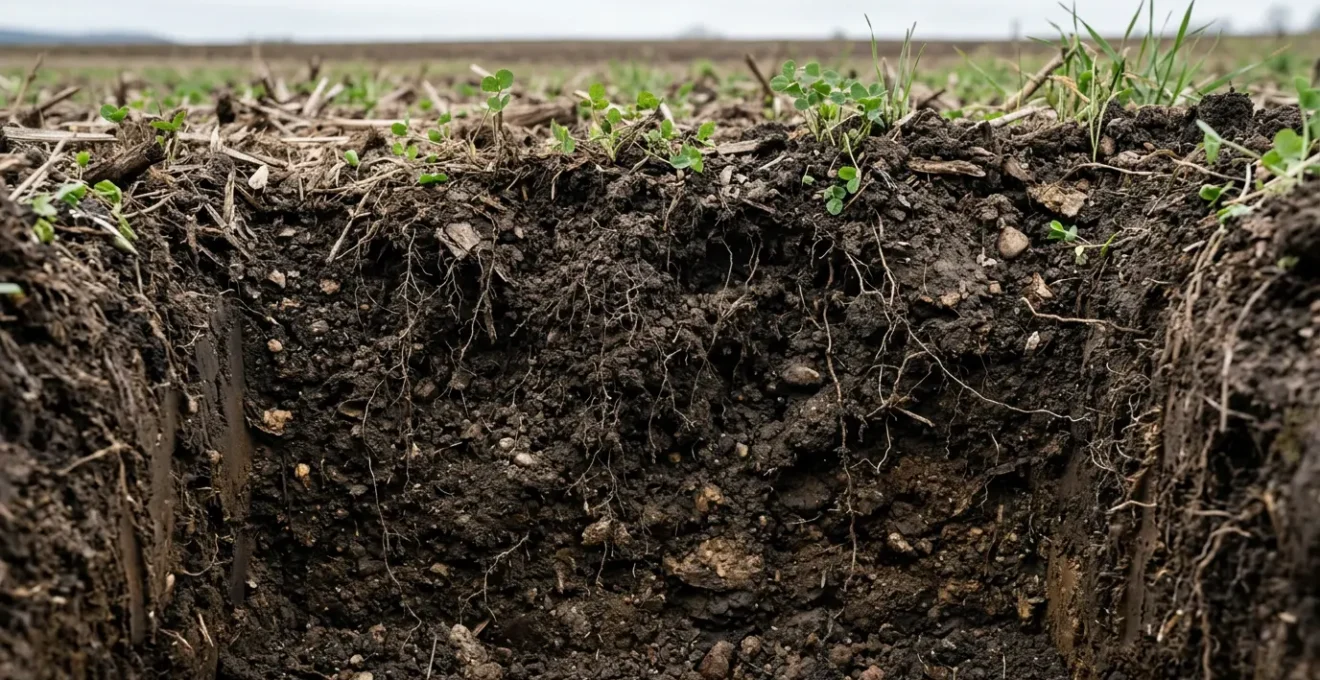
Building 1% soil humus in 5 years isn’t about indiscriminately adding more organic matter; it’s about precisely engineering its decomposition and preservation.
- Success depends on managing the carbon-to-nitrogen (C:N) ratio of inputs to feed the correct microbial populations, not starve them.
- Prioritizing fungal-dominant decomposition pathways through minimal tillage and high-carbon inputs like woodchips builds more stable, long-lasting humus.
- You can’t manage what you don’t measure correctly. Adopting rigorous protocols like Equivalent Soil Mass (ESM) is non-negotiable to track real progress.
Recommendation: Shift your focus from “how much” carbon you add to “how” it’s processed and measured in your soil system. Your biggest gains are hidden in data integrity and microbial management.
The goal is ambitious, yet essential: increase soil humus by 1% within five years. For a committed farmer, this metric represents not just a target for carbon sequestration but a fundamental investment in long-term fertility, water retention, and resilience. Yet, the path is often obscured by a fog of well-intentioned but overly simplistic advice. You’re told to “just add compost,” “stop tilling,” or “leave the straw,” as if these were standalone magic bullets.
But if you’ve tried these methods, you know the results can be frustratingly slow or inconsistent. What if the conventional wisdom is incomplete? The true leverage to achieve such a significant gain in a short timeframe doesn’t lie in simply increasing inputs, but in mastering the biochemistry of humification. This is not just farming; this is a carbon engineering project. It requires a shift in mindset from being a passive manager of organic matter to an active director of microbial pathways and nutrient stoichiometry.
This guide moves beyond the platitudes. We will dissect the precise, metric-focused strategies that separate hopeful wishing from predictable results. We will explore why some carbon inputs are more effective than others, how to manage nutrients to accelerate humus formation without violating regulations, and the critical measurement mistakes that can make five years of hard work seem to vanish. This is your operational roadmap to building a verifiable, stable, and valuable carbon asset right beneath your feet.
Summary: A 5-Year Carbon Farming Roadmap: The Metrics to Building 1% Soil Humus
- Why Straw Incorporation Alone Won’t Build Stable Humus Rapidly?
- How to Comply with Nitrogen Limits When Applying High Rates of Compost?
- Woodchip or Manure: Which Builds Long-Term Carbon More Effectively?
- The Tillage Mistake That Burns Off 5 Years of Humus in One Season
- When to Add Nitrogen to Facilitate Humification of High-Carbon Residues?
- The Bulk Density Mistake That Inflates Your Carbon Stock Figures
- Why Bacteria and Fungi Are the Engine of Nutrient Cycling?
- Why Soil Carbon Measurements Fluctuate Wildly Between Labs?
Why Straw Incorporation Alone Won’t Build Stable Humus Rapidly?
Incorporating high-carbon residues like straw seems like the most direct path to building soil organic matter. You are, after all, returning carbon directly to the soil. However, the ambition of a 1% humus increase in five years demands we look closer at the numbers. The core issue lies in nutrient stoichiometry, specifically the carbon-to-nitrogen (C:N) ratio. Straw has a very high C:N ratio, typically around 80:1. The microbes responsible for decomposition, however, require a diet with a C:N ratio closer to 24:1 to function and build their bodies. When faced with a mountain of carbon (straw) and very little nitrogen, they pull available nitrogen from the surrounding soil, a process known as nitrogen immobilization.
This temporarily “ties up” nitrogen, making it unavailable for your cash crop and significantly slowing the decomposition process. Instead of being efficiently converted into stable humus, much of the carbon from the straw is respired back into the atmosphere as CO₂ by starving microbes. A comprehensive meta-analysis of 68 studies confirms this inefficiency, finding that on average, only 0.35 Mg C ha⁻¹ yr⁻¹ is sequestered from straw incorporation alone. This rate is far too slow to meet our ambitious goal. Straw is not the problem, but using it in isolation without managing the associated nutrient dynamics is a recipe for slow progress.
How to Comply with Nitrogen Limits When Applying High Rates of Compost?
Applying high rates of compost is a cornerstone of building soil carbon, but it introduces a significant regulatory and agronomic challenge: managing nitrogen. Many jurisdictions impose limits on total nitrogen application to prevent leaching and environmental contamination. A high-volume compost strategy could easily exceed these limits if not managed with precision. The key to compliance lies in understanding the concept of Nitrogen Mineralization Rate. Not all nitrogen in compost is immediately available to plants.
The nitrogen in compost is primarily in a stable, organic form. It must be broken down (mineralized) by soil microbes before it becomes plant-available. The rate at which this happens is highly dependent on the compost’s maturity and C:N ratio. According to USDA guidelines, for most mature composts, only 10% to 25% of the total nitrogen becomes available in the first year. This slow-release characteristic is your primary tool for management. By documenting the compost’s C:N ratio and total N content from a lab analysis, you can build a defensible case for regulators that you are not applying excessive plant-available nitrogen, but rather building a stable pool of organic N for future seasons.
Strategic management of the compost’s C:N ratio is therefore paramount:
- High C:N Compost (>30:1): Use this to maximize carbon input while temporarily immobilizing excess N already in the soil, effectively “locking it up” in the microbial biomass.
- Balanced C:N Compost (20:1 to 30:1): This is the ideal range for both balanced nutrient release for the current crop and significant humus formation.
- Low C:N Compost (<20:1): Avoid this when near your N limit, as it will act as a slow-release fertilizer and contribute more available N than desired.
This approach transforms compost from a simple bulk amendment into a precision tool for carbon sequestration and nutrient management.
Woodchip or Manure: Which Builds Long-Term Carbon More Effectively?
The choice between common amendments like manure and woodchips is not just a matter of availability; it’s a strategic decision that dictates which microbial pathway you are feeding, with profound implications for long-term carbon stability. Manure is rich in simple sugars and available nutrients, promoting a rapid, bacterial-dominant decomposition pathway. Bacteria are efficient decomposers that quickly cycle nutrients, making them available to plants, but they also respire a significant portion of the carbon back into the atmosphere as CO₂. It’s a “live fast, die young” strategy that is excellent for short-term fertility.
Woodchips, on the other hand, are composed of complex, recalcitrant carbon compounds like lignin and cellulose. This feedstock favors a fungal-dominant decomposition pathway. Fungi, particularly mycorrhizal fungi, are the master builders of the soil. They create extensive hyphal networks that are the foundation of stable soil aggregates. Their bodies have a much higher C:N ratio than bacteria, meaning they “lock up” more carbon in their biomass for longer periods. This is the “slow and steady” strategy for building resilient, long-lasting humus.
As the illustration of these pathways suggests, fungi create a physical structure that bacteria leverage. A compelling rhizobox experiment highlights this tradeoff: while raw manure pellets increased wheat yield by 36.3%, their biochar form was less effective at reducing CO₂ emissions than woodchip biochar. The study found that woodchip biochar reduced rhizosphere CO₂ emissions by 29.7%, indicating its superior long-term carbon stability. For the ambitious carbon farmer, the conclusion is clear: while manure provides a quick nutrient boost, woody materials are the superior long-term investment in building a stable carbon architecture.
The Tillage Mistake That Burns Off 5 Years of Humus in One Season
After years of carefully building soil organic matter through compost, cover crops, and reduced inputs, a single pass with a plow or deep ripper can annihilate that progress. This isn’t an exaggeration; it’s a catastrophic biological event. The mistake is viewing tillage as a purely physical process. In reality, it is a violent disruption of the soil’s painstakingly constructed aggregate architecture, the very foundation of stable humus.
Stable humus doesn’t exist as free particles in the soil. It is protected from rapid decomposition by being physically locked away inside soil aggregates. These aggregates are complex structures, glued together by microbial secretions and, most importantly, physically bound by the extensive web of fungal hyphae. As pioneering soil scientists Tisdall and Oades noted in their foundational research:
Fungal hyphae improves macro-aggregate formation by binding micro-aggregates.
– Tisdall and Oades (soil structure researchers), Contribution by fungi and bacteria to aggregate stability of cultivated soils
Tillage acts like an earthquake, shattering these aggregates and shredding the fungal networks that hold them together. This exposes the protected carbon to a feeding frenzy by opportunistic bacteria. The sudden influx of oxygen and fragmented organic matter causes a massive spike in microbial respiration, burning off years of accumulated carbon as CO₂ in a matter of weeks. A three-year field experiment powerfully demonstrated the opposite effect: a zero-tillage system increased water-stable macroaggregates by 36.38% in the topsoil layer compared to conventional tillage, proving that avoiding this mechanical destruction is paramount to preserving and growing your carbon asset.
When to Add Nitrogen to Facilitate Humification of High-Carbon Residues?
We’ve established that high-carbon residues like straw are inefficient for humus building on their own due to nitrogen immobilization. The logical next step is to strategically add nitrogen to correct the C:N ratio and fuel the microbial engine. The question is not *if* you should add nitrogen, but *when* and *how much* to transform a slow, inefficient process into a rapid, targeted humification event. The goal is to provide just enough nitrogen to meet the microbial demand without creating excess that could be lost to the environment or over-stimulate the wrong kind of microbial activity.
The target C:N ratio for humus itself provides the answer. As multiple soil science sources synthesize, the C:N ratio of stable humus is consistently around 12:1. Your high-carbon straw residue is at 80:1. To get from 80:1 to the microbial “sweet spot” of 24:1 and ultimately to the stable 12:1 humus ratio, nitrogen must be added. The ideal timing for this application is at the point of residue incorporation. Applying nitrogen (e.g., as liquid UAN, manure, or a legume cover crop) simultaneously with the high-carbon input ensures the microbes have all the building blocks they need from the start.
The results of this synergistic approach are dramatic. Research has demonstrated that a strategy combining straw at 3 Mg C ha⁻¹ yr⁻¹ with a balanced application of nitrogen fertilizer achieved not only a 32.7% yield increase but also a sequestration rate of 0.85 Mg C ha⁻¹ yr⁻¹. This is more than double the rate of straw alone, moving it from a negligible contributor to a significant driver toward our 1% goal. This isn’t just fertilizing a crop; it’s feeding the microbial workforce that builds your soil’s long-term wealth.
The Bulk Density Mistake That Inflates Your Carbon Stock Figures
As a metric-focused farmer, you live by the numbers. But what if one of the most common numbers—soil organic carbon percentage (%C)—is giving you a dangerously misleading picture of your progress? This is the bulk density mistake. As you successfully add organic matter, your soil becomes healthier, more aggregated, and “fluffier.” This “fluffiness” means the soil’s bulk density (the mass of soil in a given volume) decreases. A cubic foot of healthy, low-density soil simply weighs less than a cubic foot of compacted, degraded soil.
Here’s the trap: if you take a soil sample to a fixed depth (e.g., 6 inches) year after year, you are sampling a smaller *mass* of soil as the bulk density decreases. An increase in your %C reading could simply be an artifact of this “fluffiness,” not a true increase in the total carbon stock on your land. You could see a rising %C on your lab report while your actual tonnes of carbon per hectare remain flat or even decline. This is a critical point of data integrity that separates amateur carbon accounting from professional carbon management.
To get an accurate, defensible measurement of your carbon asset, you must account for changes in bulk density. The gold standard for this is the Equivalent Soil Mass (ESM) method. Instead of sampling to a fixed depth, ESM involves adjusting the sampling depth in subsequent years to ensure you are always comparing the same mass of soil. This removes the variable of bulk density from the equation and gives you a true picture of your carbon stock change.
Action Plan: Protocol for Accurate Soil Carbon Stock Measurement
- Always measure bulk density simultaneously when collecting soil carbon samples from the same location and depth.
- Calculate Carbon Stock (t/ha) using the formula: %C × Bulk density (g/cm³) × Sampling depth (cm), not just relying on the %C value alone.
- Adopt the Equivalent Soil Mass (ESM) method: Adjust sampling depth in subsequent years to compare the same soil mass, not the same volume.
- Standardize your process by sampling at consistent times of the year (e.g., post-harvest) to minimize seasonal biological variability.
- Create composite samples of 15-20 cores per management zone to average out spatial variability and ensure a statistically valid result.
Why Bacteria and Fungi Are the Engine of Nutrient Cycling?
The soil is not a passive reservoir of nutrients; it is a dynamic, living system powered by a vast and complex microbial engine. At the heart of this engine are two primary groups: bacteria and fungi. Understanding their distinct roles is fundamental to managing soil fertility and carbon sequestration. Bacteria are the primary decomposers, the “sprinters” of the soil food web. They specialize in breaking down simple, easy-to-digest organic materials like sugars and fresh plant residues. This rapid turnover releases a quick flush of nutrients, making them available for plants. They are the engine of nutrient cycling.
Fungi, especially the mycorrhizal and saprophytic types, are the “marathon runners” and structural engineers. They possess powerful enzymes capable of breaking down the most complex and recalcitrant compounds in organic matter, such as lignin and cellulose found in wood and tough plant fibers. But their most critical role is in building the soil itself. Fungal hyphae are thread-like structures that grow through the soil, physically binding tiny soil particles (microaggregates) into larger, more stable macroaggregates. This physical enmeshment is the primary mechanism for creating good soil structure.
Case Study: Fungal Hyphae as Soil Engineers
Microcosm experiments revealed the direct physical impact of fungi on soil structure. Researchers observed that fungal hyphae act as a physical net, bridging gaps between soil particles through a process of enmeshment, particularly effective at high moisture levels. A key finding was that fungal biomass density was a main predictor of soil aggregation stability. The study concluded that introducing fungi significantly modified the soil’s hydrological properties, improving water retention and sorptivity, all thanks to the improved macroaggregate formation driven by the physical action of the hyphal network.
In essence, bacteria ensure the system has ready cash flow (available nutrients), while fungi build the long-term capital assets (stable humus and soil structure). A healthy soil needs both, but for the specific goal of building stable humus, a management strategy that favors and protects the fungal community—such as minimizing tillage and providing complex carbon sources—is absolutely paramount.
Key Takeaways
- Stable humus formation is not about the quantity of raw carbon input, but about precisely managing the C:N ratio to fuel efficient microbial conversion.
- Favoring fungal-dominant pathways through practices like minimal tillage and the use of woody materials is critical for building the long-term, stable carbon structures that constitute humus.
- Accurate measurement is non-negotiable; using protocols like Equivalent Soil Mass (ESM) and consistent lab practices is essential to track real progress and avoid misleading data.
Why Soil Carbon Measurements Fluctuate Wildly Between Labs?
You’ve done the hard work. You’ve managed your C:N ratios, protected your fungal networks, and sampled with care. You send your samples to a lab, and the results come back… but they seem inconsistent with last year’s results from a different lab. This frustrating scenario is a common pitfall in carbon farming and a major threat to your data integrity. The uncomfortable truth is that not all lab measurements are created equal, and variations between labs can be significant enough to mask real progress or create false positives.
These fluctuations typically arise from two main sources: methodology and internal calibration. The most common discrepancy is between the Dry Combustion (Dumas) method and the Loss-on-Ignition (LOI) method. Dry combustion is the scientific gold standard; it directly measures the carbon in a sample. LOI, on the other hand, involves burning a sample and measuring the weight loss, which is then used to *estimate* organic matter. This estimation can be thrown off by the presence of clay minerals and other non-organic compounds, leading to inaccuracies. Even between labs using the same method, differences in equipment calibration, sample preparation, and quality control can introduce variability. Typical agricultural soil humus content ranges from 2-10%, so a small analytical error can represent a huge portion of your annual gain.
As the on-the-ground manager, you cannot control a lab’s internal processes. However, you can control your own protocol to build a defensible and consistent dataset over time. The key is to eliminate as many variables as possible:
- Lab Consistency: Always use the same analytical laboratory for all measurements across all years. This eliminates inter-lab variability.
- Method Specification: Explicitly request the Dry Combustion (Dumas) method for total carbon analysis, not Loss-on-Ignition (LOI).
- Temporal Consistency: Sample at the same time each year (e.g., post-harvest) to minimize noise from seasonal biological activity.
- Spatial Consistency: Use GPS to mark your sampling zones and maintain precise depth control, creating composite samples from 15-20 cores per zone.
By implementing a rigorous and consistent protocol, you transform soil testing from a source of frustrating ambiguity into a powerful tool for strategic management.
Armed with these protocols for both on-farm management and data collection, you are no longer just participating in a regenerative movement; you are engineering a verifiable, predictable, and valuable outcome. The next step is to deploy this rigorous monitoring framework on your own operation, turning your soil into a precisely managed carbon asset.