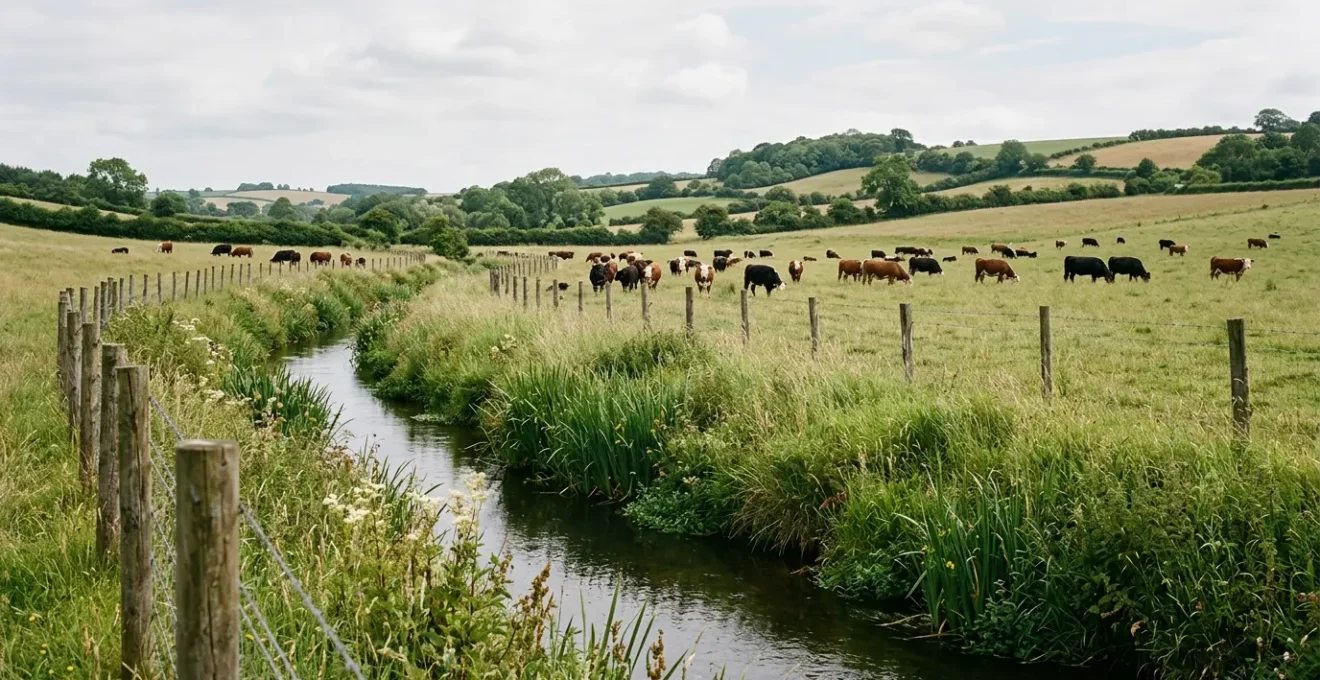
Effective watercourse management is a system to de-risk your farm financially, not just an environmental cost.
- Even temporarily dry ditches fall under the Farming Rules for Water, requiring a formal risk assessment.
- Alternative watering solutions like pasture pumps maintain vital livestock access without direct river entry, preserving grazing areas.
- Specific capital grants can cover a significant portion of fencing costs, but choosing the right scheme for your project is critical to maximising funding.
Recommendation: Begin with a formal risk assessment of all ditches and watercourses on your land to identify priority areas for action and build a defensible compliance strategy.
The sight of an official envelope from the Environment Agency (EA) can be a source of considerable anxiety for any livestock farmer. Vague directives about diffuse pollution and the ever-present threat of inspection create uncertainty. The common advice is often a blunt and unhelpful “fence off your rivers.” This simplistic approach ignores the practical realities of farming: the loss of valuable grazing land and the critical need for livestock to access water. It frames compliance as a costly chore that only diminishes the farm’s productivity.
However, this perspective is fundamentally flawed. The key to navigating the Farming Rules for Water is not to simply erect barriers, but to implement a robust compliance system. This involves a strategic shift in thinking, viewing watercourse management as a form of financial de-risking. By understanding the nuances of the regulations, deploying smart watering technology, and strategically targeting capital grants, you can protect your watercourses, satisfy inspectors, and maintain the operational efficiency of your farm. It’s about transforming a regulatory burden into a well-managed component of your business.
This guide moves beyond the generic advice. It provides a compliance officer’s perspective on building that system. We will dissect the rules that apply even to dry ditches, explore practical watering alternatives, compare the grant schemes that pay for fencing, and highlight the common but costly mistakes in buffer zone management that could jeopardise your Basic Payment Scheme (BPS) payments. This is your blueprint for achieving compliance without compromising your farm’s productivity.
Summary: A Farmer’s Blueprint for Compliant Watercourse Management
- Why the ‘Farming Rules for Water’ Apply Even to Dry Ditches?
- How to Install Pasture Pumps So Cattle Drink Without Entering the River?
- Capital Grants for Fencing: Which Scheme Pays Best per Metre?
- The Weed Control Mistake in Buffer Zones That Loses You BPS
- How Wide Should Your Buffer Be to Stop Phosphate Runoff Effectively?
- The Consent Mistake with the Environment Agency That Could Fines You
- The Winter Spreading Mistake That Pollutes Water and Wastes Nutrients
- Natural Water Retention Measures: Are Leaky Dams Worth the Investment?
Why the ‘Farming Rules for Water’ Apply Even to Dry Ditches?
A common and dangerous misconception is that a ditch or channel that is dry for much of the year is exempt from watercourse regulations. This is incorrect. The Environment Agency’s enforcement is based on the principle of hydrological connectivity. This means any feature designed to carry water—even intermittently—is considered part of the wider catchment area. During a heavy rainfall event, a seemingly insignificant dry ditch can become a primary conduit for transporting sediment, nutrients, and pesticides from your fields directly into a main river.
Ignoring these features is a significant compliance risk. The EA is actively inspecting farms for these issues, and their data reveals a widespread problem. In fact, data from the Environment Agency shows around 30% of inspected farms have significant gaps in their nutrient management planning, often related to overlooking these minor watercourses. An inspector will not see a dry ditch; they will see a potential pollution pathway. Demonstrating that you have assessed and managed this risk is a crucial part of your due diligence.
The first step in your compliance system is therefore to map and assess every single one of these features. Your OS maps are the starting point; any continuous blue line, regardless of its typical state, falls under the regulations. You must then evaluate factors like slope, soil type, and proximity to the main river to build a risk profile for your farm. This documented assessment is your first line of defence during an inspection, proving you have taken a proactive and responsible approach to managing diffuse pollution across your entire holding.
How to Install Pasture Pumps So Cattle Drink Without Entering the River?
Fencing off a watercourse immediately raises a practical problem: how do you provide water for your livestock without losing the entire field for grazing? The solution lies in creating alternative watering points that bring the water to the cattle, rather than allowing the cattle to go to the water. Pasture pumps, particularly nose-operated diaphragm pumps, are an effective and increasingly popular method for achieving this. These mechanical devices allow cattle to pump their own water from the river into a trough on the safe side of the fence.
This technology is not a novelty; it is a proven, reliable solution. The mechanism is simple: a cow pushes a lever with its nose, which operates a diaphragm that draws water up a pipe from the watercourse and into a small drinking bowl. The system is entirely self-sufficient, requiring no external power. Experience shows that cattle learn to use these pumps very quickly, often within a day. They provide a clean, constant source of water, reducing the risk of waterborne diseases associated with drinking from a slow-moving or poached river edge.
As the image demonstrates, the pump provides a controlled access point for drinking. The cost-effectiveness of these systems is well-documented. They represent a modest capital outlay that completely resolves the issue of river access, preventing bank erosion, direct faecal contamination, and sedimentation. This single investment solves a major compliance headache while keeping your riverside pastures fully productive.
Case Study: Scottish Government Alternative Watering Trial
A trial across multiple farms in Ayrshire and the Scottish Borders provided clear evidence of the practicality of pasture pumps. The findings showed a single standard pump, costing around £250 plus pipework, could comfortably supply water for approximately 15 cattle. Installation was straightforward, taking only about 20 minutes when the pump was secured to a stable base like a railway sleeper or concrete block. Most importantly, the nose-operated mechanism was quickly adopted by the livestock, demonstrating its viability as a real-world solution for farmers.
Capital Grants for Fencing: Which Scheme Pays Best per Metre?
Financing the installation of extensive watercourse fencing is a primary concern for most farmers. Fortunately, significant financial support is available through various environmental schemes. This is a key part of the government’s strategy to improve water quality, and as such, the funding pots are substantial. For instance, DEFRA announced a total of £225 million allocated for Capital Grants in 2026, a portion of which is dedicated to items that protect watercourses. The challenge is not a lack of funding, but navigating the different schemes to identify which one offers the best return for your specific project.
The payment rates, application processes, and management obligations vary significantly between schemes like the Countryside Stewardship (CS), the Sustainable Farming Incentive (SFI), and specific Capital Grants. Simply choosing the scheme with the highest per-metre rate may not be the most strategic move. For example, a CS grant might offer a good rate for fencing but require you to enter into a longer-term agreement with other habitat management obligations. A standalone Capital Grant might be more direct but have a highly competitive and evidence-heavy application process. Your choice should be based on a careful analysis of your farm’s needs, your willingness to take on additional management tasks, and the specific timing of grant application windows.
The following table provides a comparative overview of the main fencing grant options available to UK farmers. It is designed to act as a starting point for your financial planning, allowing you to weigh the per-metre rate against the complexity and commitment required by each scheme.
| Scheme | Rate per Metre | Max Grant Amount | Application Complexity | Approval Timeline | Management Obligations |
|---|---|---|---|---|---|
| Countryside Stewardship FG1 (Fencing) | £6.34/m | Varies by tier | Medium – requires habitat management link | Variable by tier | Photo evidence, maintain for agreement duration |
| Capital Grants 2025 (Water Quality) | Varies by item | £25,000 (water quality items) | High – complete evidence required at application | Opens July 2026 | One application per SBI per year |
| SFI 2024 (with separate capital items) | Action-based payment | No direct capital funding in SFI | Low – quarterly payments | Rolling applications | Less prescriptive than CS |
| FETF (Farm Equipment & Technology Fund) | Not fencing-specific | £1,000-£25,000 per theme | Medium | Closes 28 April 2026 | Supports equipment requiring improved handling areas |
The Weed Control Mistake in Buffer Zones That Loses You BPS
Establishing a fenced buffer zone along a watercourse is a critical step, but its management is where many farmers inadvertently fall foul of cross-compliance rules, risking their BPS payments. The most common and costly mistake is the indiscriminate use of herbicides. Buffer strips, particularly those established under environmental schemes or required by new regulations, are designated as areas where no fertiliser or pesticide applications are permitted. Broadcast spraying a buffer zone to control weeds is a clear breach of these rules and will be identified during an RPA inspection.
This prohibition on spraying doesn’t mean you have to let injurious weeds like docks, thistles, or ragwort take over. It simply means you must shift to a non-chemical or highly targeted management strategy. The goal is to control weeds while allowing a dense, grassy sward to establish. This sward is your primary tool for filtering runoff, and its integrity is paramount. Effective management focuses on cultural controls: strategic cutting, topping, and in some cases, overseeding with competitive grasses to naturally suppress weed growth.
For notifiable weeds, spot treatment is still possible, but it must be done with precision. Using a weed wiper, which applies herbicide directly to the target weed’s foliage without contacting the surrounding grass, is a compliant method. Similarly, short-duration, high-density grazing with temporary electric fencing can be an effective tool during dry periods when the risk of soil compaction and runoff is low. The key is to demonstrate a planned, thoughtful approach to weed management that respects the primary function of the buffer zone.
Case Study: Hedgerow and Watercourse Buffer Strip Rules
Since May 2024, UK regulations mandate the presence of 2-metre buffer strips next to qualifying hedgerows and watercourses on agricultural land. These rules explicitly forbid cultivation, fertiliser application, and pesticide use within these strips. The regulations apply to hedgerows over 20m long and are designed to protect these vital habitats and prevent runoff. Non-compliance is not just a cross-compliance issue; it is a prosecutable offence. Derogations for pest or disease control are possible but require prior approval from the RPA, highlighting the importance of a ‘permission-first’ approach.
How Wide Should Your Buffer Be to Stop Phosphate Runoff Effectively?
The question of buffer strip width is not one with a single, simple answer. While regulations may specify a minimum, such as the 2-metre rule for hedgerows, achieving effective nutrient and sediment capture often requires a more sophisticated, site-specific approach. The effectiveness of a buffer is determined by factors like slope gradient, soil type, and the nature of the runoff. A narrow 2-metre strip on a steep, clay-based slope will be far less effective than a wider strip on flat, loamy soil. The goal is not to meet a minimum number, but to design a system that works for your specific landscape.
A highly effective strategy is the three-zone buffer design. This approach layers different types of vegetation to perform distinct functions, creating a multi-stage filter for runoff. This moves beyond a simple grass strip to a more robust ecological system. It is a more involved design but offers far superior protection for the watercourse and demonstrates a high level of environmental management to any inspector.
As the illustration shows, this system creates successive barriers. The zone closest to the crop slows flow and traps coarse sediment. The middle zone enhances water infiltration and nutrient uptake by plant roots. The final zone, adjacent to the river, provides bank stability and a final layer of filtration. The total width should be adjusted for topography; on slopes exceeding 7 degrees, the overall width might need to be doubled to achieve the same level of effectiveness. As experts from the Farm Wildlife Information Platform note in their guidance on grass margins:
spreading the buffers across all down slope edges of fields will have a greater benefit than a single localised wide buffer
– Farm Wildlife Information Platform, Grass margins as buffer strips guidance
This highlights a key strategic point: it is better to have functional buffers everywhere they are needed, rather than one very wide, showcase buffer in a single location. The three-zone approach provides a template for creating these functional buffers across the farm.
The Consent Mistake with the Environment Agency That Could Fines You
One of the most financially damaging mistakes a farmer can make is assuming that work near a watercourse, even beneficial work like fencing, can be undertaken without permission. Carrying out activities on or near a ‘main river’ without prior consent from the Environment Agency is a criminal offence that can lead to significant fines and an order to remove the work at your own cost. The EA takes its role in flood risk management very seriously, and the Environment Agency has conducted more than 10,000 farm inspections since 2021 to enforce these and other regulations.
The crucial first step, before ordering materials or engaging a contractor, is to determine the designation of your watercourse. You must check the official Main River Map on the GOV.UK website. If your river is designated as a ‘main river’, a Flood Risk Activity Permit is almost certainly required. Furthermore, the EA is not the only body you may need to consult. If your land lies within a floodplain, your local Internal Drainage Board (IDB) will have an interest in any new structures. If the area has historical significance, a Scheduled Monument Consent from Historic England may be necessary. In environmentally sensitive areas, such as a Site of Special Scientific Interest (SSSI), Natural England may even object to fencing if grazing is considered essential for maintaining the habitat’s ecological value.
Navigating this web of consents can seem daunting, but it is a non-negotiable part of the process. Approaching the EA and other bodies with a clear, well-documented plan is the best strategy. Frame your proposal in their language, focusing on how your project mitigates flood risk and minimises ecological impact, rather than solely on its agricultural benefits. Following a systematic checklist ensures you have considered all angles before breaking ground, saving you from a costly enforcement action down the line.
Your Pre-Work Consent Audit Checklist
- Verify Consent Need: Works on ‘main river’ designated watercourses always require EA consultation; check GOV.UK main river maps for your location.
- Floodplain Considerations: Contact your local Internal Drainage Board (IDB) before erecting permanent fencing if your land lies on a floodplain; temporary fencing may be required instead.
- Archaeological Clearance: Obtain Scheduled Monument consent from Historic England before fencing on or near sites of archaeological importance.
- SSSI Exemptions Check: Be aware that Natural England may not consent to fencing in wetland SSSIs or priority habitats where riparian grazing is deemed necessary to maintain ecological interest.
- Frame Your Application: Structure your proposal using EA terminology, focusing on ‘flood risk mitigation’ and ‘ecological impact minimisation’ rather than purely agricultural gains.
The Winter Spreading Mistake That Pollutes Water and Wastes Nutrients
The temptation to spread slurry or manure during winter months, when land is often more accessible and workload may be lighter, can lead to one of the most significant breaches of the Farming Rules for Water. Spreading organic manures on waterlogged, frozen, or snow-covered ground creates an extremely high risk of nutrient runoff. The soil has no capacity to absorb the nutrients, and the first significant thaw or rainfall will wash a large proportion of that valuable nitrogen and phosphate directly into nearby watercourses. This is not just an environmental issue; it is a major economic loss.
You are, in effect, pouring expensive fertiliser into the river. The nitrogen and phosphate in your slurry have a direct replacement cost in the form of manufactured fertiliser. Every litre of slurry that runs off the field is a quantifiable financial loss. When an EA inspector investigates a pollution incident linked to winter spreading, their primary evidence will be your lack of a credible nutrient management plan that accounts for soil conditions and weather risk. They will look for proof that you assessed the risk before spreading and that the application was matched to crop and soil need—a need that is virtually zero on saturated winter soils.
The key to compliance and profitability is rigorous planning and patience. This means having adequate slurry storage to get you through the high-risk winter period and only spreading when both soil and weather conditions are suitable. Calculating the potential financial loss from a single runoff event can be a powerful motivator to invest in better storage and refine your application strategy. It reframes the issue from a regulatory headache to a matter of resource efficiency and business sense.
Case Study: The EA’s Enforcement Approach
The Environment Agency’s official enforcement guidance for the Farming Rules for Water emphasises a planned approach to applying organic manures. Land managers are required to demonstrate that they have a nutrient management plan which takes into account pollution risk factors like weather and soil condition. The EA’s approach is typically advice-led first, directing farmers to resources from Catchment Sensitive Farming. However, for significant or repeated breaches, they will escalate to civil or criminal sanctions, which can result in substantial fines. Inspections will verify that a plan exists, soil tests are recent (within the last 5 years), and applications do not create a clear risk of diffuse pollution.
Key Takeaways
- Hydrological connectivity means all ditches, even those that are frequently dry, are a compliance risk under the Farming Rules for Water.
- Buffer zone management is critical for BPS compliance; the use of broadcast herbicides is a clear breach, and non-chemical weed control methods are required.
- Securing grant funding is possible but demands careful selection of the right scheme (e.g., Countryside Stewardship, Capital Grants) to match your specific project needs and management capacity.
Natural Water Retention Measures: Are Leaky Dams Worth the Investment?
As awareness of flood risk and water quality grows, there is increasing discussion around Natural Water Retention Measures (NWRM), such as creating leaky dams or restoring wetlands. These “softer” engineering approaches aim to slow the flow of water through the landscape, reducing flood peaks and allowing more time for sediment and nutrients to settle out. For a farmer already investing in fencing and buffer strips, the question arises: is it worth taking the next step and investing in these more complex measures?
The answer is: it depends, but it should not be your first priority. Before considering major interventions like leaky dams, it is absolutely essential to master the fundamentals of watercourse management. As guidance from the Campaign for the Farmed Environment (CFE) highlights, even a “simple” fence installation requires a nuanced, site-specific assessment. A poorly placed fence can create new environmental problems. For instance, halting grazing on riverbanks can lead to the unchecked spread of invasive species like Himalayan balsam or allow woody growth to become so dense that it becomes unsuitable for species like water voles, which prefer tussocky grass margins.
This demonstrates a crucial principle for your compliance system: get the basics perfect before moving on to advanced techniques. Your resources—both time and money—are better spent ensuring every fence is correctly sited, every buffer zone is effectively managed, and every watering point is compliant. Leaky dams and other NWRM projects have their place, often as part of a larger, catchment-scale project led by organisations like the Rivers Trust. They are typically not a standalone action for an individual farmer to undertake without significant expert guidance and funding. The real return on investment for most farmers lies in the diligent application of the measures discussed in this guide. Perfecting your fencing, buffer, and nutrient management will deliver the vast majority of the compliance and environmental benefits, and forms the solid foundation upon which any future, more ambitious projects could be built.
Case Study: CFE Guidance on Fencing Best Practices
The Campaign for the Farmed Environment’s guidance emphasises that successful watercourse fencing is a balancing act. The primary goal is to prevent erosion and direct pollution, but this must be weighed against potential new risks. Ungrazed banks can develop their own ecological problems. The guidance stresses that fences should always be placed on stable ground set back from erosion-prone bank edges, with enough space to allow for mechanical vegetation control if needed. Grant assistance for these well-planned projects is often available from Catchment Sensitive Farming and local Rivers Trusts, reinforcing the need for a thoughtful, planned approach.
To safeguard your business and ensure peace of mind, the logical next step is to conduct a thorough, documented watercourse risk assessment and begin mapping out a phased compliance plan for your farm today.