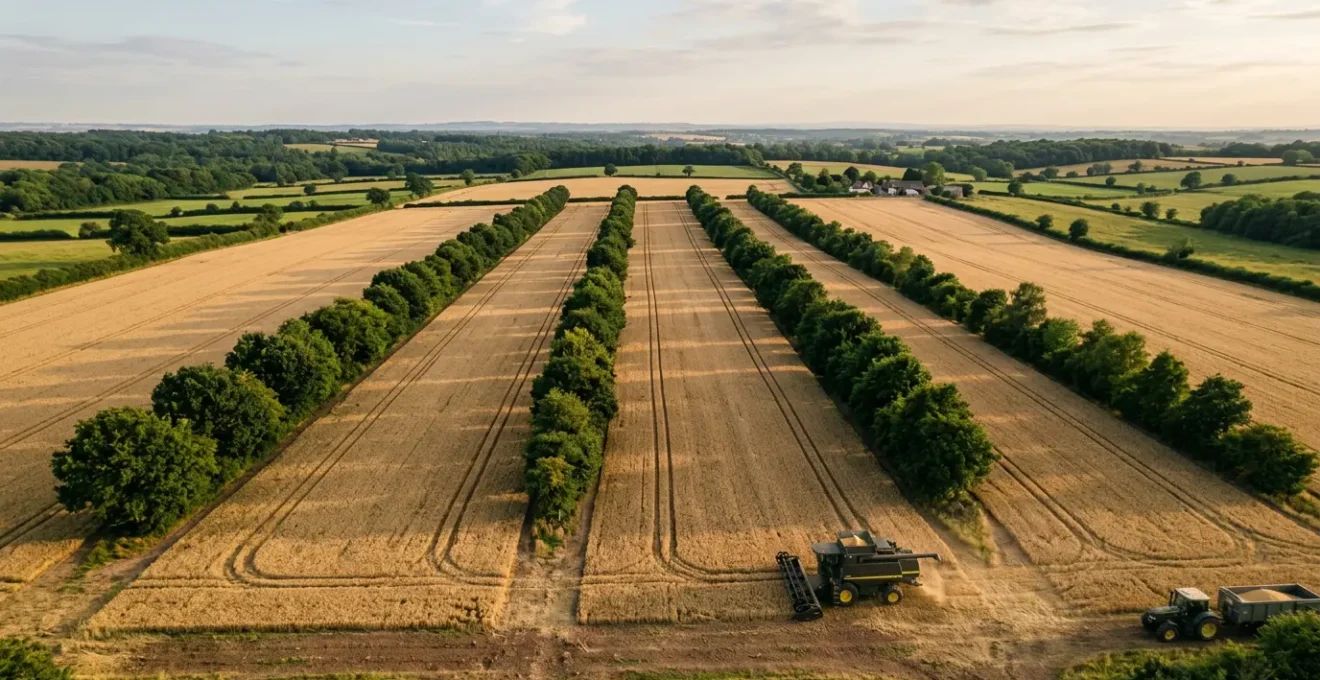
Integrating trees into a large-scale arable farm is not about sacrificing machinery efficiency; it’s an engineering challenge that can be solved with smart systems design.
- The system’s viability hinges on designing headlands and turning radii that match the operational footprint of your existing combine.
- A disciplined formative pruning schedule is essential to create machinery clearance and simultaneously produce high-value, knot-free timber.
- Cooperative machinery sharing models can drastically reduce the capital expenditure on specialised equipment needed for long-term management.
Recommendation: Approach your farm layout as a systems engineer, planning tree placement around machinery workflow to minimise non-productive time and maximise long-term asset integration.
For the large-scale arable farmer, the idea of planting trees can feel like a direct threat to operational efficiency. The conventional wisdom often suggests that adopting agroforestry means downsizing machinery, sacrificing the 30-foot combine harvester that makes modern farming viable. This creates a false choice: either embrace ecological benefits or maintain operational scale. Many discussions focus on the generic advantages of biodiversity or soil health, failing to address the primary concern of a practical farm manager: “How does this work with my existing, expensive equipment?”
The truth is, integrating trees is not an ecological compromise but a systems engineering problem. The solution doesn’t lie in smaller tractors, but in a more intelligent layout. By treating the farm as a cohesive system, where both the machinery and the trees are long-term assets, it’s possible to design an alley cropping layout that works with, not against, high-capacity equipment. This requires a shift in perspective—from simply planting trees to designing an integrated production system where every element, from turning radius to canopy height, is planned from the outset.
This guide moves beyond the abstract benefits and provides a practical, operational framework. We will dissect the critical design factors, focusing on how to make alley cropping work at scale. We’ll examine the non-negotiable role of headland space, efficient management techniques for tree rows, optimal alley widths for both machinery and ecology, and the long-term scheduling of pruning and harvesting that fits within the demanding arable calendar.
This article provides a detailed roadmap for designing and managing alley cropping systems that are fully compatible with large-scale farm machinery. Explore the sections below to understand the key operational considerations, from initial layout to long-term financial planning.
Contents: Designing an Efficient Alley Cropping System
- Why Headland Space Is the Critical Factor in Alley Cropping Design?
- How to Mow Tree Strips Efficiently Without Damaging Trunks?
- 24m or 36m: Which Alley Width Optimizes Biodiversity and Efficiency?
- The Pruning Schedule Required to Keep Alleys Clear for Cab Height
- When to Harvest Timber: Scheduling Forestry Work Around the Arable Calendar
- The Spacing Mistake That Makes Spraying Impossible in Alley Systems
- How to Reduce Fixed Machinery Costs by 20% Through Cooperative Agroecology?
- Planting Trees on Arable Land: How to Minimize Yield Loss at Headlands?
Why Headland Space Is the Critical Factor in Alley Cropping Design?
In any large-scale arable operation, efficiency is measured in minutes and metres. The single most significant point of failure for alley cropping integration is underestimating the operational footprint of large machinery, particularly at the headlands. A 30-foot combine doesn’t just need a 30-foot gap; it requires a wide, clear arc to turn efficiently without constant, time-consuming three-point turns. This non-productive time is a direct hit to profitability.
Therefore, the entire system design must begin with the machinery’s turning radius. Before a single tree is planted, you must map out the path of your largest piece of equipment. This involves more than just a simple measurement; it’s about simulating the machine’s movement at a realistic operating speed. Factors to consider include the space needed for the header to clear the first tree in the row upon entry and exit, and sufficient room for implements like sprayers and spreaders to fold and unfold.
A successful UK-based project designing a temperate alley cropping system provides a clear blueprint. The process started by assessing the farm’s existing machinery assets and their specific operational requirements. Only after defining the minimum headland radius and width did the project move to optimising row alignment and tree spacing. This machinery-first approach ensures that the tree layout serves the farm’s logistics, not the other way around. It transforms the headland from a potential bottleneck into a deliberately engineered component of an efficient system, proving that scale and agroforestry can coexist.
How to Mow Tree Strips Efficiently Without Damaging Trunks?
Once the alleys are established, the uncropped tree strips require ongoing management to control weeds and grass, which compete with young trees for water and nutrients. The most obvious solution, mowing, introduces a new risk: machinery damage. The bark of young trees is extremely thin, and even minor contact from a mower deck or string trimmer can girdle a tree, effectively killing it. The key to efficient mowing is creating a system that keeps equipment at a safe distance from the trunks.
Several practical strategies can be implemented. First, establishing a 2-3 inch layer of mulch around the tree base serves as a clear visual “no-go” zone for operators. Second, installing physical trunk guards provides a robust defence against accidental contact. Finally, eliminating the need for close-up work by removing turf at the tree base or using handheld clippers for detail work can prevent costly mistakes. These small preventative measures are part of a larger risk-mitigation strategy essential for protecting your long-term timber or fruit asset.
An even more integrated approach is to rethink mowing altogether. By incorporating livestock, the tree strip transforms from a maintenance liability into a productive grazing area. Sheep, in particular, are excellent for this role. They are light on the soil and their grazing habits naturally control vegetation without the risk of mechanical damage. This method of “biological mowing” is a prime example of systems engineering, stacking functions to create a more resilient and efficient farm.
As shown here, integrating livestock like sheep turns weed management into a productive enterprise. With temporary electric fencing, they provide precise, damage-free vegetation control around the valuable young trees, reducing labour and machinery costs while adding another revenue stream to the agroforestry system.
24m or 36m: Which Alley Width Optimizes Biodiversity and Efficiency?
The debate between 24m and 36m alley widths directly reflects the central tension in agroforestry design: balancing operational efficiency with ecological benefits. A 36-metre alley comfortably accommodates a 30ft (approx. 9m) combine with a sprayer or spreader that has a 36m boom, simplifying field operations into single passes. This is the pinnacle of operational efficiency. A 24m alley, however, requires more complex logistics, such as multiple sprayer passes or specialised equipment, potentially increasing non-productive time.
From an ecological standpoint, narrower alleys can lead to faster canopy closure, which enhances microclimate benefits and can increase the density of beneficial insects and birds. However, the orientation of the rows is far more critical than the exact width. As one research team noted, row orientation is a decision with decades-long consequences for everything from erosion to shading.
The orientation of tree rows within the field is one of the most crucial aspects of design and implementation, as it affects efficient field management (cultivation direction and therefore number of turns and headland), wind and water erosion, as well as shading, and thus persisting and influencing over decades the fields’ productivity.
– Research team studying orientation effects in alley cropping, ShadOT modelling tool study published in PMC
Furthermore, regulatory frameworks may impose constraints. For instance, to be eligible for certain payments under the EU’s CAP, agroforestry systems may need to maintain a minimum distance, such as 20m, between tree rows and the field edge. Ultimately, the choice is not just between two numbers. It’s a strategic decision based on your farm’s primary objectives. If maximising operational simplicity with existing large machinery is the goal, a wider 36m system is superior. If you are willing to adapt machinery and operations to boost ecological function, a 24m system could be considered, but the layout must be meticulously planned to avoid logistical nightmares.
The Pruning Schedule Required to Keep Alleys Clear for Cab Height
For an alley cropping system to be viable with large machinery, trees cannot be left to grow naturally. A disciplined, long-term pruning plan is not optional; it is a core component of the system’s design, essential for creating the vertical clearance needed for a combine cab and sprayer booms. This process, known as formative pruning or “high pruning,” involves systematically removing lower branches in the tree’s early years (typically years 3 through 10) to develop a long, straight, branch-free trunk.
The goal is to create a “tunnel” effect, where machinery can pass underneath the tree canopy without any risk of collision. This requires a clear target height, usually at least 5-6 metres, to accommodate the tallest equipment. Pruning must be done proactively, anticipating the future dimensions of both the trees and the machinery. Waiting until branches become a problem is too late; by then, they are too thick to remove without damaging the tree or leaving large knots that devalue the timber.
This intensive management is not just a cost; it’s an investment. As Jim O’Neill, an Agroforestry Development Manager, explains, high pruning serves three purposes: it provides machinery clearance, allows more light to reach the alley crops, and, crucially, produces valuable, knot-free timber. This final point is a major economic driver. In fact, research on pruned timber economics demonstrates that knot-free timber can attract premium prices 50-100% higher than unpruned logs. This turns a mandatory operational task into a significant source of future revenue, perfectly illustrating the principle of asset integration.
When to Harvest Timber: Scheduling Forestry Work Around the Arable Calendar
Timber harvesting in an alley cropping system is fundamentally different from traditional clear-fell forestry. The objective is not to liquidate the asset in one go, but to selectively harvest mature trees while maintaining the overall structure and ecological function of the system. This requires careful planning to integrate forestry operations into the tight schedule of an arable farm. The ideal window for harvesting is during the winter, after the cash crops are harvested and before spring drilling begins. This minimises conflict with primary farm activities and reduces the risk of soil compaction, as the ground is often firmer.
Low-impact harvesting techniques are essential. Instead of heavy, disruptive machinery, the focus is on methods that protect the soil and surrounding trees. This can involve using smaller, specialised extraction equipment or laying down temporary timber mats to create designated pathways, spreading the machine’s weight and preventing deep ruts. The goal is continuous cover, where individual trees are removed without disrupting the entire row, allowing younger trees to grow and ensuring the system’s benefits persist over time.
As Agroforestry Development Manager Jim O’Neill states, “Agroforestry aims to maintain the benefits that the trees bring over time, which means harvesting can look different.” This phased approach is another example of long-term systems engineering. It treats the timber not as a one-off windfall but as a perennial crop with a long rotation, providing a steady, diversified income stream that complements the annual arable revenue.
This image demonstrates a low-impact, selective harvesting operation. By working in the dormant season and using methods that protect the soil, timber can be extracted without compromising the integrity of the alley cropping system, ensuring its long-term productivity and ecological benefits remain intact.
The Spacing Mistake That Makes Spraying Impossible in Alley Systems
While headlands are critical for turning, the most common day-to-day operational mistake is failing to establish and enforce adequate buffer zones along the tree rows themselves. A sprayer boom travelling at speed has very little margin for error. Even a slight drift or operator miscalculation can cause the end of the boom to strike a tree trunk. With the bark thickness being less than 1/16 inch on young trees, such an impact can be devastating and is a frequent cause of tree mortality in poorly planned systems.
The mistake is assuming that the alley width alone provides sufficient clearance. In reality, a dedicated, inviolable buffer zone is required within the tree strip itself. This isn’t just a line on a map; it must be a physical and visual barrier for machinery operators. The goal is to design a system that makes it difficult, if not impossible, to get equipment too close to the tree trunks. This is a classic example of “designing for safety” applied to an agricultural context.
Creating these protective buffers is straightforward if planned from the start. By implementing clear guidelines, you build a resilient system that protects your tree assets from the daily pressures of arable operations. This proactive approach prevents the costly damage that can make spraying and other tasks impossible to carry out efficiently.
Action Plan: Establishing Machinery Buffer Zones
- Install Mulch Rings: Establish mulch rings extending at least 3 feet from the trunk base. This acts as a physical buffer and a clear visual cue for operators to keep their distance.
- Use Edging or Guards: Install decorative edging or highly visible tree guards to create a definitive boundary line that is easy to see from a tractor cab.
- Define Equipment Pathways: Clearly mark designated pathways for heavy equipment, especially during establishment or harvesting, keeping vehicles well clear of the drip line to prevent root zone compaction.
- Enforce No-Parking Zones: Strictly prohibit parking or driving any equipment within the tree drip line (the area directly under the canopy) to protect sensitive roots.
- Operator Education: Before any work begins, ensure all equipment operators are educated on the locations of root protection zones and the importance of respecting buffer areas.
Key Takeaways
- Alley cropping design for large farms must start with the machinery’s operational footprint, especially its turning radius at headlands.
- Formative pruning is a non-negotiable investment that provides essential machinery clearance and produces high-value, knot-free timber.
- Cooperative models for sharing specialised machinery are a proven strategy to overcome high capital costs and make large-scale agroforestry economically viable.
How to Reduce Fixed Machinery Costs by 20% Through Cooperative Agroecology?
One of the most significant barriers to adopting alley cropping at scale is the perceived need for a whole new fleet of specialised machinery for tasks like pruning, mulching, and harvesting. This capital expenditure can make the entire proposition seem economically unviable. As the UK’s Agricology network has noted, there is a “current lack of machinery tailored for intercropping systems.” However, the solution may not be individual ownership, but shared access.
Cooperative models offer a powerful strategy to overcome this financial hurdle. By pooling resources with neighbouring farms, a group of farmers can collectively purchase or lease specialised equipment, spreading the cost and increasing the utilisation rate of each machine. This approach can dramatically lower the fixed machinery costs for each individual farm—often by 20% or more—transforming the financial equation of agroforestry.
This isn’t a theoretical concept; it’s a proven model. The Route 9 Chestnut Cooperative in Kentucky provides a compelling example of this principle in action. Here, multiple farms work together to manage and harvest hay from over 1,800 acres of chestnut alleys. As highlighted in a case study on their cooperative model, sharing equipment makes the large-scale operation economically efficient. With their oldest trees now over 50 years old, the cooperative demonstrates the long-term viability and financial resilience that shared asset management can bring to agroforestry.
Case Study: The Route 9 Chestnut Cooperative Machinery Sharing Model
In Maysville, Kentucky, Hill Farms, Propagate, and Agroforestry Partners successfully manage and harvest hay across 1,860 acres of chestnut alleys as part of the Route 9 Chestnut Cooperative. This model proves how sharing specialized equipment for alley cropping systems enables farmers to manage large-scale agroforestry operations economically, reducing the capital burden on any single farm and ensuring long-term financial sustainability.
Planting Trees on Arable Land: How to Minimize Yield Loss at Headlands?
A primary concern for any arable farmer considering agroforestry is the potential for yield loss, particularly at the interface between the tree rows and the cropped alleys. The fear is that trees will compete for light, water, and nutrients, reducing the yield of the primary cash crop. While this competition is a real factor, a well-designed system can mitigate these effects and, in many cases, lead to greater overall land productivity.
The key lies in understanding the dynamics of shading and resource use. According to the Agroforestry Research Trust, yields of alley crops are not significantly reduced by shading until the tree height reaches the alley width. At that stage, the system is often mature enough to be transitioned to a more profitable silvopastoral (trees and livestock) system if desired. This provides a long operational window where both crops and trees can thrive. In fact, research on temperate alley cropping transformation shows that these systems often demonstrate “overyielding,” meaning the combined output of trees and crops is higher than if they were grown separately on the same land area.
Practical examples in the UK bear this out. A 50-acre field in Devon successfully integrated rows of apple and elder trees with heritage wheat grown in the alleys. The wheat was harvested and used by a local mill, demonstrating that productive arable yields can be maintained alongside tree crops. This not only minimises yield loss but creates a diversified, high-value local food system. The trees at the headlands and in the rows are not a source of loss, but the foundation of a more resilient and multi-functional agricultural landscape.
By adopting a systems-engineering mindset, it is entirely feasible to design and manage a productive alley cropping system that integrates seamlessly with your existing large-scale machinery. The key is to plan for your operational footprint from day one. To take the next step, begin by mapping the precise turning radius and clearance requirements of your combine and sprayer.