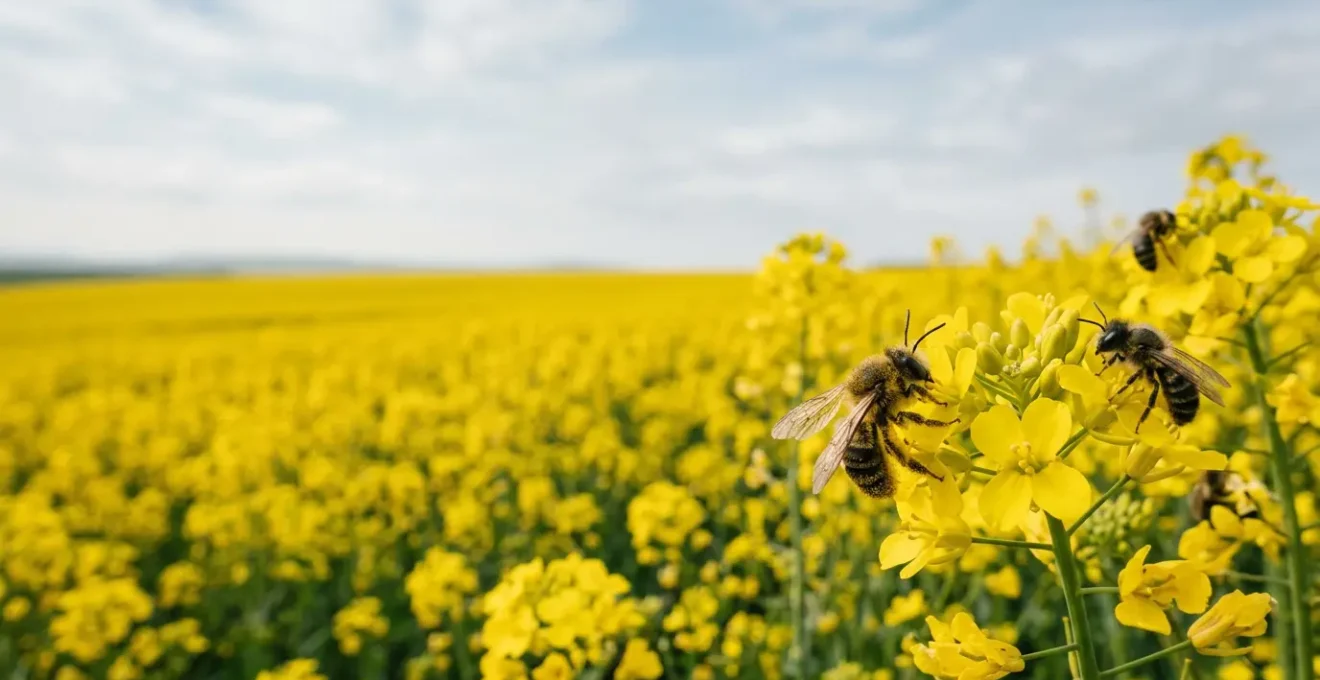
The key to breaking oilseed rape yield ceilings isn’t more inputs; it’s leveraging wild pollinators as a more efficient, self-sustaining, and profitable agronomic asset.
- Wild bees are proven to be 2-3 times more effective at pollination per visit than honeybees and are better adapted to UK weather conditions.
- Creating simple, on-farm habitats for these pollinators is a one-time investment that delivers compounding returns, unlike the recurring cost of renting honeybee hives.
Recommendation: Shift from a reactive, chemistry-focused approach to a proactive, system-building strategy that treats your farm’s ecosystem as your most valuable production tool.
For the modern oilseed rape (OSR) grower, hitting a yield plateau is a familiar frustration. You’ve optimized nutrient plans, refined your drilling strategy, and battled cabbage stem flea beetle with every tool available, yet the needle refuses to move. The conventional wisdom of “more inputs” is reaching its economic and ecological limits. We’ve been taught to look at soil, chemistry, and genetics for answers, often overlooking the most powerful, and free, workforce available: wild pollinators.
The common approach is to either rely on the partial self-pollination of the crop or rent honeybee hives, considering pollination a passive bonus. This perspective is fundamentally flawed. It ignores the significant “pollination deficit” that holds back most OSR crops and mistakes the most visible pollinator (the honeybee) for the most effective one. The reality, supported by extensive data, is that a healthy population of wild pollinators, particularly mining bees and hoverflies, is a direct driver of seed set, oil content, and ultimately, your gross margin.
But what if we stopped treating pollination as a matter of luck and started managing it as a quantifiable agronomic strategy? This article will shift your perspective. We will move beyond the platitude of “helping the bees” and provide a data-driven framework to treat wild pollinators as a productive farm asset. This is not about ecological charity; it’s about a calculated investment in natural capital that can outperform chemical inputs and unlock the final, most profitable 20% of your OSR yield potential. We’ll dissect the science, provide actionable plans for habitat creation, and present the hard economic evidence to prove that building a resilient farm ecosystem is the most forward-thinking business decision you can make.
This guide provides a complete, evidence-based framework for integrating wild pollinators into your farming system as a core profitability driver. It is structured to walk you through the ‘why’, the ‘how’, and the ‘how much’ of this powerful agronomic strategy.
Summary: A Strategic Guide to Pollinator-Driven OSR Profitability
- Why Wind Pollination Alone Leaves 30% of OSR Potential on the Table?
- How to Create Nesting Sites for Mining Bees Next to OSR Fields?
- Honeybees vs Wild Bees: Which Is More Efficient Per Acre of OSR?
- The Spraying Mistake During Flowering That Kills Your Free Workers
- How Close Must Flower Strips Be to the Crop for Maximum Effect?
- Which Wildflower Mix Attracts Hoverflies to Eat Aphids in July?
- Why You Must Release Predatory Mites Before You See the Pest?
- Biological Control in Polytunnels: Avoiding Thrip Damage Without Chemistry?
Why Wind Pollination Alone Leaves 30% of OSR Potential on the Table?
Oilseed rape is often considered a crop that can “get by” on its own, thanks to its ability to self-pollinate and be pollinated by wind (anemophily). This is a dangerous half-truth that masks a significant opportunity cost. While wind and self-pollination establish a baseline yield, they are inefficient processes, leaving a substantial portion of flowers unfertilized or poorly fertilized. This results in fewer seeds per pod and lower overall yield, creating what entomologists call a “pollination deficit”. This is the gap between your actual yield and your field’s maximum genetic potential.
Insect pollination is the key to closing this gap. When bees and other insects visit the flowers, they transfer pollen far more effectively than the wind, ensuring comprehensive fertilization. This leads not only to more pods but also to pods with a higher number of seeds, which is a direct driver of yield. The contribution is not marginal; it is substantial. For instance, while conditions vary, studies repeatedly demonstrate the impact of pollinator access. In fact, one study showed a 12% higher yield with pollinator access in fields, and other research suggests this deficit can be as high as 30% in UK conditions. Relying solely on wind and self-pollination is akin to intentionally operating your farm at 70-80% capacity.
For an OSR grower, this means that the plateau in yield you are experiencing may not be a nutrient or soil issue, but a biological one. You have a hidden, unpaid workforce waiting to be activated. The first step to boosting your yield is to acknowledge this deficit and recognise that active pollinator management is not just an environmental nice-to-have, but a critical agronomic lever.
How to Create Nesting Sites for Mining Bees Next to OSR Fields?
If wild pollinators are the workforce, then nesting sites are their home base. Unlike honeybees, which live in managed hives, over 90% of bee species are solitary. Many of the most important OSR pollinators, like mining bees (Andrena spp.), nest in underground tunnels. Providing these nesting sites is the single most effective action you can take to build a large, resident population of pollinators directly on your farm. The goal is to create permanent, safe habitats where they can thrive year after year.
Creating this habitat is surprisingly straightforward and can be done with existing farm machinery. The key is to create patches of bare, undisturbed, well-drained soil, ideally on south-facing banks to catch the sun. These “bee banks” provide the perfect conditions for female mining bees to excavate their nests. The image below shows a perfect example of what to aim for: a simple earth bank with visible tunnels, turning a non-productive field edge into a bustling pollinator factory.
As you can see, the structure is simple. The critical factors are the soil type (sandy or loamy), the exposure to the sun, and, most importantly, the guarantee of no disturbance from tillage or compaction. These sites become a permanent asset on your farm, with pollinator populations growing and compounding their value each season. This is proactive system-building, turning a marginal area into a high-value ecological service provider.
Action Plan: Creating a Bee Bank on Your Farm
- Site Selection: Identify a south-facing slope or field margin with well-drained, sandy-loam soil. Ensure it’s within 250 meters of the OSR crop to match the bees’ foraging range.
- Ground Preparation: Use a bucket loader or plough to strip vegetation, creating a patch of bare ground at least 5 feet wide. Firm the soil but do not over-compact it.
- Habitat Protection: Mark the area clearly. Ensure it is excluded from all future tillage, spraying, and vehicle traffic operations. This is a year-round habitat.
- Resource Connectivity: Check that the site is close to both the OSR field (pollen/nectar) and a water source (ditch, pond), which are essential for brood provisioning.
- Monitor and Maintain: Annually, in late winter, gently clear any encroaching dense vegetation to keep patches of bare soil exposed. Avoid deep disturbance.
Honeybees vs Wild Bees: Which Is More Efficient Per Acre of OSR?
The common solution for pollination has long been to rent honeybee (Apis mellifera) hives. However, from a data-driven, agronomic perspective for OSR, this is often an inefficient allocation of resources. While honeybees are excellent generalists, wild bees are specialists and far more effective pollinators of oilseed rape. They are the high-performance engines of pollination, and building their populations offers a much higher return on investment.
The superior efficiency of wild bees comes down to biology and behaviour. Research has consistently shown their advantage; for example, some studies found that native bees are 2 to 3 times more effective per visit at transferring pollen. This is because many wild bees are “pollen collectors” first, actively gathering pollen to provision their nests, while honeybees are primarily “nectar collectors” that pollinate more incidentally. Furthermore, native UK species like bumblebees and mining bees are better adapted to our climate, remaining active in the cooler, windier, and more overcast conditions that often keep honeybee colonies grounded during the crucial OSR flowering window.
The economic model also heavily favours wild bees. Renting honeybee hives is a recurring operational expense, whereas creating habitat for wild bees is a one-time capital investment that builds a self-sustaining, permanent asset on your farm. This shifts pollination from a cost centre to a compounding farm asset. The table below, drawing on data from multiple studies, outlines the clear strategic advantages of focusing on wild pollinators.
| Factor | Honeybees (Apis mellifera) | Wild Bees (Andrena, Lasioglossum, Bombus spp.) |
|---|---|---|
| Pollination model | Rental/recurring cost | One-time habitat investment |
| Per-visit efficiency | Baseline (1x) | 2-3x higher pollen deposition |
| Weather tolerance | Inactive in cool/windy conditions | Active in cooler temperatures and wind |
| Foraging motivation | Primarily nectar collectors | Primarily pollen collectors (better pollination) |
| Correlation with OSR yield | No significant relationship found in some studies | Positive association with seed set and yield/straw ratio |
| Behavioral advantage | Standard pollination | Buzz pollination capability (some species) |
| Long-term sustainability | Vulnerable to colony collapse, requires annual contracts | Self-sustaining if habitat maintained |
The Spraying Mistake During Flowering That Kills Your Free Workers
Once you’ve invested in building a wild pollinator workforce, the most critical mistake you can make is to inadvertently destroy it. Applying insecticides during flowering, especially during the day, is the agronomic equivalent of setting fire to your own factory. Bees and other pollinators are extremely vulnerable to pesticides, and even sub-lethal doses can impair their navigation and foraging abilities, effectively neutralising your pollinator asset for the season and poisoning the next generation in their nests.
The guiding principle must be to protect this valuable workforce with the same diligence you would apply to any high-value piece of equipment. This requires a shift in mindset: every spray application during or near flowering must be scrutinised for its necessity and its potential impact on pollinators. As experts from Michigan State University Extension state, the hierarchy of protection is clear and unambiguous.
The best way to protect pollinators from pesticide exposure is to avoid sprays while crop flowers are open.
– Michigan State University Extension, Pollinator stewardship during fruit crop bloom
When spraying is unavoidable, timing and technique are everything. The goal is to minimise any contact between active chemicals and foraging insects. This means moving away from a calendar-based schedule to one that is responsive, precise, and timed to avoid bee activity entirely. The following checklist provides a framework for auditing your spraying protocol to ensure it is pollinator-safe.
Checklist: Your Pollinator Protection Spraying Audit
- Timing Audit: Review spray records. Are all applications near flowering strictly limited to the period between sunset and sunrise, when bees are inactive?
- Necessity Audit: For each application, was it based on rigorous crop walking and established economic injury levels (EILs), or was it a preventative/routine spray?
- Drift Control Audit: Is your sprayer equipped with low-drift nozzles? Are applications always halted in winds that could cause drift onto field margins or flowering weeds?
- Formulation Audit: Review the products used. Are you prioritising liquid formulations over powders or micro-encapsulated products, which are more hazardous to bees?
- Habitat Contamination Audit: Have you mapped your bee banks and flower strips? Are you maintaining unsprayed buffer zones around these critical habitats to prevent runoff and drift contamination?
How Close Must Flower Strips Be to the Crop for Maximum Effect?
Creating nesting sites provides the “housing” for your pollinator workforce; planting wildflower strips provides the “canteen” and “service station.” These strips are not just for aesthetics; they are a critical piece of infrastructure in a high-performance pollination system. They provide a continuous source of nectar and pollen before and after the OSR crop blooms, sustaining the population and ensuring a large, healthy workforce is present the moment your crop needs it. But for this infrastructure to be effective, its location is paramount.
The effectiveness of a flower strip is directly related to its proximity to both the nesting sites and the crop itself. Most solitary bees have a limited foraging range, often just 200-500 meters from their nest. Therefore, for maximum impact, flower strips must be placed as close to the target crop as possible, ideally integrated directly into the field system as beetle banks, or planted along every field margin, as shown below. This creates a “pollinator highway” that funnels beneficial insects directly into the crop.
Placing a beautiful wildflower meadow a kilometre away from the OSR field is largely ineffective for crop pollination. The energy the bees would expend travelling would negate the benefit. The most effective strategies see flower strips as an integral part of the field, not a separate conservation area. By placing these resources where the bees need them, you are ensuring your investment in seed and habitat delivers a measurable return in the form of increased pollination within the cash crop. Think of it as logistics: you wouldn’t build a warehouse miles from the factory it’s meant to serve.
Which Wildflower Mix Attracts Hoverflies to Eat Aphids in July?
A brilliantly designed pollination strategy delivers benefits beyond just yield. By carefully selecting the species in your wildflower strips, you can simultaneously attract pollinators and a formidable army of pest predators. Chief among these are hoverflies. While adult hoverflies are important pollinators that feed on nectar and pollen, their larvae are voracious predators of aphids, one of the key secondary pests in OSR, especially in July after flowering.
This is a perfect example of “stacking functions” in an agro-ecological system. The same flower strip that supports your bees can also provide a free, self-replicating pest control service. The potential impact is huge; scientific studies demonstrate that a single hoverfly larva can consume over 400 aphids during its development. Multiplying that by the thousands of larvae a healthy habitat can support provides a level of pest suppression that would require repeated chemical applications.
To specifically attract adult hoverflies and encourage them to lay eggs near your crop, your wildflower mix should include plants with simple, open flowers that allow easy access to nectar and pollen. Hoverflies have short mouthparts and struggle with complex flower structures. The ideal mix, targeted for summer aphid control, should therefore be rich in:
- Umbellifers: Plants from the carrot family like Wild Carrot, Cow Parsley, and Fennel are exceptionally attractive to hoverflies.
- Daisies and Composites: Species like Yarrow, Ox-eye Daisy, and Corn Marigold provide perfect landing platforms.
- Simple Flowers: Phacelia and Buckwheat are fast-growing and provide abundant, easily accessible nectar, making them excellent components of any mix.
By including these species in your margins and beetle banks, you are not just feeding pollinators; you are actively recruiting a predatory workforce that will protect your crop later in the season, reducing your reliance on insecticides and further protecting your primary pollinator assets. This is the hallmark of a truly integrated and resilient system.
Key takeaways
- Wild bees are 2-3 times more efficient at pollinating OSR than honeybees and are better suited to UK weather.
- Creating simple, on-farm habitats like bee banks is a one-time investment that builds a compounding, self-sustaining pollinator workforce.
- The biggest threat to this asset is ill-timed spraying; applications during flowering must be avoided or restricted to night-time to protect your “free workers.”
Why You Must Release Predatory Mites Before You See the Pest?
The title of this section may seem to refer to polytunnels, but the underlying principle is the most important mental shift an OSR grower can make. It’s the philosophy of proactive system-building. In a greenhouse, a grower releases predatory mites *before* a red spider mite infestation takes hold, creating a standing army to prevent the problem from ever starting. This is in stark contrast to the traditional field-scale approach of “scout and spray”—waiting for a problem to appear and then reacting with chemistry.
Creating beetle banks and flower strips on your farm is exactly the same principle. You are proactively “releasing” a diverse population of ground beetles, spiders, hoverflies, and parasitoid wasps into your farm ecosystem. You are building the predator population *before* the slugs, aphids, and pollen beetles arrive. This is the core of Integrated Pest Management (IPM) applied at a landscape scale, a philosophy perfectly captured by this guiding principle.
Think Like a Greenhouse Grower – Frame habitat creation not as a passive act, but as a proactive release of a natural enemy army. You’re building the population before the problem starts.
– Integrated Pest Management Principle
This proactive approach creates resilience. Instead of your farm being a sterile environment where pests can multiply unchecked until a chemical intervention, it becomes a complex, dynamic ecosystem where pests are constantly suppressed by a resident population of natural enemies. The following case study on ground beetles exemplifies this perfectly.
Case Study: Proactive Habitat for Systemic Pest Control
Research on European oilseed rape fields demonstrated that establishing grassy banks and tussocks before pest emergence creates permanent habitat for ground beetles (Carabidae) that consume slugs and other OSR pests. These same habitat structures also serve dual purposes as overwintering sites for queen bumblebees. The study showed that fields with established beetle banks had significantly lower pest pressure and reduced need for chemical intervention. This proactive, ecosystem-building approach shifts the farming paradigm from reactive problem-solving (spraying when pests appear) to proactive system-building, where a healthy farm ecosystem becomes the most powerful and cost-effective pest management tool. The habitat investment is made once, but the beneficial insect populations compound year after year, creating a resilient farm asset.
Biological Control: How Lessons from Polytunnels Prove the Profitability of On-Farm Ecology
The final, and most persuasive, argument for adopting this strategy is the economic data. For too long, on-farm ecology has been framed as a cost or a regulatory burden. However, large-scale studies are now providing definitive proof that managing for beneficial insects is not just good for the environment; it’s one of the most profitable decisions a farmer can make. The lessons learned from controlled environments like polytunnels—where biological control is a standard, cost-effective practice—are now being validated in broadacre crops.
A landmark study published by the Royal Society provides the hard numbers to convince even the most sceptical grower. The research quantified the effects of pesticides, insect pollination, and soil quality on OSR yield and, crucially, on gross margin. The results were unequivocal.
Economic Proof: Bee Pollination Outperforms Pesticides for Profitability
This study across nearly 300 farm fields in France demonstrated that fields with higher pollinator abundance achieved 15-40% greater yields and gross margins compared to fields with reduced pollinator abundance. Critically, bee abundance and its interaction with insecticide use accounted for a staggering 70.4% of the total variance explained in yield. The research showed a significant negative interaction between insecticides and bees, proving that protecting and enhancing pollinator populations delivers more economic value than the chemical inputs designed to protect the crop. This data provides hard evidence that biological ecosystem services, when properly managed, are more profitable than chemistry-intensive approaches.
This data is transformative. It proves that the investment in habitat creation and pollinator-safe practices translates directly into a healthier bottom line. The study confirmed that farms with higher bee abundance could expect 15-40% greater yield and gross margins. This isn’t a small, marginal gain; it’s a significant leap in profitability that places pollinator management at the very heart of modern, data-driven agronomy. It confirms that the most powerful tool for boosting your OSR yield is already on your farm; you just need to learn how to manage it.
Start today by walking your field margins not just to look for pests, but to identify the potential for creating these high-value ecological assets. Your journey to breaking the yield ceiling begins with the first bee bank.