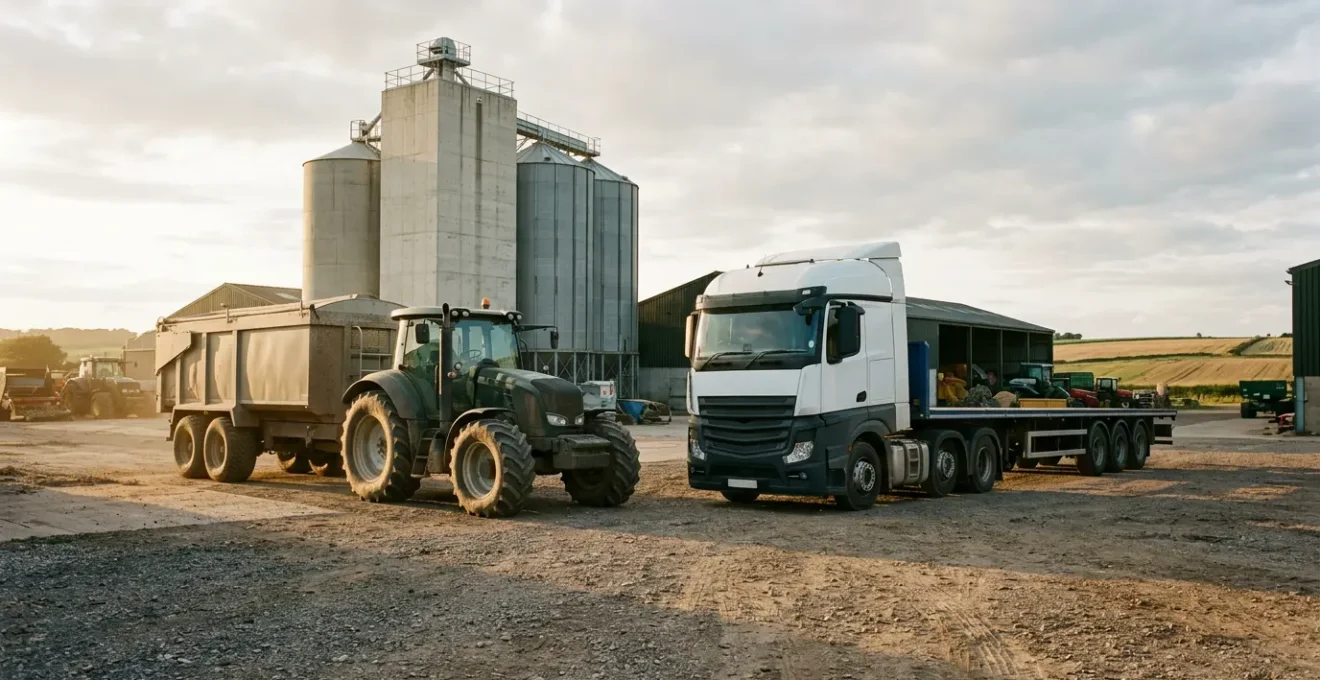
The decision to own a lorry is no longer a simple cost-per-mile calculation; it’s a strategic pivot to transform haulage from a cost centre into a competitive advantage.
- Owning an HGV provides unparalleled control over your supply chain, enabling guaranteed quality and just-in-time delivery that commands premium prices.
- Contractors offer flexibility but expose your business to volatile peak-season pricing, availability risks, and a loss of direct brand control.
Recommendation: A full audit of your delivery volume, distances, and potential for backhauling is the essential first step to determine the true risk-adjusted return on investment.
For any large-scale grain producer, the relentless rise in road haulage costs feels like a constant drain on profitability. Every invoice from a contractor is a reminder of a dependency you can’t control. The conventional wisdom suggests a straightforward calculation: weigh the costs of fuel, insurance, and a driver against the contractors’ fees. If your numbers are lower, you buy the lorry. This approach, however, misses the bigger picture and the strategic opportunities that are now on the table.
The conversation has moved beyond a simple line-item comparison. Factors like the loss of red diesel exemptions, driver shortages, and increasing buyer demands for supply chain transparency have changed the entire equation. Relying solely on third-party hauliers might offer short-term flexibility, but it can create long-term vulnerabilities. What if a contractor can’t meet your harvest-time demand? What if their standards don’t align with the premium markets you want to access? The real question is not just about saving money, but about taking control.
This analysis reframes the debate. We will treat the decision not as an accounting exercise, but as a strategic investment in your farm’s operational resilience and market power. By viewing an in-house lorry as a tool for logistical value-add, you can unlock new revenue streams, secure better contracts, and insulate your business from market volatility. This guide will walk you through the critical operational, regulatory, and financial factors, moving from the initial cost pressures to the advanced strategies that turn transport into a profit-driving asset.
To navigate this complex decision, this article breaks down the core financial, operational, and strategic considerations. We’ll explore everything from regulatory changes to contract negotiation, providing a clear framework for your analysis.
Table of Contents: A Strategic Analysis of Farm Haulage Options
- Why the ‘White Diesel’ Rule Change Killed the Farm Haulage Advantage?
- How to Reduce Empty Miles When Delivering Grain to Mills?
- Tractor & Trailer or HGV: Which Is Cheaper for 20-Mile Round Trips?
- The Tachograph Mistake That Can Lose You Your Operator’s Licence
- When to Move Grain: Avoiding Harvest Traffic vs Waiting for Winter Prices
- How to Reduce Fixed Machinery Costs by 20% Through Cooperative Agroecology?
- The Fine Print in Forward Contracts That Leaves You Exposed to Inflation
- How to Secure Long-Term Contracts by Guaranteeing Food Security Standards?
Why the ‘White Diesel’ Rule Change Killed the Farm Haulage Advantage?
The financial landscape for agricultural transport was fundamentally altered by the 2022 rule change restricting the use of rebated red diesel. Previously, many farm operations could use red diesel for a wider range of haulage activities, giving them a significant cost advantage over general hauliers who were required to use standard ‘white’ diesel. This effectively subsidized on-farm transport, making the decision to run an older lorry a relatively simple one. However, the new legislation has levelled the playing field in a way that penalizes inefficiency.
Now, any journey that is not strictly for “purposes relating to agriculture, horticulture, or forestry” requires the use of white diesel. This includes delivering your grain to a third-party mill or processor. The financial impact is immediate and substantial. For previously exempt users, this change has led to an approximate 47p per litre increase in fuel costs, instantly eroding the historical cost buffer that farm-owned transport enjoyed. This single regulatory shift acts as a catalyst, forcing a re-evaluation of the entire transport strategy.
This is no longer a question of marginal gains. The elimination of the fuel rebate means that if you choose to own and operate your own HGV, you are competing directly on operational efficiency with professional logistics companies. Every litre of fuel counts, and every poor decision regarding routing, vehicle maintenance, or driver performance is now fully exposed on your balance sheet. The new rules have made the strategic analysis of owning versus contracting more critical than ever before.
How to Reduce Empty Miles When Delivering Grain to Mills?
The single greatest source of inefficiency—and hidden cost—in any haulage operation is the “empty mile.” This is the distance a lorry travels without a payload, typically on the return journey after a delivery. For a grain producer, this means the entire trip back from the mill is often a pure cost with no revenue attached. When you use a contractor, this cost is baked into their overall rate. When you own the lorry, this cost becomes your direct responsibility, and minimizing it is the key to achieving a positive ROI.
The scale of this problem is significant across the industry. In fact, European transport statistics show around one-fifth (20%) of total road freight transport is carried out by empty vehicles. For a farm operation, a 50% empty running rate (delivery out, empty back) is the default scenario. Improving your asset utilisation rate by finding a “backload”—a paying load for the return journey—is the most effective way to make an owned lorry profitable. This requires a shift in mindset from simply being a grain producer to becoming a logistics operator.
This is where strategic route planning becomes essential. Before investing in a lorry, you must map out potential backloading opportunities. Are there local businesses that need goods transported from the area around the mill back towards your farm? This could be anything from agricultural supplies and fertiliser to construction materials. Establishing these relationships and utilising load-finding platforms transforms the return journey from a liability into a revenue stream. Without a credible backhauling strategy, the economics of owning your own lorry for grain delivery are fundamentally challenged.
As this perspective shows, the journey from farm to mill is not just a simple A-to-B route. It is a corridor of logistical opportunities. A successful in-house haulage operation depends on identifying and capitalising on the commercial activity along this entire corridor, not just at its endpoints. This proactive approach to logistics management is what separates a cost-draining vehicle from a profit-generating asset.
Tractor & Trailer or HGV: Which Is Cheaper for 20-Mile Round Trips?
For short-haul grain movements, particularly those under 20 miles, a common internal debate arises: is it more economical to use an existing high-horsepower tractor and a large trailer, or is a dedicated HGV a better investment? The tractor and trailer combination seems attractive on the surface; you already own the primary asset, and it avoids much of the regulatory burden associated with HGVs. However, a purely financial analysis often reveals a different story.
The key is to differentiate between fixed costs and per-mile operating costs. A tractor is not designed for sustained road haulage. Its engine and transmission are optimised for high-torque, low-speed fieldwork. On the road, this results in significantly higher fuel consumption per mile and slower average speeds (15-20 mph) compared to an HGV designed for road efficiency (50-60 mph). This speed difference directly impacts the most valuable resource on the farm: operator time. A round trip that takes an HGV 25 minutes could easily take a tractor over an hour, pulling skilled labour away from more productive farm tasks.
While the initial capital outlay for an HGV is higher, its operating efficiency makes it more economical as the number of annual trips increases. A tractor and trailer may be the cheapest option for a handful of local movements, but as soon as you approach or exceed 50 annual trips, the lower per-mile cost and time savings of an HGV begin to deliver a superior return on investment.
The following comparison, based on a model from agricultural economists, breaks down the key financial and operational differences. As the analysis from Iowa State University Extension shows, the break-even point is a critical calculation.
| Cost Factor | Tractor & Trailer | HGV Lorry |
|---|---|---|
| Fixed Costs (annual) | Lower (existing farm equipment) | Higher (depreciation, insurance, operator licence) |
| Per-Mile Operating Cost | Higher (slower speed, lower efficiency) | Lower (optimized for road transport) |
| Speed & Time Efficiency | 15-20 mph average | 50-60 mph average |
| Operator Time Value | High opportunity cost (farm labor) | Professional driver (dedicated role) |
| Break-Even Point | Optimal for <50 annual trips | Economical for 50+ annual trips |
| Regulatory Compliance | Minimal (agricultural exemptions) | Full (tachograph, O-licence, MOT) |
Ultimately, the decision hinges on volume and the opportunity cost of your labour. For a large grain producer making frequent deliveries, the HGV is almost always the more professional and financially sound long-term choice, even for seemingly short distances.
The Tachograph Mistake That Can Lose You Your Operator’s Licence
Beyond the financial calculations of fuel and maintenance, the single largest operational risk of bringing haulage in-house is compliance. The world of HGV operation is governed by a strict set of rules, and at the heart of this system is the tachograph. Mismanaging tachograph records is not a minor administrative error; it is the fastest way to incur heavy fines, driver suspensions, and potentially the revocation of your entire Operator’s Licence, effectively shutting down your transport operation.
The gravity of this cannot be overstated. For authorities like the DVSA in the UK, tachograph infringements are the primary focus of enforcement. In fact, statistics reveal that an overwhelming 84.5% of HGV operator convictions are related to offences concerning drivers’ hours and tachograph records. Common mistakes made by new operators include failing to download data from the vehicle unit and driver card within the legally mandated deadlines, not analysing the data for infringements, and failing to account for all mileage driven.
For a farm business transitioning into haulage, the most dangerous mistake is assuming that a casual approach will suffice. The system requires rigorous, documented processes. Simply having the equipment is not enough; you must have a robust system for data download, storage, and analysis. Forgetting to download a driver’s card for 29 days is not a small oversight—it is a prosecutable offence. Failure to properly train drivers on how to record their activities (e.g., switching the mode to ‘break’ or ‘other work’) can lead to a pattern of infringements that will be flagged immediately during a roadside stop or premises inspection.
Essential Tachograph Compliance Checklist
- Vehicle Unit Data: Download from the vehicle unit at a maximum of every 90 days.
- Driver Card Data: Download data from every driver card without fail every 28 days.
- Record Storage: Securely store all downloaded tachograph records for a minimum of 12 months.
- Systematic Reminders: Implement an automated reminder system for all download deadlines to prevent missed dates.
- Data Analysis: Analyze all downloaded data weekly to identify missing mileage and infringement patterns before they become a major issue.
Treating tachograph compliance as a core business function, on par with financial accounting, is non-negotiable. The risk of getting it wrong is simply too high, and ignorance of the rules is never an acceptable defence.
When to Move Grain: Avoiding Harvest Traffic vs Waiting for Winter Prices
A significant strategic advantage of owning your own lorry is the ability to decouple the act of harvesting from the act of transportation. When you rely on third-party contractors, you are often forced to move grain immediately post-harvest, a period when demand for haulage is at its absolute peak. This surge in demand creates a seller’s market for transport, exposing you to significant price premiums and the risk of contractor unavailability.
This peak season premium is not a minor fluctuation. In fact, transport industry analysis shows a 15-25% rate increase during peak agricultural seasons like the September-October harvest. By investing in adequate on-farm grain storage with proper aeration, you can hold your crop safely and choose to transport it during off-peak periods. This strategy offers a powerful dual advantage: you can wait for more favourable winter market prices for your grain while simultaneously booking transport when haulage rates are at their lowest.
Owning your lorry provides the operational leverage to execute this strategy perfectly. You are not at the mercy of a contractor’s schedule. You can plan deliveries for November, January, or February when roads are quieter and both internal and external transport costs are lower. This allows you to integrate your logistics directly with your market sales strategy. For instance, you could secure a forward contract for a January delivery and have complete confidence in your ability to meet that commitment without worrying about finding a haulier.
This approach transforms the lorry from a simple tool for moving grain into a key enabler of your entire commercial strategy. It gives you the power to choose the optimal time to sell and the optimal time to transport, maximising profitability on both fronts. The cost savings from avoiding peak-season transport premiums alone can contribute significantly to the lorry’s annual ROI.
How to Reduce Fixed Machinery Costs by 20% Through Cooperative Agroecology?
For many large producers, the financial barrier to owning an HGV isn’t the operating cost, but the high upfront capital investment and fixed annual costs like insurance and licensing. A powerful strategy to overcome this hurdle is to move beyond individual ownership and explore cooperative models. Sharing the ownership and operating costs of a lorry with one or two trusted neighbouring farms can provide the benefits of in-house transport at a fraction of the individual financial burden.
This approach, often seen in continental Europe, treats the lorry as a shared community asset. The core principle is to match the investment level to the usage requirement. By pooling resources, a group of three farmers can collectively purchase and operate a high-spec HGV that none of them could justify owning alone. This immediately reduces the capital outlay per farm and spreads the fixed costs, potentially lowering the total cost of ownership for each member by more than 20%.
Case Study: The Tiered Membership Cooperative Model
Successful farm machinery cooperatives often establish formal, tiered membership structures. For instance, a “premium” member might pay a higher annual fee to guarantee access during their critical harvest window, while “standard” members pay a lower fee plus a per-use charge. The success of these models hinges on clear, written agreements that cover liability, booking protocols, maintenance contributions, and exit strategies. Crucially, many successful co-ops hire a dedicated driver or part-time coordinator to manage the asset professionally, removing administrative friction and ensuring the service operates with the reliability of a commercial enterprise.
While this requires a high degree of trust and formal agreement, the financial and operational benefits are compelling. It allows farms to gain operational leverage and control over their logistics without bearing the full weight of the investment. It also fosters a culture of agroecological collaboration, where resources are used more efficiently across the local landscape, reducing the total number of vehicles and journeys required.
The key to success is moving from informal “handshake” arrangements to a professionally managed structure. With the right legal framework and a shared commitment to efficient utilisation, a cooperative lorry can be the smartest transport investment a group of farmers can make.
The Fine Print in Forward Contracts That Leaves You Exposed to Inflation
Whether you own your lorry or use contractors, the terms of your grain sales contracts can have a massive impact on your final transport profitability. Many producers focus solely on the headline price per tonne, overlooking clauses in the fine print that can erode margins. A common pitfall is accepting contracts where the transport cost is bundled into the commodity price, or where the buyer dictates the transport terms. This effectively hands control of your logistics costs to your customer.
To protect your business from inflation and unforeseen costs, it’s crucial to negotiate transport as a separate and distinct element of any forward contract. This provides transparency and allows you to manage that cost component proactively. If you have an in-house lorry, this negotiating stance is significantly strengthened. You can demonstrate your capacity to deliver at a known cost, giving you the operational leverage to reject unfavourable transport arrangements proposed by a buyer.
A robust negotiation strategy should always aim to mitigate risk. This means insisting on clauses that protect you from factors outside your control. For example, a fuel escalator clause, tied to a public government index, ensures that if diesel prices spike, the transport rate adjusts accordingly, protecting your margin. Similarly, you should specify precise delivery windows and include penalties for buyer-caused delays, such as not being ready to accept delivery, which would otherwise leave your driver and vehicle idle at your expense.
When entering contract negotiations, consider the following points as a non-negotiable part of your strategy:
- Always negotiate commodity price and transport costs as separate line items.
- Insist on a fuel price escalator clause tied to a transparent government fuel price index.
- Specify exact delivery windows and penalties for buyer-caused delays that impact your haulage costs.
- Retain the right to arrange your own transport if you can demonstrate it is more cost-effective.
- Define clear delivery terms, such as ex-farm or a maximum haulage distance covered by the agreed price.
By treating the transport agreement with the same diligence as the commodity sale itself, you transform the contract from a potential liability into a tool for securing predictable and profitable revenue.
Key Takeaways
- The decision to own a lorry is a strategic pivot, not just a cost-saving measure; it is an investment in supply chain control and market leverage.
- Minimizing empty miles through a robust backhauling strategy is the single most critical factor for making an in-house HGV profitable.
- Compliance is non-negotiable. The administrative rigour required for tachograph management and operator licensing must be treated as a core business function.
How to Secure Long-Term Contracts by Guaranteeing Food Security Standards?
In today’s competitive market, simply delivering grain at an agreed price is no longer enough to secure the most lucrative, long-term contracts. Premium food manufacturers, millers, and retailers are increasingly focused on the integrity of their entire supply chain. They demand traceability, quality assurance, and a verifiable chain of custody from the field to their factory gate. This is where owning your own lorry can transition from being a logistical tool to a powerful marketing and sales asset.
When you use a general haulage contractor, your grain is transported in a vehicle that might have been carrying non-food materials, animal feed, or other bulk products just hours earlier. Cross-contamination, however small the risk, is a major concern for quality-conscious buyers. By operating a dedicated, food-grade-only HGV, you can offer a guarantee that generalists cannot match. This provides a compelling unique selling proposition that justifies a price premium and builds immense trust.
This “logistical value-add” is a significant market differentiator. It demonstrates a professional commitment to quality that extends beyond the farm gate. You can create a tangible record of this commitment, cementing your status as a preferred supplier and moving the conversation away from a race-to-the-bottom on price.
Case Study: Dedicated Transport as a Market Differentiator
Forward-thinking farm businesses that own dedicated food-grade lorries are successfully marketing this capability to secure premium contracts. They maintain detailed vehicle logbooks to prove the lorry is never used for non-food cargo and follows a documented, auditable cleaning schedule between loads. Some have further enhanced this by adding low-cost IoT sensors to monitor temperature and humidity during transit, providing data-backed quality assurance reports with each delivery. This level of transparency allows them to integrate directly with a buyer’s production schedule, offering guaranteed Just-in-Time (JIT) delivery that reduces the buyer’s inventory costs and locks the farm in as an indispensable supply chain partner.
By investing in and properly managing your own transport, you are not just delivering a commodity; you are delivering a promise of quality, safety, and reliability. For buyers in the premium food sector, that promise is worth paying for, and it is the foundation upon which strong, resilient, and profitable long-term partnerships are built.
The next logical step is to conduct a detailed, risk-adjusted ROI analysis for your specific operation, weighing the capital investment against the potential for reduced costs, enhanced market access, and greater strategic control.