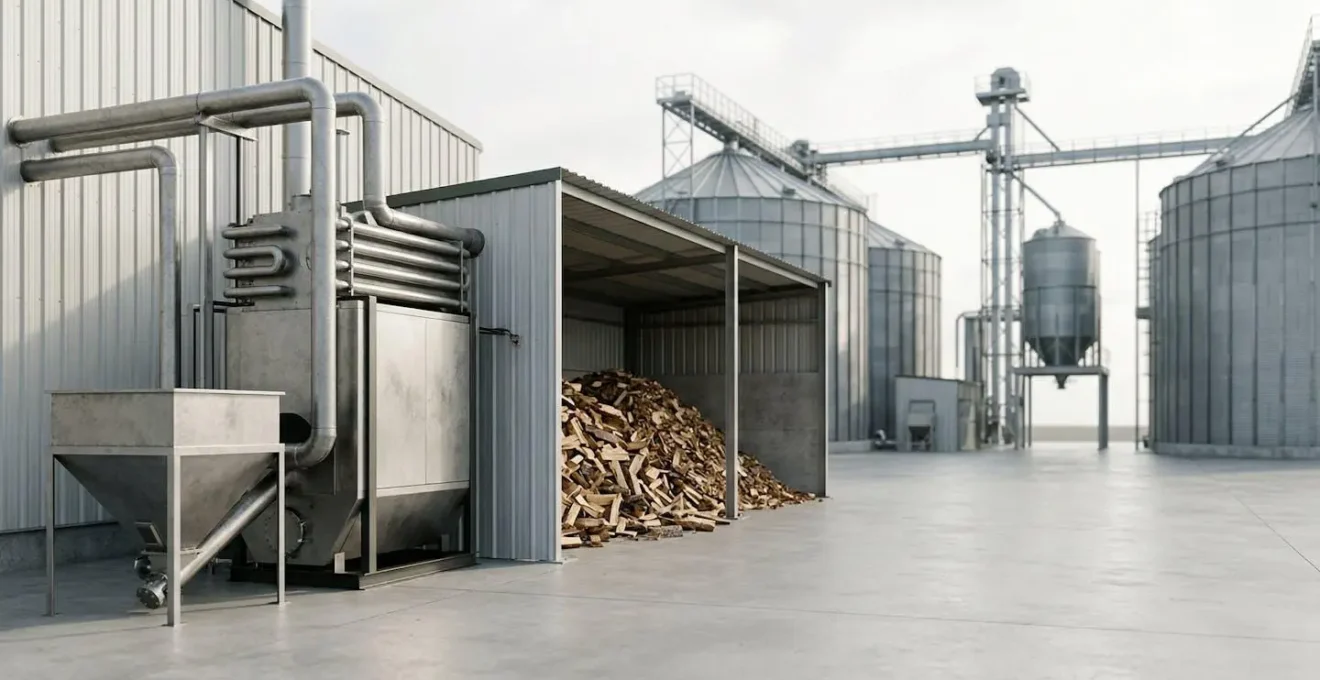
Switching from diesel to a biomass boiler for grain drying can reduce energy costs from over £100,000 to under £10,000 annually by transforming on-farm timber into a valuable fuel source.
- Success depends on engineering principles: correctly sizing the boiler’s kW output and managing fuel moisture to prevent rapid corrosion.
- Even without government subsidies like the RHI, the economic case is driven by the stark cost difference between purchased fossil fuels and processed on-farm wood.
Recommendation: Treat this as an integrated engineering project. Your first step is a feasibility study calculating your specific drying energy needs against your sustainable timber yield.
As any farmer knows, the post-harvest period brings one of the year’s most significant operational costs: the diesel or gas bill for grain drying. For decades, this has been an accepted, albeit painful, reality. The conventional approach has been to hunt for slightly cheaper fossil fuel suppliers or hope for a dry harvest. However, for farms with their own woodland, a far more strategic solution exists, one that turns a landscape asset into an energy powerhouse. This isn’t just about swapping one fuel for another; it’s about fundamentally re-engineering your farm’s energy system for cost-resilience and self-sufficiency.
Many discussions around biomass stop at “it’s cheaper” or “it’s green.” These statements are true, but they miss the critical details that determine success or failure. A poorly specified or managed biomass system can become a liability, suffering from corrosion, inefficiency, and regulatory breaches. The real key to unlocking the immense savings is not just buying a boiler, but mastering the integrated system: the fuel, the combustion process, the control systems, and the heat delivery to your grain store. This requires thinking like an engineer.
This guide provides the technical and practical framework to do just that. We will move beyond the surface-level benefits to dissect the core engineering principles. We’ll cover how to avoid catastrophic boiler corrosion, accurately calculate the energy duty cycle required for your tonnage, assess the economic viability in a post-subsidy world, and navigate the critical regulations that govern installation. Finally, we’ll explore how to fully close the loop by turning the system’s “waste” into a valuable input for your land.
To navigate this technical subject, this article is structured to walk you through each critical engineering consideration, from fuel quality to system safety. The following summary outlines the key stages of specifying and operating a successful biomass heating system for your grain store.
Summary: A Technical Guide to On-Farm Biomass Grain Drying
- Why Burning Wet Woodchip Corrodes Your Boiler in 2 Seasons?
- How to Calculate the kW Output Needed to Dry 500t of Wheat?
- RHI Closure: Is Biomass Still Viable Without Government Payments?
- The Flue Height Mistake That Breaches Clean Air Regulations
- How to Recycle Wood Ash Back to Land as a Potash Fertilizer?
- How to Season Firewood in 6 Months Using Polytunnels?
- When to Run Fans: Using Automated Differentials to Save Electricity
- How to Prevent Grain Store Fires Using Remote Heat Sensors?
Why Burning Wet Woodchip Corrodes Your Boiler in 2 Seasons?
The single most critical factor determining the lifespan and efficiency of a biomass boiler is fuel quality, specifically its moisture content. While it’s tempting to chip and burn freshly felled “green” wood, doing so creates a highly corrosive environment that can destroy a new boiler in as little as two seasons. The problem lies in the physics of combustion and the chemistry of the flue gases. High moisture content in the woodchip lowers the combustion temperature inside the boiler. This incomplete, cooler burn produces a cocktail of volatile compounds, including chlorides and sulphates derived from the wood itself.
When these compounds mix with water vapour in the flue gas, they form aggressive acids. As this gas travels through the system and cools against the heat exchanger surfaces, it reaches its “dew point,” causing the acidic moisture to condense directly onto the metal. According to detailed research, this process is accelerated because hygroscopic salts in the deposits actively absorb moisture, forming concentrated salt solutions that eat away at the steel. This is why research published in Energy & Fuels identified this low-temperature corrosion as a primary failure mechanism in biomass boilers.
To prevent this, boiler manufacturers universally recommend maintaining a fuel moisture content below 30%, with an ideal target of around 15% to 20%. At this level of dryness, the combustion temperature is high enough to ensure complete burning, keeping corrosive elements in a gaseous state until they are safely expelled out of the flue. Furthermore, system maintenance during downtime is just as critical. The American Boiler Manufacturers Association (ABMA) provides a stark warning on this separate but related issue:
Oxygen pitting can perforate a boiler tube in as little as two to three weeks during an unprotected idle period.
– American Boiler Manufacturers Association (ABMA), Boiler layup procedures and corrosion prevention guidelines
This highlights that system integrity depends on managing moisture both in the fuel during operation and in the boiler itself during shutdown periods. Ignoring fuel energetics isn’t a minor inefficiency; it’s a direct cause of premature and catastrophic equipment failure.
How to Calculate the kW Output Needed to Dry 500t of Wheat?
Sizing a biomass boiler for grain drying is not a matter of guesswork; it requires a precise calculation of the system’s required thermal duty cycle. An undersized boiler will fail to dry the grain in the required weather window, risking spoilage, while an oversized boiler represents a significant and unnecessary capital expense. The calculation begins with a simple question: how much water do you need to remove?
Let’s take a practical example: drying 500 tonnes of wheat from a harvest moisture content of 18% down to a safe storage level of 13.5%. This 4.5% reduction represents 22.5 tonnes (22,500 kg) of water that must be evaporated. The next step is to determine the energy required for this phase change. As a baseline, agricultural engineers estimate approximately 1,200 BTU of energy is needed to remove one pound of water from grain. Converting this to metric and kWh (1 kWh = 3,412 BTU), we can establish the total energy demand.
However, this raw figure is just the start. A robust calculation must also account for several real-world variables. These include the specific heat capacity of the grain itself (oats and wheat behave differently), the ambient air temperature and humidity which dictate the air’s capacity to absorb more moisture, and, crucially, the system’s inherent inefficiencies. Heat is always lost through ductwork and the structure of the drying floor, typically adding 10-25% to the total energy requirement. Finally, the boiler’s kW rating must be sufficient to deliver this total energy within your operational timeframe, whether that’s 100 hours or 200 hours of drying. Matching fan airflow (CFM) to the boiler’s heat output is the final step in designing a balanced and effective system.
RHI Closure: Is Biomass Still Viable Without Government Payments?
For many years, the decision to install a biomass boiler was heavily influenced by the Renewable Heat Incentive (RHI), a government scheme that provided attractive quarterly payments. With the closure of the RHI to new applicants, a critical question arises: does the economic case for biomass still stand on its own? The answer, for a farmer with access to their own timber, is an emphatic yes. The financial model has simply shifted from subsidy-chasing to a more fundamental focus on operational cost displacement.
The economics are now driven by a direct comparison: the cost of running your grain dryer on diesel or LPG versus the cost of processing your own timber. The former involves purchasing a volatile, expensive commodity, while the latter involves your own labour, machinery running costs (chipper, tractor), and maintenance. When calculated, the savings are often staggering. For instance, data from one installation showed how a switch to biomass allowed a customer to reduce grain drying energy costs from $130,000 annually on fossil fuels to just $8,000 in operational costs for their biomass system. This represents a saving of over 90%.
This isn’t an isolated case. Real-world farm operations demonstrate the powerful economics at play, even when accounting for all associated labour and processing costs.
Case Study: Mountfair Farming, Scottish Borders
Mountfair Farming provides a clear example of post-RHI viability. By integrating a 1MW biomass boiler into their grain drying operation, they successfully halved their drying costs. The cost fell from a straight diesel figure of £4-£5 per tonne to just £2-£2.50 per tonne using biomass as a pre-heating source. This calculation already factors in the costs of fuel processing and labour, proving that the primary saving on fuel purchase far outweighs the operational overhead of using on-farm timber.
The closure of the RHI has, in effect, clarified the business case. The investment is no longer about generating an income stream from subsidies but about making a strategic capital investment to virtually eliminate one of the largest and most volatile variable costs in an arable farming operation. The return on investment is now measured directly in annual diesel savings.
The Flue Height Mistake That Breaches Clean Air Regulations
Specifying a biomass boiler system goes beyond simple heat calculations; it is a construction project that must comply with strict environmental and building regulations. One of the most frequently overlooked, yet most critical, aspects is the design and height of the boiler’s flue or chimney. An incorrectly specified flue not only impairs boiler performance but can also constitute a breach of the Clean Air Act, leading to potential fines and enforcement action from the local authority.
The primary purpose of the flue is to safely disperse the products of combustion, including particulate matter (PM), high enough into the atmosphere to prevent them from causing a local nuisance or impacting air quality. The regulations are particularly stringent for larger systems. Any biomass boiler exceeding a fuel burn rate of 45.4 kg/hr (approximately equivalent to a 100-150 kW boiler, depending on fuel) requires a formal chimney height approval from the local council. Getting this wrong can be a costly mistake, potentially requiring a complete re-installation.
Determining the correct height is not a simple rule of thumb. It is a technical calculation that must account for the building’s height, the local topography, the presence of nearby tall buildings or trees, and the boiler’s specific heat output. For installations within designated Air Quality Management Areas (AQMAs), a more detailed dispersion modelling assessment may be required. Failing to get this right at the planning stage is a major compliance risk.
Action Plan: Key Checks for Chimney Height Determination
- Assess Draught Requirements: First, determine the necessary height to create the optimal draught for your specific boiler model, following the guidance in Approved Document J of the Building Regulations.
- Evaluate Site-Specific Factors: Account for the immediate environmental context, including local terrain, dominant wind direction, and the proximity of any higher buildings that could disrupt airflow and dispersion.
- Factor in Thermal Output: The calculation must include the total kW/hr rating of the boiler room and the appliance’s efficiency, as this determines the volume and temperature of flue gases.
- Match Flue Specifications: Ensure the flue diameter and material (e.g., twin-wall insulated stainless steel) are correctly specified by the manufacturer for the boiler’s output and fuel type.
- Check Local Air Quality Rules: For installations in or near an AQMA, use the official Biomass Assessment Tool (like TG09 in the UK) to evaluate emission dispersion requirements.
- Consult All Stakeholders: Before any installation work begins, consult with the boiler manufacturer, a certified installer (such as HETAS), your local authority’s planning and environmental health departments, and your farm insurance provider.
Ultimately, the flue is an integral safety and compliance feature of the boiler system. Treating it as an afterthought is a risk that is not worth taking, both financially and legally.
How to Recycle Wood Ash Back to Land as a Potash Fertilizer?
A well-managed biomass system embodies the principles of a circular economy, turning a waste product from one process into a valuable input for another. The ash produced by the boiler is not waste to be disposed of; it is a potent source of mineral nutrients that can be recycled back to the land, reducing the need for purchased fertilizers and closing the farm’s nutrient loop.
Clean wood ash, derived from untreated timber, is an excellent organic source of Potassium (K), commonly known as potash. Potassium is a vital macronutrient for crop growth, playing a key role in water regulation, enzyme activation, and starch formation. In addition to potassium, wood ash is rich in Calcium Carbonate, which has a liming effect, helping to raise the pH of acidic soils. It also contains other essential micronutrients like magnesium, phosphorus, and manganese. The key nutrient it lacks is Nitrogen, which is volatilized during combustion.
However, applying wood ash requires the same precision as applying any other fertilizer. It is not a material to be spread indiscriminately. The first step is to get the ash professionally analysed to understand its exact nutrient composition and pH. A corresponding soil analysis of the target fields is also essential. This data allows you to calculate a safe and effective application rate that meets the crop’s nutrient requirements without over-applying or excessively raising the soil pH.
Application should be done evenly using a lime or fertilizer spreader, and it’s best to avoid applying it at the same time as nitrogen-based fertilizers (like urea), as the high pH of the ash can cause the nitrogen to be lost to the atmosphere as ammonia gas. By treating wood ash as the mineral fertilizer that it is, you can offset a portion of your annual P and K fertilizer bill, adding another layer of economic benefit to the biomass system while improving your farm’s soil health and sustainability.
How to Season Firewood in 6 Months Using Polytunnels?
As established, achieving a low moisture content in your woodchip is non-negotiable for boiler health and efficiency. While traditional open-air seasoning of logs can take 18-24 months, it is possible to accelerate this process significantly and dry woodchip to its optimal state in as little as six months using a simple, cost-effective structure: a polytunnel or a purpose-built solar kiln. This active drying method gives you complete control over your fuel quality.
The principle is to create a ‘solar kiln’ that harnesses the sun’s energy. This is typically a three-sided bay or shed with a clear roof made of polycarbonate or heavy-duty polytunnel plastic. This roof traps solar radiation, significantly raising the internal air temperature. The floor of the bay is crucial; it should be a perforated or slatted floor system, often built from pallets or wooden bearers, creating an air plenum underneath the chip pile. This ensures air can circulate through the entire mass of wood, not just over the top.
The ‘active’ component is a low-power circulation fan. This fan, often controlled by a timer or a humidistat, pulls the warm, dry air from outside through the plenum and up through the chip pile. As the air passes through the wood, it picks up moisture and becomes saturated. The fan then expels this moisture-laden air out of the structure. This constant, forced ventilation is what dramatically speeds up the drying process compared to passive air-drying. For this to work effectively, the chip pile should not be too deep—a maximum depth of 1.2 to 1.5 metres is recommended to ensure good air penetration.
The economic incentive for taking this step is substantial. Beyond protecting your boiler investment, producing your own perfectly seasoned fuel is far cheaper than buying it in. As one manufacturer notes, using woodchips at optimal dryness can provide a 60% fuel cost reduction compared to buying pre-dried chips at market prices. Building a simple solar kiln is a small investment that pays huge dividends in fuel cost and system reliability.
When to Run Fans: Using Automated Differentials to Save Electricity
Once you have a source of heat from your biomass boiler, the next challenge is applying it intelligently to the grain. A common and costly mistake is to run the drying fans continuously, regardless of the ambient weather conditions. This wastes a tremendous amount of electricity and can even be counterproductive, potentially adding moisture back into the grain if the outside air is too humid. The engineering solution is to use an automated differential controller to manage the entire drying system.
A differential controller is the brain of the operation. It uses at least two sensors: one measuring the temperature and relative humidity of the ambient air outside, and another measuring the conditions in the air plenum beneath the grain. It continuously compares these two readings to determine if the outside air has the capacity to dry the grain. The fans are only activated when the controller calculates that running them will have a net drying effect. This simple logic can cut fan electricity consumption by 30-50% or more compared to continuous running.
The integration with a biomass boiler makes this system even more powerful. The controller can be programmed to act as the master for the entire system. Its primary strategy is to use unheated ambient air whenever possible. However, when it detects that the ambient air’s relative humidity is too high to be effective (a common occurrence overnight or during damp weather), it can automatically call for heat from the biomass boiler. The boiler then provides a small amount of supplemental heat—just enough to raise the incoming air temperature by a few degrees (e.g., 5-8°C), which dramatically lowers its relative humidity and restores its drying potential.
This integrated approach, as seen in systems like the Opico 4810 dryer, ensures maximum efficiency. The boiler is only fired when absolutely necessary, and the fans only run when they can be effective. This represents true system integrity, where the controls, fans, and heat source work in concert to achieve the desired result with the minimum possible consumption of both electricity and biomass fuel.
Key Takeaways
- Fuel moisture is the single most important factor for boiler longevity and efficiency; below 20% is the target to prevent acid corrosion.
- Correct boiler sizing is not a guess; it requires an engineering calculation of the specific thermal duty cycle needed to remove a target water mass from your grain within a set time.
- Post-RHI, the economic viability of biomass is now purely driven by the direct operational savings of replacing purchased fossil fuels with processed on-farm timber.
How to Prevent Grain Store Fires Using Remote Heat Sensors?
The final pillar of a professionally managed biomass and grain storage system is safety, specifically the prevention of fires. While boiler room safety is paramount, an equally significant risk lies within the stored materials themselves: the grain and the woodchip pile. In both cases, pockets of excess moisture can trigger biological activity (mould and microbial growth), which generates heat. If this heat cannot escape, it can build up to a point of spontaneous combustion. This risk makes temperature monitoring an essential, not optional, safety protocol.
The most effective way to manage this risk is through the use of remote heat sensors. These are typically long probes containing multiple thermocouples at different depths, which are inserted directly into the grain bulk or the woodchip pile. These sensors provide a continuous, real-time picture of the temperature profile throughout the stored mass. Modern systems are wireless and can transmit data directly to a computer or smartphone, allowing for constant monitoring without having to be physically present.
The purpose of this monitoring is early detection. The system can be configured to trigger an alarm if any sensor detects a temperature rising above a pre-set safety threshold (e.g., 20°C for long-term grain storage). This alarm gives you the early warning needed to take corrective action before a dangerous situation develops. The action might involve turning on ventilation fans to cool the ‘hot spot’ or, in more advanced cases, using a screw conveyor to move the affected grain or chip out of the store to break up the hot spot and allow it to cool.
This proactive approach to safety is the final component of a truly integrated system. It links the condition of the stored material directly to the control systems (alarms and fans), creating a feedback loop that protects your valuable assets—the grain, the fuel, and the infrastructure itself. It moves safety from a reactive hope to a managed, data-driven process.
The logical next step is to commission a detailed feasibility study for your specific farm. This should begin with an accurate assessment of your sustainable timber resources against your calculated grain drying energy needs to build a robust business case for the investment.