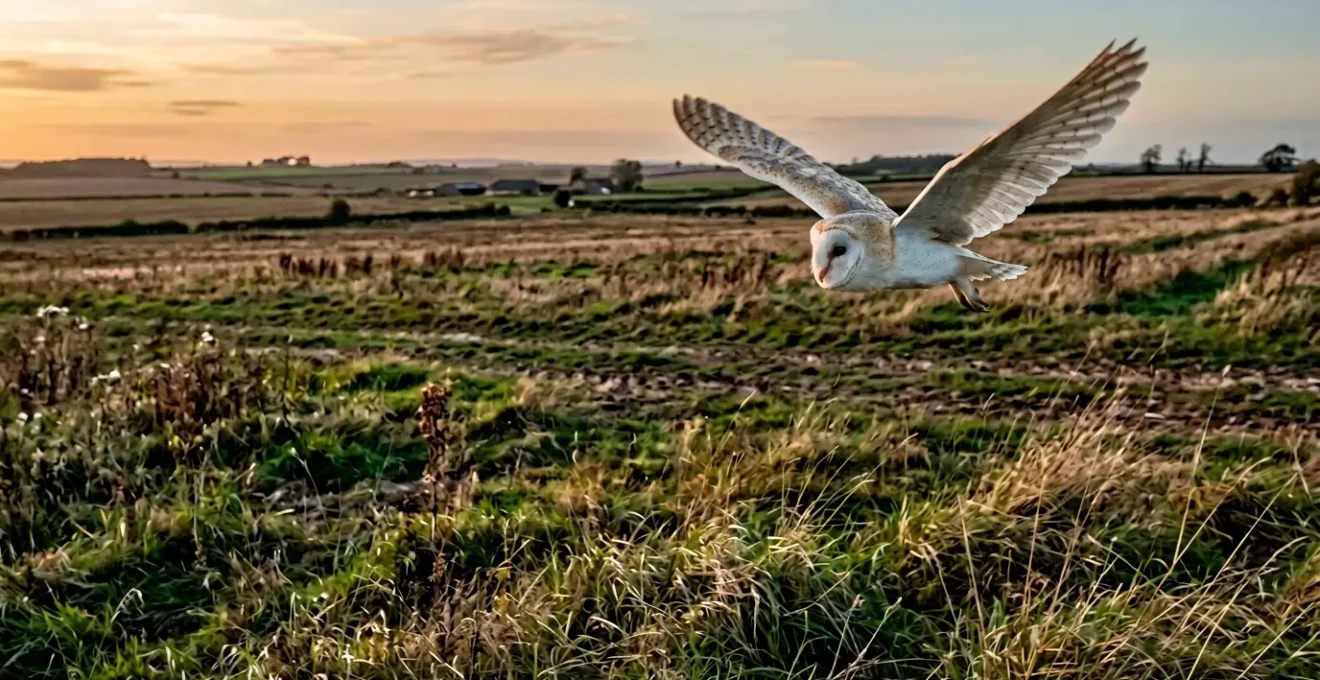
Barn owls aren’t just an alternative to poison; they are a more profitable investment, capable of drastically cutting your cost-per-kill for rodents by over 95%.
- A single breeding pair can eliminate up to 1,800 rats a year, working for free every single night.
- Modern, safer rodenticides are available that can control rats without causing the devastating secondary poisoning that kills your resident owls.
- True success comes from designing a complete on-farm system with habitats like grass strips and beetle banks that support a resilient food web.
Recommendation: Shift your mindset from endlessly “baiting” pests to proactively “building ecological infrastructure” for long-term, self-sustaining, and more profitable rodent control.
As a grain store owner, you know the sinking feeling. You see the tell-tale signs of rats—the droppings, the gnawed bags, the constant, low-level drain on your profits. The cycle is exhausting and expensive: you spend a small fortune on bait, worry about resistance rendering it useless, and live with the nagging concern of poisoning non-target animals, or worse, contaminating your stock. The conventional wisdom is to just keep baiting, maybe trying a different, more expensive poison next time.
Many people have heard that barn owls are “good” for pest control, perhaps suggesting you “put up a nest box.” This is often where the advice stops, leaving it as a quaint, feel-good alternative rather than a serious business strategy. But what if this view is fundamentally flawed? What if the most effective, resilient, and ultimately cheaper solution isn’t just swapping one tool (bait) for another (an owl), but redesigning your approach entirely?
This article will demonstrate that the key to mastering rodent control lies not in a simple substitution, but in building a complete, self-sustaining ecological system on your farm. We’ll move beyond platitudes and dive into the hard economics, the practical ‘how-to,’ and the system-wide thinking that transforms a recurring pest control expense into a permanent, working farm asset. By understanding the true cost-per-kill and the dynamics of your farm’s ecosystem, you can create a landscape where predators thrive and pests are naturally and continuously suppressed.
This guide provides a comprehensive overview of the strategy, from the economic justification to the practical design of habitats. Explore the full picture to understand how each piece connects to build a more resilient and profitable operation.
Summary: The Bottom Line on Barn Owls: A Cheaper, Better Way to Control Rats Than Poison
- Why a Pair of Barn Owls Eats More Rats Than 5kg of Bait?
- How to Position Owl Boxes to Maximize Occupancy Rates?
- Cats or Kestrels: Which Is Better for Mouse Control in Hay Sheds?
- The Rodenticide Mistake That Kills Your Resident Owls
- How to Manage Rough Grass Strips to Boost Vole Populations for Owls?
- Why Carabid Beetles Are Your Best Defense Against Slugs?
- Why Moisture Migration Creates Hotspots Even in Dry Grain?
- How to Design Beetle Banks That Qualify for SFI Payments?
Why a Pair of Barn Owls Eats More Rats Than 5kg of Bait?
The comparison between barn owls and rodenticides isn’t about equivalence; it’s about a fundamental difference in efficiency and cost. While bait is a consumable expense, a barn owl is a self-replicating, highly motivated pest control asset. The sheer volume of their work is staggering. Field research from oil palm plantations demonstrates that a single breeding pair can consume between 1,500 to 1,800 rats per year. This isn’t a one-time effect; it’s a continuous, nightly service provided for free once the initial infrastructure is in place. Young owls, once they fledge, will also contribute to this hunting pressure.
This relentless predation translates into dramatic economic benefits. The most powerful way to see this is through the cost-per-kill metric. A landmark three-year study in California vineyards calculated the true cost of different methods. It found that conventional trapping cost an average of $8.11 per rodent removed. In stark contrast, the cost per rodent killed by barn owls was just $0.34. That’s a 96% reduction in cost, a number no grain store owner can afford to ignore. This isn’t a fluke; other data backs this up. In Malaysia, the introduction of barn owl programs led to a 50 to 100% reduction in baiting costs for oil palm plantations, effectively eliminating a major operational expense.
The math is simple. A block of bait kills a finite number of rats and then it’s gone, requiring repurchase. A pair of owls kills thousands, teaches its young to kill thousands more, and asks only for a safe place to live in return. It’s the difference between paying a recurring subscription fee and making a one-time capital investment that pays dividends for years.
How to Position Owl Boxes to Maximize Occupancy Rates?
Simply erecting a nest box is not a guarantee of success; it’s a piece of ecological infrastructure that must be sited with strategic intent. While general baseline data from agricultural installations shows a respectable 50% occupancy rate, you can significantly beat these odds by understanding what an owl is looking for: safety, quiet, and access to food. The placement of the box is as critical as its construction.
Think of it from the owl’s perspective. They need a clear, unobstructed flight path to their primary hunting grounds—open fields, grasslands, and field margins. They are sensitive to constant human and vehicle traffic, and to noise pollution. Placing a box on a busy grain-loading bay is far less likely to succeed than mounting it on a quieter, dedicated pole or a less-frequented building facing away from the hub of activity. The goal is to create a secure launching point into their “workplace.”
The surrounding landscape is paramount. Barn owls typically hunt within a 1.5km radius of their nest, so the quality of the habitat within that circle dictates the box’s attractiveness. A box surrounded by well-managed rough grass strips and connected hedgerows is prime real estate. Research has even shown that placing two boxes on the same large barn can be more effective than single boxes, possibly due to social cues or providing alternative roosting sites.
Your Action Plan: Nest Box Placement Checklist
- Altitude Check: Install boxes at locations below 700 meters, as higher altitudes are negatively correlated with occupancy.
- Pairing Strategy: When possible, place two nest boxes on the same large barn; paired boxes show significantly higher occupancy (48%) than singles (31%).
- Location Priority: Avoid dense urban areas. Prioritize rural zones with open hunting grounds and lower human disturbance.
- Habitat Connection: Ensure biodiversity promotion areas (like rough grass strips) are available within the 1.5km home range of the box.
- Flight Path & Orientation: Ensure boxes face away from high-traffic areas while maintaining clear, open flight paths to hunting grounds. Mount them at a height of 12-20 feet.
Cats or Kestrels: Which Is Better for Mouse Control in Hay Sheds?
For smaller rodents like mice, particularly in structures like hay sheds, the debate often turns to farm cats versus smaller raptors like kestrels. While cats are the traditional choice, a modern, biosecure perspective reveals they are a significantly riskier and less effective option. A farm cat’s hunting is opportunistic and often focused on entertainment rather than necessity. They are also notorious for predating on non-target species like songbirds and beneficial small mammals.
However, the most compelling argument against cats in a farm or grain storage context is biosecurity. As noted in agricultural biosecurity literature, this is a critical concern:
cats can transmit diseases like Toxoplasma gondii through their feces, which can contaminate hay meant for livestock, potentially leading to animal sickness or miscarriages
– General veterinary epidemiology research, Agricultural biosecurity literature
This risk of contamination is a serious liability that kestrels and other raptors simply do not pose. Kestrels are specialist hunters, focusing intently on small rodents. They can be encouraged with smaller nest boxes placed inside or on the exterior of open-sided barns and sheds.
Deploying raptors as a primary control method is a scalable strategy. For instance, large-scale Spanish agricultural programs demonstrate success with an installation density of around 5 nest boxes per square kilometer (one for every 20 hectares), covering both barn owls for larger rodents and kestrels for smaller ones. This systematic approach treats pest control as a planned part of the farm’s ecology, rather than relying on the unpredictable and risky habits of a domestic predator. For a business handling grain or feed, the choice is clear: the clean, focused, and biosecure predation of a kestrel is professionally superior to the liability of a farm cat.
The Rodenticide Mistake That Kills Your Resident Owls
Here is the tragic irony of many pest control efforts: the very poisons used to control rats are systematically wiping out the most effective natural rat predators. This isn’t a rare accident; it’s a widespread crisis. The use of second-generation anticoagulant rodenticides (SGARs) is the single biggest mistake a land manager can make when trying to foster a healthy predator population. These poisons don’t kill a rat instantly. Instead, a poisoned rat stumbles around for days, becoming a slow, easy target for a hunting owl.
The owl eats the poisoned rat, ingesting the toxin. This is known as secondary poisoning. The scale of the problem is horrifying; the latest UK monitoring data from 2022 reveals that a staggering 79.5% of tested barn owls contained rodenticide residues. The toxins accumulate in the owl’s system, causing internal bleeding and a slow, agonizing death. Frightening research on brodifacoum toxicity shows it can take 6 to 17 days for an owl to die after eating just three poisoned mice. This means that by using these common baits, you are not just failing to solve your rat problem; you are actively destroying the solution.
Fortunately, science offers a better way forward for situations where baiting is considered unavoidable. This doesn’t mean returning to ineffective first-generation products. Instead, it means choosing smarter, safer active ingredients.
Case Study: Cholecalciferol as a Safer Rodenticide Alternative
A groundbreaking 2023 Malaysian study published in Nature tested the impact of cholecalciferol (a form of Vitamin D3) on barn owls. Captive owls were fed rats that had been poisoned with this alternative rodenticide. The results were clear: the owls that consumed four poisoned rats over seven days showed zero mortality and no symptoms of poisoning. In stark contrast, owls in the control group fed rats poisoned with traditional anticoagulants suffered from hemorrhaging and death. This provides powerful evidence that cholecalciferol is a viable, commercially available alternative that can be integrated into a pest management system that also relies on barn owls, breaking the deadly cycle of secondary poisoning.
How to Manage Rough Grass Strips to Boost Vole Populations for Owls?
A successful barn owl program isn’t just about providing a house; it’s about stocking the pantry. For an owl, the most reliable and energy-rich food source is not always rats, but voles. Managing your field margins and less productive areas to create ideal vole habitat is the most powerful step you can take to anchor an owl population to your property. This is a core principle of managing predator-prey dynamics: to support a healthy predator population, you must first cultivate a healthy prey base.
Voles thrive in a very specific environment: the dense, matted layer of grass at ground level known as “thatch.” A manicured, neatly mown field edge offers them no shelter from predators and no food. A “rough grass strip,” on the other hand, is a vole paradise. These are designated areas planted with tussock-forming grasses like cocksfoot, timothy, and fescues, which are managed to maximize this crucial thatch layer. When this habitat is right, the prey density can be immense; California research measuring prey density found thriving habitats supported between 685 to 1,077 voles per hectare. This creates a reliable, 24/7 buffet for your resident owls, ensuring they stay on your land and raise healthy broods.
Managing these strips involves a different mindset. It’s not about neatness. Rotational mowing—cutting only a portion of the strip each year—is essential to maintain the thatch structure. Designing them as connected “hunting highways” that link nest boxes to different parts of the farm is far more effective than creating isolated patches. These strips are not wasted space; they are a vital piece of ecological infrastructure, a production zone for your free, furry pest controllers.
Why Carabid Beetles Are Your Best Defense Against Slugs?
The principles of biological control extend far beyond charismatic predators like owls. A truly resilient farm ecosystem is built from the ground up, and one of the most important, yet often overlooked, allies in this system is the carabid beetle, or ground beetle. For any operation that deals with crops at some stage, slugs represent a significant threat. While you’re focusing on rats in the grain store, these beetles are providing a constant, free, and highly effective slug control service in the fields.
A healthy population of ground beetles can be voracious predators of slug eggs and small slugs, significantly reducing pest pressure before it becomes a major problem requiring chemical intervention. This proactive, preventative control is a hallmark of a well-functioning ecological system. In fact, a robust beetle population is more than just a pest controller; it’s a key bioindicator of your farm’s overall health. As noted by agricultural entomologists:
A thriving carabid population indicates good soil structure, low soil compaction, and healthy organic matter—all factors that lead to better crop yields and reduced input costs
– Agricultural entomology research, Integrated Pest Management literature
This highlights a crucial point in our systems-thinking approach: the very same actions that support beetle populations (like creating beetle banks) also improve soil health, reduce erosion, and benefit the entire farm. This creates a cascade of positive effects, where one good decision reinforces another. This is the opposite of the chemical approach, which often has negative, cascading side effects. The goal is to build a system where the pest control is a by-product of a healthy, functioning farm, a system where integrated pest management programs document that a network of just ten barn owl families can remove 20,000 rodents a year.
Why Moisture Migration Creates Hotspots Even in Dry Grain?
As a grain store owner, your primary battle is against spoilage, and moisture is the number one enemy. While you may have invested heavily in drying equipment to get your grain to a “safe” moisture content, the threat doesn’t end there. A phenomenon known as moisture migration can create dangerous hotspots even in seemingly dry grain. This occurs when temperature differences within the grain mass cause moisture to move from warmer areas to cooler areas, typically concentrating near the surface or along cool exterior walls during winter. This localized increase in moisture can be all it takes to trigger mould growth, insect infestations, and significant spoilage.
So, where do rodents fit into this picture? They are a primary catalyst for this dangerous process. It’s not just about the grain they eat, which is damaging enough. The real, systemic damage comes from what they do to the storage environment. Their burrowing and tunnelling activities create channels and voids within the grain pile. These pathways disrupt the uniform density of the grain, creating air pockets that accelerate temperature fluctuations and provide perfect conduits for moisture migration. A rat tunnel acts like a miniature ventilation shaft, carrying warm, moist air to cooler surfaces where it condenses.
Furthermore, rodent damage to bags and storage infrastructure creates physical entry points for damp air from outside. A small tear in a bag or a gnawed seal on a bin is an open invitation for moisture. The economic impact of this secondary damage is immense. Beyond the direct loss of grain, the costs of spoilage, contamination, and the potential for rejected loads can be catastrophic. The total estimates of rodent costs to the UK economy show an impact of £60-200 million annually, a significant portion of which is due to this kind of secondary spoilage in stored products. Controlling rodents isn’t just about protecting the grain they might eat; it’s about protecting the integrity of your entire storage environment.
Key Takeaways
- The economic argument is clear: biological control with barn owls offers a cost-per-kill that is over 95% cheaper than conventional trapping or baiting.
- Secondary poisoning from common rodenticides is the single greatest threat to your resident owls. Choosing safer alternatives like cholecalciferol or, ideally, no poison at all is essential.
- A systems approach that integrates nest boxes with dedicated habitat (rough grass strips, beetle banks) is the most resilient and effective long-term strategy for pest management.
How to Design Beetle Banks That Qualify for SFI Payments?
The ultimate goal of this systems-based approach is to move from a mindset of reactive pest control to one of proactive habitat creation. Beetle banks, like rough grass strips, are another vital piece of ecological infrastructure. These are raised earth banks, typically running through the middle of large fields, sown with native grasses. They provide crucial overwintering habitat for beneficial insects like carabid beetles and spiders, which then emerge in the spring to control pests like aphids and slugs across the entire field.
In many regions, governments are recognizing the immense public good these features provide and are offering financial incentives to create them. The UK’s Sustainable Farming Incentive (SFI) is one such example, providing payments for farmers who install features like beetle banks that meet specific criteria for width, length, and seed mix. While the specific rules are country-dependent, the principle is universal: designing these features to meet subsidy requirements can turn a good ecological decision into a direct revenue stream. This is known as “payment stacking,” where a single feature like a well-designed beetle bank can simultaneously qualify for payments for habitat creation, pollen/nectar mix, and hedgerow management, maximizing the return on investment.
However, the most powerful economic finding is that this approach is profitable *even without subsidies*. An economic model of barn owl programs in Israeli agriculture found that investing in nest boxes was highly profitable on its own. The model, which calculated a per-box cost of around $50/year, demonstrated a clear positive return on investment purely from the value of the pest control provided. The study’s authors concluded that the practice is so profitable it should be encouraged through stricter rodenticide regulations rather than requiring subsidies for adoption. This is the end game: building a farm so resilient and efficient that the pest control is a built-in, profitable feature of the operation, not an annual expense on the balance sheet.
To begin implementing these strategies, the first step is to walk your property with a new set of eyes. Start mapping your farm’s “predator potential”—identifying the ideal locations for nest boxes, the field margins that could become rough grass strips, and the large fields that could benefit from a beetle bank. This initial assessment is the starting point for transforming your farm from a consumer of pest control products to a producer of natural, resilient, and profitable pest management.